Event submissions
Published
 10.3390/foods_2020-07804 (registering DOI)
 This submission belongs to the session 8. Nutraceuticals and Functional Foods of the event 1st International Electronic Conference on Food Science and Functional Foods
Published date
10 Nov, 2020
Citation
Hong Ngoc Thuy Pham, Quan Van Vuong, Michael C. Bowyer, Christopher J. Scarlett, Phytochemical profiles and potential health benefits of Helicteres hirsuta Lour., in Proceedings of 1st International Electronic Conference on Food Science and Functional Foods, 10 November–25 November 2020, MDPI: Basel, Switzerland, doi: 10.3390/foods_2020-07804
Share
Email
Facebook
Twitter
LinkedIn
Phytochemical profiles and potential health benefits of Helicteres hirsuta Lour.
'%3e%3cpath%20d='M12.6647%2010.9104C12.4176%2010.325%2012.0589%209.7933%2011.6088%209.34485C11.16%208.89511%2010.6283%208.53653%2010.0432%208.28891C10.038%208.28629%2010.0327%208.28498%2010.0275%208.28236C10.8437%207.69282%2011.3743%206.73252%2011.3743%205.64907C11.3743%203.85423%209.92005%202.40002%208.12522%202.40002C6.33038%202.40002%204.87618%203.85423%204.87618%205.64907C4.87618%206.73252%205.40677%207.69282%206.22296%208.28367C6.21772%208.28629%206.21248%208.2876%206.20724%208.29022C5.62031%208.53783%205.09365%208.89287%204.64167%209.34616C4.19192%209.79496%203.83334%2010.3266%203.58573%2010.9117C3.34247%2011.4846%203.21128%2012.0987%203.19925%2012.721C3.1989%2012.735%203.20135%2012.7489%203.20646%2012.7619C3.21157%2012.7749%203.21924%2012.7868%203.22901%2012.7968C3.23877%2012.8068%203.25045%2012.8148%203.26334%2012.8202C3.27623%2012.8256%203.29007%2012.8284%203.30406%2012.8284H4.09012C4.14776%2012.8284%204.19362%2012.7825%204.19493%2012.7262C4.22113%2011.7148%204.62726%2010.7676%205.34519%2010.0497C6.08802%209.30686%207.07452%208.89811%208.12522%208.89811C9.17592%208.89811%2010.1624%209.30686%2010.9052%2010.0497C11.6232%2010.7676%2012.0293%2011.7148%2012.0555%2012.7262C12.0568%2012.7839%2012.1027%2012.8284%2012.1603%2012.8284H12.9464C12.9604%2012.8284%2012.9742%2012.8256%2012.9871%2012.8202C13%2012.8148%2013.0117%2012.8068%2013.0214%2012.7968C13.0312%2012.7868%2013.0389%2012.7749%2013.044%2012.7619C13.0491%2012.7489%2013.0515%2012.735%2013.0512%2012.721C13.0381%2012.0947%2012.9084%2011.4856%2012.6647%2010.9104ZM8.12522%207.90243C7.52388%207.90243%206.95792%207.66793%206.53214%207.24215C6.10636%206.81636%205.87185%206.2504%205.87185%205.64907C5.87185%205.04773%206.10636%204.48177%206.53214%204.05599C6.95792%203.63021%207.52388%203.3957%208.12522%203.3957C8.72655%203.3957%209.29252%203.63021%209.7183%204.05599C10.1441%204.48177%2010.3786%205.04773%2010.3786%205.64907C10.3786%206.2504%2010.1441%206.81636%209.7183%207.24215C9.29252%207.66793%208.72655%207.90243%208.12522%207.90243Z'%20fill='%235D1EE1'/%3e%3c/g%3e%3c/svg%3e)
Hong Ngoc Thuy Pham 1,2

Quan Van Vuong 1
Michael C. Bowyer 1
Christopher J. Scarlett 1
1. School of Environmental and Life Sciences, Faculty of Science, University of Newcastle, Ourimbah, NSW 2258, Australia.
2. Faculty of Food Technology, Nha Trang University, No. 2 Nguyen Dinh Chieu Street, Nha Trang City, Khanh Hoa 8458, Vietnam.
Abstract
Helicteres hirsuta Lour. (H. hirsuta) has been used traditionally as a folk medicine for treating a range of common diseases such as furuncle treatment, pain relief, dysentery, measles, flu, anti-malaria and anti-obesity in some Asian countries, revealing that this plant material contains important bioactive compounds, which are linked with health benefits and/or can act as therapeutic agents. Hence, many attempts have been made to isolate and identify the key bioactive compounds present in H. hirsuta and conduct in vitro tests to investigate their biological activities. We recently revealed that H. hirsuta leaf contained high levels of total phenolic content [192.6 mg gallic acid equivalents (GAE)/g] and total flavonoid content [215.2 mg catechin equivalents (CE)/g]. The stem of H. hirsuta also had high contents of TPC and TFC (212.6 mg GAE/g and 280.1 mg CE/g, respectively). The results also revealed that phenolic compounds from this plant had a strong positive correlation with antioxidant capacity including DPPH, ABTS radical scavenging activity and ferric reducing antioxidant power (R2 range of 0.78 and 0.99), which are known to link with diverse bioactivities including antioxidant, antimicrobial, anticancer, antiobesity and antidiabetic effects. Additionally, H. hirsuta leaf and stem were found to contain high levels of saponins (808.0 and 347.5 mg escin equivalents/g, respectively), that were determined using colorimetric assay. Several individual compounds have been identified in the extracts of H. hirsuta, including rutin, methyl caffeate, 5,8-dihydroxy-7,4¢-dimethoxyflavone, isoscutellarein 4¢-methyl ether 8-O-b-D-glucopyranoside, 4,4¢-sulfinylbis(2(tert-butyl)-5-methylphenol), 7-O-methylisoscutellarein, 7,4¢-di-O-methylisoscutellarein, six lignans (pinoresinol, medioresinol, syringaresinol, boehmenan, boehmenan H, and trans-dihydrodiconiferyl alcohol), betulinic acid, 3-O-trans-caffeoylbetulinic acid, 3b-benzoylbetulinic acid, betulinic acid methyl ester, lupeol, 3β-O-acetylbetulinic acid, simiarenol, stigmasterol and β-sitosterol. The derived extracts and isolated compounds from this plant have been shown to inhibit the growth of various cancer cell lines in vitro as well as offering a promising source of active compounds for other health problems including obesity, diabetes and malaria. Further studies on the mechanisms of bioactive compounds from this plant are suggested to elucidate their mechanisms of action for health benefits. In addition, more in vivo tests associated with clinical trials are also needed to validate and confirm their effects for further development of nutraceutical and pharmaceutical products from this plant material.
Keywords
Helicteres hirsuta Lour.
bioactive compounds
health benefits
Manuscript
sciforum-034566.pdf
Poster
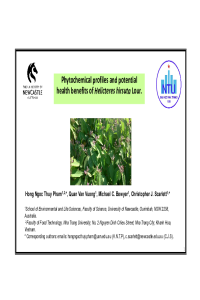
Hong Ngoc Thuy Pham_Presentation_Sci forum Nov2020.pdf
Applying nanotechnology to okara for developing soy protein gel-based foods
EFFECT OF THE PARTIAL SUBSTITUTION OF WHEAT FLOUR with QUINOA, KIWICHA, AND CAÑIHUA SEED FLOURS GERMINATED ON THE RHEOLOGICAL CHARACTERISTICS OF THE DOUGH TO MAKE SLICED BREAD