Event submissions
Published
 10.3390/foods_2020-07806 (registering DOI)
 This submission belongs to the session 6. Food Texture–Sensory Evaluation and Instrumental Measurement of the event 1st International Electronic Conference on Food Science and Functional Foods
Published date
10 Nov, 2020
Citation
LUZ MARÍA PAUCAR-MENACHO, WILLIAMS ESTEWARD CASTILLO - MARTINEZ, WILSON DANIEL SIMPALO LOPEZ, LOURDES ESQUIVEL-PAREDES, CRISTINA MARTINEZ-VILLALUENGA, EFFECT OF THE PARTIAL SUBSTITUTION OF WHEAT FLOUR with QUINOA, KIWICHA, AND CAÑIHUA SEED FLOURS GERMINATED ON THE RHEOLOGICAL CHARACTERISTICS OF THE DOUGH TO MAKE SLICED BREAD, in Proceedings of 1st International Electronic Conference on Food Science and Functional Foods, 10 November–25 November 2020, MDPI: Basel, Switzerland, doi: 10.3390/foods_2020-07806
Share
Email
Facebook
Twitter
LinkedIn
EFFECT OF THE PARTIAL SUBSTITUTION OF WHEAT FLOUR with QUINOA, KIWICHA, AND CAÑIHUA SEED FLOURS GERMINATED ON THE RHEOLOGICAL CHARACTERISTICS OF THE DOUGH TO MAKE SLICED BREAD

LUZ MARÍA PAUCAR-MENACHO 1

WILLIAMS ESTEWARD CASTILLO - MARTINEZ 1
'%3e%3cpath%20d='M12.6647%2010.9104C12.4176%2010.325%2012.0589%209.7933%2011.6088%209.34485C11.16%208.89511%2010.6283%208.53653%2010.0432%208.28891C10.038%208.28629%2010.0327%208.28498%2010.0275%208.28236C10.8437%207.69282%2011.3743%206.73252%2011.3743%205.64907C11.3743%203.85423%209.92005%202.40002%208.12522%202.40002C6.33038%202.40002%204.87618%203.85423%204.87618%205.64907C4.87618%206.73252%205.40677%207.69282%206.22296%208.28367C6.21772%208.28629%206.21248%208.2876%206.20724%208.29022C5.62031%208.53783%205.09365%208.89287%204.64167%209.34616C4.19192%209.79496%203.83334%2010.3266%203.58573%2010.9117C3.34247%2011.4846%203.21128%2012.0987%203.19925%2012.721C3.1989%2012.735%203.20135%2012.7489%203.20646%2012.7619C3.21157%2012.7749%203.21924%2012.7868%203.22901%2012.7968C3.23877%2012.8068%203.25045%2012.8148%203.26334%2012.8202C3.27623%2012.8256%203.29007%2012.8284%203.30406%2012.8284H4.09012C4.14776%2012.8284%204.19362%2012.7825%204.19493%2012.7262C4.22113%2011.7148%204.62726%2010.7676%205.34519%2010.0497C6.08802%209.30686%207.07452%208.89811%208.12522%208.89811C9.17592%208.89811%2010.1624%209.30686%2010.9052%2010.0497C11.6232%2010.7676%2012.0293%2011.7148%2012.0555%2012.7262C12.0568%2012.7839%2012.1027%2012.8284%2012.1603%2012.8284H12.9464C12.9604%2012.8284%2012.9742%2012.8256%2012.9871%2012.8202C13%2012.8148%2013.0117%2012.8068%2013.0214%2012.7968C13.0312%2012.7868%2013.0389%2012.7749%2013.044%2012.7619C13.0491%2012.7489%2013.0515%2012.735%2013.0512%2012.721C13.0381%2012.0947%2012.9084%2011.4856%2012.6647%2010.9104ZM8.12522%207.90243C7.52388%207.90243%206.95792%207.66793%206.53214%207.24215C6.10636%206.81636%205.87185%206.2504%205.87185%205.64907C5.87185%205.04773%206.10636%204.48177%206.53214%204.05599C6.95792%203.63021%207.52388%203.3957%208.12522%203.3957C8.72655%203.3957%209.29252%203.63021%209.7183%204.05599C10.1441%204.48177%2010.3786%205.04773%2010.3786%205.64907C10.3786%206.2504%2010.1441%206.81636%209.7183%207.24215C9.29252%207.66793%208.72655%207.90243%208.12522%207.90243Z'%20fill='%235D1EE1'/%3e%3c/g%3e%3c/svg%3e)
WILSON DANIEL SIMPALO LOPEZ 1
LOURDES ESQUIVEL-PAREDES 2

CRISTINA MARTINEZ-VILLALUENGA 3
1. Departamento de Agroindustria y Agrónoma, Facultad de Ingeniería, Universidad Nacional del Santa, Nuevo Chimbote, Ancash, Perú.
2. Programa de Estudios en Ingeniería Industrial, Universidad Cesar Vallejo, Nuevo Chimbote, Perú.
3. Department of Food Characterization, Quality and Safety, Institute of Food Science, Technology and Nutrition (ICTAN-CSIC), 28040, Madrid, Spain
Abstract
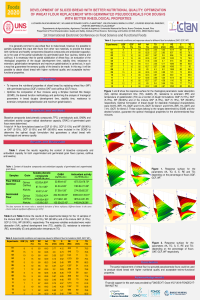
They were subjected to rheological analysis (Farinography, amylography, and extensography) in Brabender equipment to 14 experimental treatments of dough mixtures to make sliced bread with partial substitution of wheat flour (WF) by quinoa germinated flour (QGF), kiwicha germinated flour (KGF) and cañihua germinated flour (CGF), following a Simplex Centroid Mixture Design (SCMD) to determine the optimal dough that guarantees a sliced bread with technological and sensory quality. The substitution ranges (R) of the mixtures (M) were: RM1: QGF (5-15%), CGF (5-15%) and WF (80-90%); and RM2: KGF (5-15%), CGF (5-15%) and WF (80-90%). The optimization was carried out by applying the desired function methodology, taking the WF mass as a control, optimizing as a function of development time (min), stability time (min) ¸ resistance to extension (BU), gelatinization temperature (°C ) and maximum gelatinization (AU). The results indicate that the substitution levels influence the technical characteristics necessary to produce functional sliced bread similar to commercially sliced bread. Two optimal mixtures (OM) were determined, being OM1: 87.6% (WF), 5% (KGF) and 7.4% (CGF) and OM2: 84.6% (WF), 5% (QGF ) and 10.4% (CGF).
Keywords
Andean grains
bread
germination
Simplex Centroid Mixture Design
mass rheology
Manuscript
sciforum-034852.pdf
Poster
POSTER FOODS 2020_sciforum-034852_PAUCAR-MENACHO et al..pdf
Phytochemical profiles and potential health benefits of Helicteres hirsuta Lour.
The impact of galactooligosaccharides on the bioavailability of sterols: a randomized, crossover, double-blind clinical trial