Event submissions
Published
 10.3390/foods_2020-07809 (registering DOI)
 This submission belongs to the session 8. Nutraceuticals and Functional Foods of the event 1st International Electronic Conference on Food Science and Functional Foods
Published date
10 Nov, 2020
Citation
Virginia Blanco-Morales, Amparo Alegría, Guadalupe García-Llatas, The influence of galactooligosaccharide addition to a plant sterol-enriched beverage upon plant sterol colonic metabolization: A clinical trial, in Proceedings of 1st International Electronic Conference on Food Science and Functional Foods, 10 November–25 November 2020, MDPI: Basel, Switzerland, doi: 10.3390/foods_2020-07809
Share
Email
Facebook
Twitter
LinkedIn
The influence of galactooligosaccharide addition to a plant sterol-enriched beverage upon plant sterol colonic metabolization: A clinical trial
'%3e%3cpath%20d='M12.6647%2010.9104C12.4176%2010.325%2012.0589%209.7933%2011.6088%209.34485C11.16%208.89511%2010.6283%208.53653%2010.0432%208.28891C10.038%208.28629%2010.0327%208.28498%2010.0275%208.28236C10.8437%207.69282%2011.3743%206.73252%2011.3743%205.64907C11.3743%203.85423%209.92005%202.40002%208.12522%202.40002C6.33038%202.40002%204.87618%203.85423%204.87618%205.64907C4.87618%206.73252%205.40677%207.69282%206.22296%208.28367C6.21772%208.28629%206.21248%208.2876%206.20724%208.29022C5.62031%208.53783%205.09365%208.89287%204.64167%209.34616C4.19192%209.79496%203.83334%2010.3266%203.58573%2010.9117C3.34247%2011.4846%203.21128%2012.0987%203.19925%2012.721C3.1989%2012.735%203.20135%2012.7489%203.20646%2012.7619C3.21157%2012.7749%203.21924%2012.7868%203.22901%2012.7968C3.23877%2012.8068%203.25045%2012.8148%203.26334%2012.8202C3.27623%2012.8256%203.29007%2012.8284%203.30406%2012.8284H4.09012C4.14776%2012.8284%204.19362%2012.7825%204.19493%2012.7262C4.22113%2011.7148%204.62726%2010.7676%205.34519%2010.0497C6.08802%209.30686%207.07452%208.89811%208.12522%208.89811C9.17592%208.89811%2010.1624%209.30686%2010.9052%2010.0497C11.6232%2010.7676%2012.0293%2011.7148%2012.0555%2012.7262C12.0568%2012.7839%2012.1027%2012.8284%2012.1603%2012.8284H12.9464C12.9604%2012.8284%2012.9742%2012.8256%2012.9871%2012.8202C13%2012.8148%2013.0117%2012.8068%2013.0214%2012.7968C13.0312%2012.7868%2013.0389%2012.7749%2013.044%2012.7619C13.0491%2012.7489%2013.0515%2012.735%2013.0512%2012.721C13.0381%2012.0947%2012.9084%2011.4856%2012.6647%2010.9104ZM8.12522%207.90243C7.52388%207.90243%206.95792%207.66793%206.53214%207.24215C6.10636%206.81636%205.87185%206.2504%205.87185%205.64907C5.87185%205.04773%206.10636%204.48177%206.53214%204.05599C6.95792%203.63021%207.52388%203.3957%208.12522%203.3957C8.72655%203.3957%209.29252%203.63021%209.7183%204.05599C10.1441%204.48177%2010.3786%205.04773%2010.3786%205.64907C10.3786%206.2504%2010.1441%206.81636%209.7183%207.24215C9.29252%207.66793%208.72655%207.90243%208.12522%207.90243Z'%20fill='%235D1EE1'/%3e%3c/g%3e%3c/svg%3e)
Virginia Blanco-Morales 1

Amparo Alegría 1

Guadalupe García-Llatas 1
1. Nutrition and Food Science Area, Faculty of Pharmacy, University of Valencia, Spain
Abstract
The consumption of milk-based fruit beverages enriched with plant sterols (PS) has previously showed a cholesterol-lowering effect in postmenopausal women [1]. The addition of galactooligosaccharides (GOS) to this kind of beverages could enhance their functionality, however, its effect on the colonic metabolism of PS is yet unknown. To shed light into this regard, a randomized, double blind, crossover study with postmenopausal women (n=42, 58±4 years) was carried out with the aim of evaluating GOS effect on PS colonic metabolism. Volunteers consumed daily 250 mL of a PS-enriched beverage (1%, w/v) with or without GOS (1.8%, w/v) for 6 weeks and feces samples were collected before and at the end of each intervention period. The contents of PS (sitosterol, sitostanol, campesterol, campestanol and stigmasterol) and its metabolites (ethylcoprostanol from sitosterol, methylcoprostanone from campesterol and ethylcoprostenol from stigmasterol) were measured by CG-MS [2]. Statistically significant increments (p<0.05) in sterol concentrations (mg/g freeze-dry feces) were observed after the consumption of any of the beverages (with vs. without GOS addition) expressed as median (percentile 25;75%): 8.29 (1.49;17.27) vs. 10.79 (2.14;19.30) for sitosterol, 12.95 (2.65;20.66) vs. 14.47 (4.91;21.56) for ethylcoprostanol, 2.84 (1.34;4.91) vs. 3.16 (1.27;4.80) for sitostanol, 1.09 (0.34;2.03) vs. 1.41 (0.47;2.11) for campesterol, 0.15 (0.03;0.40) vs. 0.18 (0.03;0.45) for methylcoprostanone, 0.46 (0.20;0.80) vs. 0.44 (0.23;0.82) for campestanol, and 0.07 (0.00;0.19) vs. 0.09 (0.02;0.23) for stigmasterol. No significant changes were observed in ethylcoprostenol contents after the consumption of the beverage with or without GOS (0.01 (-0.01;0.02) vs. 0.002 (-0.02;0.02)). No significant differences in net increments were observed between beverages. These results indicate that the presence of GOS in PS-enriched beverages does not modify the colonic biotransformation of PS.
[1] Alvarez-Sala et al. (2018), Food Funct., 91: 5209-5219; [2] Cuevas-Tena et al. (2019), Clin. Nutr., 38:1549-1560.
Acknowledgements: This study is part of the National Project AGL2015-68006-C2-1-R, financed by the Ministerio de Economía y Competitividad (MINECO) and the Fondo Europeo de Desarrollo Regional (FEDER). Virginia Blanco-Morales holds a research contract under the project AGL2015-68006-C2-1-R (Ref. CPI-17-025).
Keywords
clinical trial
feces
galactooligosaccharides
milk-based fruit beverages
plant sterols
Manuscript
sciforum-034863.pdf
Poster
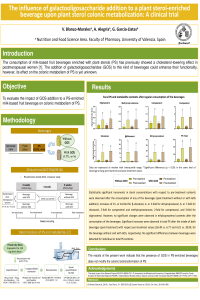
Posters Foods 2020- Metabolism PS.pdf
The impact of galactooligosaccharides on the bioavailability of sterols: a randomized, crossover, double-blind clinical trial
QUANTIFICATION OF BISPHENOL RELATED COMPOUNDS IN POLYMERIC CAN COATINGS AND IN BEVERAGE SAMPLES BY HPLC-FLD AND CONFIRMATION BY LC-MS/MS