Event submissions
Published
 10.3390/foods_2020-07811 (registering DOI)
 This submission belongs to the session 2. Food Packaging and New Packaging Materials of the event 1st International Electronic Conference on Food Science and Functional Foods
Published date
10 Nov, 2020
Citation
Antía Lestido-Cardama, Patricia Vázquez Loureiro, Ana Rodríguez Bernaldo de Quirós, María Isabel Santillana, Juana Bustos, Perfecto Paseiro Losada, Raquel Sendón, QUANTIFICATION OF BISPHENOL RELATED COMPOUNDS IN POLYMERIC CAN COATINGS AND IN BEVERAGE SAMPLES BY HPLC-FLD AND CONFIRMATION BY LC-MS/MS, in Proceedings of 1st International Electronic Conference on Food Science and Functional Foods, 10 November–25 November 2020, MDPI: Basel, Switzerland, doi: 10.3390/foods_2020-07811
Share
Email
Facebook
Twitter
LinkedIn
QUANTIFICATION OF BISPHENOL RELATED COMPOUNDS IN POLYMERIC CAN COATINGS AND IN BEVERAGE SAMPLES BY HPLC-FLD AND CONFIRMATION BY LC-MS/MS
'%3e%3cpath%20d='M12.6647%2010.9104C12.4176%2010.325%2012.0589%209.7933%2011.6088%209.34485C11.16%208.89511%2010.6283%208.53653%2010.0432%208.28891C10.038%208.28629%2010.0327%208.28498%2010.0275%208.28236C10.8437%207.69282%2011.3743%206.73252%2011.3743%205.64907C11.3743%203.85423%209.92005%202.40002%208.12522%202.40002C6.33038%202.40002%204.87618%203.85423%204.87618%205.64907C4.87618%206.73252%205.40677%207.69282%206.22296%208.28367C6.21772%208.28629%206.21248%208.2876%206.20724%208.29022C5.62031%208.53783%205.09365%208.89287%204.64167%209.34616C4.19192%209.79496%203.83334%2010.3266%203.58573%2010.9117C3.34247%2011.4846%203.21128%2012.0987%203.19925%2012.721C3.1989%2012.735%203.20135%2012.7489%203.20646%2012.7619C3.21157%2012.7749%203.21924%2012.7868%203.22901%2012.7968C3.23877%2012.8068%203.25045%2012.8148%203.26334%2012.8202C3.27623%2012.8256%203.29007%2012.8284%203.30406%2012.8284H4.09012C4.14776%2012.8284%204.19362%2012.7825%204.19493%2012.7262C4.22113%2011.7148%204.62726%2010.7676%205.34519%2010.0497C6.08802%209.30686%207.07452%208.89811%208.12522%208.89811C9.17592%208.89811%2010.1624%209.30686%2010.9052%2010.0497C11.6232%2010.7676%2012.0293%2011.7148%2012.0555%2012.7262C12.0568%2012.7839%2012.1027%2012.8284%2012.1603%2012.8284H12.9464C12.9604%2012.8284%2012.9742%2012.8256%2012.9871%2012.8202C13%2012.8148%2013.0117%2012.8068%2013.0214%2012.7968C13.0312%2012.7868%2013.0389%2012.7749%2013.044%2012.7619C13.0491%2012.7489%2013.0515%2012.735%2013.0512%2012.721C13.0381%2012.0947%2012.9084%2011.4856%2012.6647%2010.9104ZM8.12522%207.90243C7.52388%207.90243%206.95792%207.66793%206.53214%207.24215C6.10636%206.81636%205.87185%206.2504%205.87185%205.64907C5.87185%205.04773%206.10636%204.48177%206.53214%204.05599C6.95792%203.63021%207.52388%203.3957%208.12522%203.3957C8.72655%203.3957%209.29252%203.63021%209.7183%204.05599C10.1441%204.48177%2010.3786%205.04773%2010.3786%205.64907C10.3786%206.2504%2010.1441%206.81636%209.7183%207.24215C9.29252%207.66793%208.72655%207.90243%208.12522%207.90243Z'%20fill='%235D1EE1'/%3e%3c/g%3e%3c/svg%3e)
Antía Lestido-Cardama 1,2
Patricia Vázquez Loureiro 1
Ana Rodríguez Bernaldo de Quirós 1
María Isabel Santillana 3
Juana Bustos 3
Perfecto Paseiro Losada 1

Raquel Sendón 1
1. University of Santiago de Compostela
2. International Iberian Nanotechnology Laboratory
3. National Food Center, Spanish Agency for Food Safety and Nutrition
Abstract
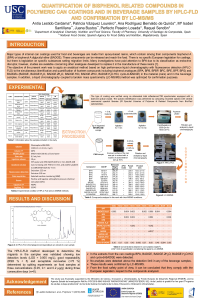
Major types of internal can coatings used for food and beverages are made from epoxy-based resins, which contain among their components bisphenol A (BPA) or bisphenol A diglycidyl ether (BADGE). These components can be released and reach the food. There is no specific European legislation for coatings, but there is legislation on specific substances setting migration limits. Many investigations have paid attention to BPA due to its classification as endocrine disruptor, however, studies are available concerning other analogues developed to replace it in the manufacture of these resins [1].
Ten cans of beverages were taken as study samples. The type of coating was verified using an attenuated total reflectance-FTIR spectrometer showing that most of the samples examined were coated with epoxy-phenolic resins.
The objective of the present work was to apply an analytical method based on high performance liquid chromatography with fluorescence detection (HPLC-FLD) to the simultaneous identification and quantification of fourteen compounds including bisphenol analogues (BPA, BPB, BPBP, BPC, BPE, BPF, BPG) and BADGEs (BADGE, BADGE.H2O, BADGE.2H2O, BADGE.HCl, BADGE.2HCl, BADGE.H2O.HCl, cyclo-di-BADGE) in the material (cans) and in the beverage samples. For this, the cans were extracted with acetonitrile for 24 hours at 70 ºC and the extract was analyzed directly, as well as the content of the cans. This method showed an adequate linearity (R2>0.9994) and low detection levels down to 5 µg/L. In addition, a liquid chromatography coupled to tandem mass spectrometry (LC-MS/MS) method was optimized for confirmation purposes.
This research was funded by the Ministerio de Ciencia, Innovación y Universidades, by Fondo Europeo de Desarrollo Regional (FEDER), and by Agencia Estatal de Investigación Ref. No. PGC2018-094518-B-I00 “MIGRACOATING” (MINECO/FEDER, UE).
References
[1] Lestido Cardama A. et al., Polymers 11 (2019) 2086.
Keywords
bisphenols
beverages
HPLC-FLD
LC-MS/MS
Manuscript
sciforum-035875.pdf
Poster
Foods1_Antía Lestido.pdf
The influence of galactooligosaccharide addition to a plant sterol-enriched beverage upon plant sterol colonic metabolization: A clinical trial
SCREENING OF VOLATILE COMPOUNDS IN BEVERAGE CANS USING PURGE AND TRAP (P&T) TECHNIQUE COUPLED TO GC-MS