Event submissions
Published
 10.3390/foods_2020-07813 (registering DOI)
 This submission belongs to the session 2. Food Packaging and New Packaging Materials of the event 1st International Electronic Conference on Food Science and Functional Foods
Published date
10 Nov, 2020
Citation
Antía Lestido-Cardama, Patricia Vázquez Loureiro, Raquel Sendón, Perfecto Paseiro Losada, Ana Rodríguez Bernaldo de Quirós, SCREENING OF VOLATILE COMPOUNDS IN BEVERAGE CANS USING PURGE AND TRAP (P&T) TECHNIQUE COUPLED TO GC-MS, in Proceedings of 1st International Electronic Conference on Food Science and Functional Foods, 10 November–25 November 2020, MDPI: Basel, Switzerland, doi: 10.3390/foods_2020-07813
Share
Email
Facebook
Twitter
LinkedIn
SCREENING OF VOLATILE COMPOUNDS IN BEVERAGE CANS USING PURGE AND TRAP (P&T) TECHNIQUE COUPLED TO GC-MS
'%3e%3cpath%20d='M12.6647%2010.9104C12.4176%2010.325%2012.0589%209.7933%2011.6088%209.34485C11.16%208.89511%2010.6283%208.53653%2010.0432%208.28891C10.038%208.28629%2010.0327%208.28498%2010.0275%208.28236C10.8437%207.69282%2011.3743%206.73252%2011.3743%205.64907C11.3743%203.85423%209.92005%202.40002%208.12522%202.40002C6.33038%202.40002%204.87618%203.85423%204.87618%205.64907C4.87618%206.73252%205.40677%207.69282%206.22296%208.28367C6.21772%208.28629%206.21248%208.2876%206.20724%208.29022C5.62031%208.53783%205.09365%208.89287%204.64167%209.34616C4.19192%209.79496%203.83334%2010.3266%203.58573%2010.9117C3.34247%2011.4846%203.21128%2012.0987%203.19925%2012.721C3.1989%2012.735%203.20135%2012.7489%203.20646%2012.7619C3.21157%2012.7749%203.21924%2012.7868%203.22901%2012.7968C3.23877%2012.8068%203.25045%2012.8148%203.26334%2012.8202C3.27623%2012.8256%203.29007%2012.8284%203.30406%2012.8284H4.09012C4.14776%2012.8284%204.19362%2012.7825%204.19493%2012.7262C4.22113%2011.7148%204.62726%2010.7676%205.34519%2010.0497C6.08802%209.30686%207.07452%208.89811%208.12522%208.89811C9.17592%208.89811%2010.1624%209.30686%2010.9052%2010.0497C11.6232%2010.7676%2012.0293%2011.7148%2012.0555%2012.7262C12.0568%2012.7839%2012.1027%2012.8284%2012.1603%2012.8284H12.9464C12.9604%2012.8284%2012.9742%2012.8256%2012.9871%2012.8202C13%2012.8148%2013.0117%2012.8068%2013.0214%2012.7968C13.0312%2012.7868%2013.0389%2012.7749%2013.044%2012.7619C13.0491%2012.7489%2013.0515%2012.735%2013.0512%2012.721C13.0381%2012.0947%2012.9084%2011.4856%2012.6647%2010.9104ZM8.12522%207.90243C7.52388%207.90243%206.95792%207.66793%206.53214%207.24215C6.10636%206.81636%205.87185%206.2504%205.87185%205.64907C5.87185%205.04773%206.10636%204.48177%206.53214%204.05599C6.95792%203.63021%207.52388%203.3957%208.12522%203.3957C8.72655%203.3957%209.29252%203.63021%209.7183%204.05599C10.1441%204.48177%2010.3786%205.04773%2010.3786%205.64907C10.3786%206.2504%2010.1441%206.81636%209.7183%207.24215C9.29252%207.66793%208.72655%207.90243%208.12522%207.90243Z'%20fill='%235D1EE1'/%3e%3c/g%3e%3c/svg%3e)
Antía Lestido-Cardama 1,2
Patricia Vázquez Loureiro 1

Raquel Sendón 1
Perfecto Paseiro Losada 1
Ana Rodríguez Bernaldo de Quirós 1
1. University of Santiago de Compostela
2. International Iberian Nanotechnology Laboratory
Abstract
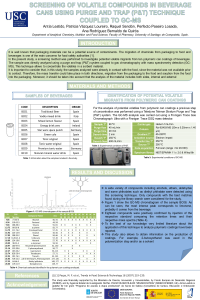
It is well known that packaging materials can be a potential source of contaminants. The migration of chemicals from packaging to food and beverages is one of the main concerns for food safety authorities [1].
In the present study, a screening method was performed to investigate potential volatile migrants from polymeric can coatings of beverages. The sample was directly analyzed using a purge and trap (P&T) system. This technique allows to concentrate the volatiles in a sorbent material. A Teledyne Tekmar Stratum P&T was used and the experimental conditions were as follows: sample temperature, 90 ºC; purge flow, 40 mL/min; purge time, 20 min; desorb time, 2 min; desorb temperature, 250 ºC; and desorb flow, 400 mL/min.
The GC-MS analysis was carried out using a Finnigan Trace Gas Chromatograph Ultra with a Finnigan Trace DSQ mass detector. The volatile compounds were separated on a Rxi-624Sil MS (30m x 0.25mm x 1.40 µm) column and with an oven program from 45 to 250 ºC. The mass spectrometer was operated under electron impact ionization and data acquisition was performed in full scan (m/z range of 20-500). Compounds detected in samples were identified by using commercial mass spectral libraries.
Ten can samples were analysed for their potential volatile migrants. A wide variety of compounds including alcohols, ethers, aldehydes and some phthalates such as diethyl phthalate were identified. Only compounds with the best matches found during the library search were considered for the study.
This research was funded by the Ministerio de Ciencia, Innovación y Universidades, by Fondo Europeo de Desarrollo Regional (FEDER), and by Agencia Estatal de Investigación Ref. No. PGC2018-094518-B-I00 “MIGRACOATING” (MINECO/FEDER, UE).
References
[1] Poças, M. F. et al., Trends in Food Science & Technology 18 (2007) 219-230.
Keywords
screening
purge and trap
can
GC-MS
Manuscript
sciforum-035879.pdf
Poster
Foods2_Antía Lestido.pdf
QUANTIFICATION OF BISPHENOL RELATED COMPOUNDS IN POLYMERIC CAN COATINGS AND IN BEVERAGE SAMPLES BY HPLC-FLD AND CONFIRMATION BY LC-MS/MS
Optimization of Hydrocolloid Levels in Medium-Chain Triglyceride-Enriched Soymilk by Response Surface Methodology