Event submissions
Published
 10.3390/foods_2020-07817 (registering DOI)
 This submission belongs to the session 2. Food Packaging and New Packaging Materials of the event 1st International Electronic Conference on Food Science and Functional Foods
Published date
10 Nov, 2020
Citation
Patricia Vazquez Loureiro, Antía Lestido Cardama, Ana Rodriguez-Bernaldo de Quirós, Perfecto Paseiro Losada, Raquel Sendón, Solid-phase microextraction (SPME) GC-MS method for the identification of volatiles in polymeric coatings for metal food and beverage cans, in Proceedings of 1st International Electronic Conference on Food Science and Functional Foods, 10 November–25 November 2020, MDPI: Basel, Switzerland, doi: 10.3390/foods_2020-07817
Share
Email
Facebook
Twitter
LinkedIn
Solid-phase microextraction (SPME) GC-MS method for the identification of volatiles in polymeric coatings for metal food and beverage cans
'%3e%3cpath%20d='M12.6647%2010.9104C12.4176%2010.325%2012.0589%209.7933%2011.6088%209.34485C11.16%208.89511%2010.6283%208.53653%2010.0432%208.28891C10.038%208.28629%2010.0327%208.28498%2010.0275%208.28236C10.8437%207.69282%2011.3743%206.73252%2011.3743%205.64907C11.3743%203.85423%209.92005%202.40002%208.12522%202.40002C6.33038%202.40002%204.87618%203.85423%204.87618%205.64907C4.87618%206.73252%205.40677%207.69282%206.22296%208.28367C6.21772%208.28629%206.21248%208.2876%206.20724%208.29022C5.62031%208.53783%205.09365%208.89287%204.64167%209.34616C4.19192%209.79496%203.83334%2010.3266%203.58573%2010.9117C3.34247%2011.4846%203.21128%2012.0987%203.19925%2012.721C3.1989%2012.735%203.20135%2012.7489%203.20646%2012.7619C3.21157%2012.7749%203.21924%2012.7868%203.22901%2012.7968C3.23877%2012.8068%203.25045%2012.8148%203.26334%2012.8202C3.27623%2012.8256%203.29007%2012.8284%203.30406%2012.8284H4.09012C4.14776%2012.8284%204.19362%2012.7825%204.19493%2012.7262C4.22113%2011.7148%204.62726%2010.7676%205.34519%2010.0497C6.08802%209.30686%207.07452%208.89811%208.12522%208.89811C9.17592%208.89811%2010.1624%209.30686%2010.9052%2010.0497C11.6232%2010.7676%2012.0293%2011.7148%2012.0555%2012.7262C12.0568%2012.7839%2012.1027%2012.8284%2012.1603%2012.8284H12.9464C12.9604%2012.8284%2012.9742%2012.8256%2012.9871%2012.8202C13%2012.8148%2013.0117%2012.8068%2013.0214%2012.7968C13.0312%2012.7868%2013.0389%2012.7749%2013.044%2012.7619C13.0491%2012.7489%2013.0515%2012.735%2013.0512%2012.721C13.0381%2012.0947%2012.9084%2011.4856%2012.6647%2010.9104ZM8.12522%207.90243C7.52388%207.90243%206.95792%207.66793%206.53214%207.24215C6.10636%206.81636%205.87185%206.2504%205.87185%205.64907C5.87185%205.04773%206.10636%204.48177%206.53214%204.05599C6.95792%203.63021%207.52388%203.3957%208.12522%203.3957C8.72655%203.3957%209.29252%203.63021%209.7183%204.05599C10.1441%204.48177%2010.3786%205.04773%2010.3786%205.64907C10.3786%206.2504%2010.1441%206.81636%209.7183%207.24215C9.29252%207.66793%208.72655%207.90243%208.12522%207.90243Z'%20fill='%235D1EE1'/%3e%3c/g%3e%3c/svg%3e)
Patricia Vazquez Loureiro 1
Antía Lestido Cardama 1
Ana Rodriguez-Bernaldo de Quirós 1
Perfecto Paseiro Losada 1

Raquel Sendón 1
1. Department of Analytical Chemistry, Nutrition and Food Science, Faculty of Pharmacy, University of Santiago de Compostela, Spain
Abstract
Food contact materials can be made of a wide variety of materials such as plastic, metal, coatings, etc. Some examples of polymeric coatings used in food and beverages cans are epoxy resins, phenolic resins, acrylics, polyesters, etc. Used as a protective layer, they are essential to preserve the food maintaining its quality, as well as to protect it from corrosion and avoid a metallic taste [1].
Some chemicals present in these types of materials are susceptible to migrate to the food and constitute a risk for consumers’ health.
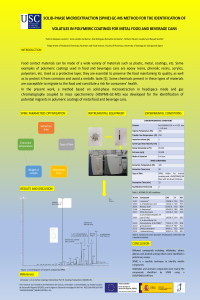
In the present work, a method based on solid-phase microextraction in headspace mode and gas chromatography coupled to mass spectrometry (HSSPME-GC-MS) was developed for the identification of potential migrants in polymeric coatings. For that purpose, a SPME holder for manual sampling and a DVB/PDMS/CAR fibre with 50–30 µm thickness was used.
Some parameters such as extraction time, equilibrium temperature or the type of fibre were optimized.
Analyses were performed on a Rxi-624Sil MS (30 m × 0.25 mm × 1.40 µm) column and under the following operating conditions: the injector temperature was set at 200ºC and the transfer line temperature was 250ºC. The ramp temperature was set from 45 to 250ºC. The mass spectrometer operated in full scan mode (20 and 500 m/z). Different compounds including, aldehydes, ethers, alkenes and alcohols among others were identified in preliminary assays. These results are in agreement with those obtained by other screening techniques.
References:
[1] Cooper I. et al. Surface Coatings International Part B: Coatings Transactions 84(2001) 91.
Acknowledgements:
This research was funded by the Ministerio de Ciencia, Innovación y Universidades, by Fondo Europeo de Desarrollo Regional (FEDER), and by Agencia Estatal de Investigación Ref. No. PGC2018-094518-B-I00 “MIGRACOATING” (MINECO/FEDER, UE).
Keywords
SPME
coatings
migrants
unknowns
GC-MS.
Manuscript
sciforum-035896.pdf
Poster
SPME_def2.pdf
Optimization of Hydrocolloid Levels in Medium-Chain Triglyceride-Enriched Soymilk by Response Surface Methodology
Non-target GC-MS analysis for the identification of semi-volatile compounds in polymeric coatings intended to come in contact with food