Event submissions
Published
 10.3390/foods_2020-07818 (registering DOI)
 This submission belongs to the session 2. Food Packaging and New Packaging Materials of the event 1st International Electronic Conference on Food Science and Functional Foods
Published date
10 Nov, 2020
Citation
Patricia Vazquez Loureiro, Antía Lestido Cardama, Raquel Sendón, Juana Bustos, Mª Teresa Nieto, Perfecto Paseiro Losada, Ana Rodriguez Bernaldo de Quirós, Non-target GC-MS analysis for the identification of semi-volatile compounds in polymeric coatings intended to come in contact with food, in Proceedings of 1st International Electronic Conference on Food Science and Functional Foods, 10 November–25 November 2020, MDPI: Basel, Switzerland, doi: 10.3390/foods_2020-07818
Share
Email
Facebook
Twitter
LinkedIn
Non-target GC-MS analysis for the identification of semi-volatile compounds in polymeric coatings intended to come in contact with food
'%3e%3cpath%20d='M12.6647%2010.9104C12.4176%2010.325%2012.0589%209.7933%2011.6088%209.34485C11.16%208.89511%2010.6283%208.53653%2010.0432%208.28891C10.038%208.28629%2010.0327%208.28498%2010.0275%208.28236C10.8437%207.69282%2011.3743%206.73252%2011.3743%205.64907C11.3743%203.85423%209.92005%202.40002%208.12522%202.40002C6.33038%202.40002%204.87618%203.85423%204.87618%205.64907C4.87618%206.73252%205.40677%207.69282%206.22296%208.28367C6.21772%208.28629%206.21248%208.2876%206.20724%208.29022C5.62031%208.53783%205.09365%208.89287%204.64167%209.34616C4.19192%209.79496%203.83334%2010.3266%203.58573%2010.9117C3.34247%2011.4846%203.21128%2012.0987%203.19925%2012.721C3.1989%2012.735%203.20135%2012.7489%203.20646%2012.7619C3.21157%2012.7749%203.21924%2012.7868%203.22901%2012.7968C3.23877%2012.8068%203.25045%2012.8148%203.26334%2012.8202C3.27623%2012.8256%203.29007%2012.8284%203.30406%2012.8284H4.09012C4.14776%2012.8284%204.19362%2012.7825%204.19493%2012.7262C4.22113%2011.7148%204.62726%2010.7676%205.34519%2010.0497C6.08802%209.30686%207.07452%208.89811%208.12522%208.89811C9.17592%208.89811%2010.1624%209.30686%2010.9052%2010.0497C11.6232%2010.7676%2012.0293%2011.7148%2012.0555%2012.7262C12.0568%2012.7839%2012.1027%2012.8284%2012.1603%2012.8284H12.9464C12.9604%2012.8284%2012.9742%2012.8256%2012.9871%2012.8202C13%2012.8148%2013.0117%2012.8068%2013.0214%2012.7968C13.0312%2012.7868%2013.0389%2012.7749%2013.044%2012.7619C13.0491%2012.7489%2013.0515%2012.735%2013.0512%2012.721C13.0381%2012.0947%2012.9084%2011.4856%2012.6647%2010.9104ZM8.12522%207.90243C7.52388%207.90243%206.95792%207.66793%206.53214%207.24215C6.10636%206.81636%205.87185%206.2504%205.87185%205.64907C5.87185%205.04773%206.10636%204.48177%206.53214%204.05599C6.95792%203.63021%207.52388%203.3957%208.12522%203.3957C8.72655%203.3957%209.29252%203.63021%209.7183%204.05599C10.1441%204.48177%2010.3786%205.04773%2010.3786%205.64907C10.3786%206.2504%2010.1441%206.81636%209.7183%207.24215C9.29252%207.66793%208.72655%207.90243%208.12522%207.90243Z'%20fill='%235D1EE1'/%3e%3c/g%3e%3c/svg%3e)
Patricia Vazquez Loureiro 1
Antía Lestido Cardama 1

Raquel Sendón 1
Juana Bustos 2
Mª Teresa Nieto 2
Perfecto Paseiro Losada 1
Ana Rodriguez Bernaldo de Quirós 1
1. Department of Analytical Chemistry, Nutrition and Food Science, Faculty of Pharmacy, University of Santiago de Compostela, Spain
2. National Food Center, Spanish Agency for Food Safety and Nutrition, Spain
Abstract
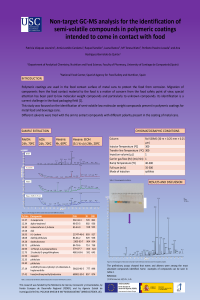
Polymeric coatings are used in the food contact surface of metal cans to protect the food from corrosion. Migration of components from the food contact material to the food is a matter of concern from the food safety point of view, special attention has been paid to low molecular weight compounds and particularly to unknown compounds. Its identification is a current challenge in the food packaging field [1].
This study was focused on the identification of semi-volatile low molecular weight compounds present in polymeric coatings for metal food and beverage cans.
Different solvents were tried with the aim to extract compounds with different polarity present in the coating of metal cans. Samples were extracted under different conditions, both methanol and acetonitrile for 24h at 70ºC, hexane for 4h at 60ºC and a mixture of hexane: ethanol (3:1 % v/v) for 24 h at 20ºC. The chromatographic separation was performed on a Rxi-5SilMS (30 m × 0.25 mm × 0.25 µm) column. Operating conditions were as follows: injector and transfer line temperature were 300ºC. The ramp temperature was set from 40 to 300ºC. The carrier gas was helium with a flow rate of 1 ml/min and data acquisition was done in full scan mode (35 and 500 m/z). Extracts were injected in splitless mode and the injection volume was 1 µL. The preliminary assays showed that esters and alkenes were among the most abundant compounds identified.
References:
[1] EFSA Journal, 6(7):21r, 1-41.
Acknowledgements:
This research was funded by the Ministerio de Ciencia, Innovación y Universidades, by Fondo Europeo de Desarrollo Regional (FEDER), and by Agencia Estatal de Investigación Ref. No. PGC2018-094518-B-I00 “MIGRACOATING” (MINECO/FEDER, UE).
Keywords
screening
polymeric coatings
GC-MS
unknown compounds
Manuscript
sciforum-035898.pdf
Poster
Non-target GC-MS analysis for the identification of semi-volatile_def.pdf
Solid-phase microextraction (SPME) GC-MS method for the identification of volatiles in polymeric coatings for metal food and beverage cans
Effects of fruit maturity on physicochemical properties, sugar accumulation and antioxidant capacity of wild harvested Kakadu plum (Terminalia ferdandian)