Event submissions
Published
 10.3390/foods_2020-07819 (registering DOI)
 This submission belongs to the session 8. Nutraceuticals and Functional Foods of the event 1st International Electronic Conference on Food Science and Functional Foods
Published date
10 Nov, 2020
Citation
Anh Dao Thi Phan, Maral Seidi Damyeh, Mridusmita Chaliha, Saleha Akter, Selina A Fyfe, Michael E. Netzel, Daniel Cozzolino, Yasmina Sultanbawa, Effects of fruit maturity on physicochemical properties, sugar accumulation and antioxidant capacity of wild harvested Kakadu plum (Terminalia ferdandian), in Proceedings of 1st International Electronic Conference on Food Science and Functional Foods, 10 November–25 November 2020, MDPI: Basel, Switzerland, doi: 10.3390/foods_2020-07819
Share
Email
Facebook
Twitter
LinkedIn
Effects of fruit maturity on physicochemical properties, sugar accumulation and antioxidant capacity of wild harvested Kakadu plum (Terminalia ferdandian)
'%3e%3cpath%20d='M12.6647%2010.9104C12.4176%2010.325%2012.0589%209.7933%2011.6088%209.34485C11.16%208.89511%2010.6283%208.53653%2010.0432%208.28891C10.038%208.28629%2010.0327%208.28498%2010.0275%208.28236C10.8437%207.69282%2011.3743%206.73252%2011.3743%205.64907C11.3743%203.85423%209.92005%202.40002%208.12522%202.40002C6.33038%202.40002%204.87618%203.85423%204.87618%205.64907C4.87618%206.73252%205.40677%207.69282%206.22296%208.28367C6.21772%208.28629%206.21248%208.2876%206.20724%208.29022C5.62031%208.53783%205.09365%208.89287%204.64167%209.34616C4.19192%209.79496%203.83334%2010.3266%203.58573%2010.9117C3.34247%2011.4846%203.21128%2012.0987%203.19925%2012.721C3.1989%2012.735%203.20135%2012.7489%203.20646%2012.7619C3.21157%2012.7749%203.21924%2012.7868%203.22901%2012.7968C3.23877%2012.8068%203.25045%2012.8148%203.26334%2012.8202C3.27623%2012.8256%203.29007%2012.8284%203.30406%2012.8284H4.09012C4.14776%2012.8284%204.19362%2012.7825%204.19493%2012.7262C4.22113%2011.7148%204.62726%2010.7676%205.34519%2010.0497C6.08802%209.30686%207.07452%208.89811%208.12522%208.89811C9.17592%208.89811%2010.1624%209.30686%2010.9052%2010.0497C11.6232%2010.7676%2012.0293%2011.7148%2012.0555%2012.7262C12.0568%2012.7839%2012.1027%2012.8284%2012.1603%2012.8284H12.9464C12.9604%2012.8284%2012.9742%2012.8256%2012.9871%2012.8202C13%2012.8148%2013.0117%2012.8068%2013.0214%2012.7968C13.0312%2012.7868%2013.0389%2012.7749%2013.044%2012.7619C13.0491%2012.7489%2013.0515%2012.735%2013.0512%2012.721C13.0381%2012.0947%2012.9084%2011.4856%2012.6647%2010.9104ZM8.12522%207.90243C7.52388%207.90243%206.95792%207.66793%206.53214%207.24215C6.10636%206.81636%205.87185%206.2504%205.87185%205.64907C5.87185%205.04773%206.10636%204.48177%206.53214%204.05599C6.95792%203.63021%207.52388%203.3957%208.12522%203.3957C8.72655%203.3957%209.29252%203.63021%209.7183%204.05599C10.1441%204.48177%2010.3786%205.04773%2010.3786%205.64907C10.3786%206.2504%2010.1441%206.81636%209.7183%207.24215C9.29252%207.66793%208.72655%207.90243%208.12522%207.90243Z'%20fill='%235D1EE1'/%3e%3c/g%3e%3c/svg%3e)
Anh Dao Thi Phan 1,2
Maral Seidi Damyeh 1,2
Mridusmita Chaliha 1,2

Saleha Akter 1,2
Selina A Fyfe 2

Michael E. Netzel 1,2

Daniel Cozzolino 1,2

Yasmina Sultanbawa 1,2
1. Centre for Nutrition and Food Sciences, Queensland Alliance for Agriculture and Food Innovation, The University of Queensland, St. Lucia, QLD 4072, Australia
2. ARC Industrial Transformation Training Centre for Uniquely Australian Foods, Queensland Alliance for Agriculture and Food Innovation, The University of Queensland, Coopers Plains, QLD 4108, Australia
Abstract
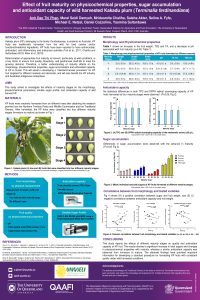
Terminalia ferdinandiana (Kakadu plum), belonging to the family Combretaceae, is endemic to Australia and has a long history of traditional medicinal applications and food cuisine by the Australian Indigenous people. This study investigated the effects of maturity stages on morphology, physicochemical parameters [total soluble solids (TSS), total acid content (TAC), pH], soluble sugar profile, and antioxidant capacity of Kakadu plum (KP) fruits that were wild harvested from different trees, and classified into four different maturity stages (immature to mature). TSS and TAC were determined by standard assays/procedures, main sugars by UHPLC–MS/MS, and antioxidant capacity [total phenolic content (TPC) and DPPH free radical scavenging capacity] by spectrophotometry. The results showed that soluble sugars (glucose, sucrose and fructose) from 1.3 to 17.7% dry weight (DW), TSS (17.0 - 52.7% DW) and TAC (1.3 - 6.7% DW) increased with maturity. However, TPC in the range of 7.4 - 21.9% DW and DPPH free radical scavenging capacity (22 - 76% inhibition at the extract concentration of 20 g.L-1) did not follow the same trend as the one observed for soluble sugars, TSS and TAC. These differences were associated with the tree-to-tree variability as a consequence of wild harvest condition. This study has provided important information to both the KP industry and Indigenous enterprises regarding the selection of the appropriate maturity stage to harvest KP fruit to target for different markets (e.g. low sugar vs. high sugar fruit).
Keywords
Terminalia ferdinandiana
Kakadu plum
Sugar profile
Maturity
Manuscript
sciforum-036070.pdf
Poster
FOODs mdpi_Anh_24Oct.pdf
Non-target GC-MS analysis for the identification of semi-volatile compounds in polymeric coatings intended to come in contact with food
Isolation of Natural Colorant Producing Aspergillus niger from Soil and Extraction of Pigment