Event submissions
Published
 10.3390/foods_2020-07820 (registering DOI)
 This submission belongs to the session 4. Food Microbiology and Biotechnology of the event 1st International Electronic Conference on Food Science and Functional Foods
Published date
10 Nov, 2020
Citation
Maria Afroz Toma, K H M Nazmul Hussain Nazir, Md. Muket Mahmud, Pravin Mishra, Md. Kowser Ali, Ajran Kabir, Md. Ahosanul Haque Shahid, Md. Abdul Alim, Isolation of Natural Colorant Producing Aspergillus niger from Soil and Extraction of Pigment, in Proceedings of 1st International Electronic Conference on Food Science and Functional Foods, 10 November–25 November 2020, MDPI: Basel, Switzerland, doi: 10.3390/foods_2020-07820
Share
Email
Facebook
Twitter
LinkedIn
Isolation of Natural Colorant Producing Aspergillus niger from Soil and Extraction of Pigment

Maria Afroz Toma 1

K H M Nazmul Hussain Nazir 1
'%3e%3cpath%20d='M12.6647%2010.9104C12.4176%2010.325%2012.0589%209.7933%2011.6088%209.34485C11.16%208.89511%2010.6283%208.53653%2010.0432%208.28891C10.038%208.28629%2010.0327%208.28498%2010.0275%208.28236C10.8437%207.69282%2011.3743%206.73252%2011.3743%205.64907C11.3743%203.85423%209.92005%202.40002%208.12522%202.40002C6.33038%202.40002%204.87618%203.85423%204.87618%205.64907C4.87618%206.73252%205.40677%207.69282%206.22296%208.28367C6.21772%208.28629%206.21248%208.2876%206.20724%208.29022C5.62031%208.53783%205.09365%208.89287%204.64167%209.34616C4.19192%209.79496%203.83334%2010.3266%203.58573%2010.9117C3.34247%2011.4846%203.21128%2012.0987%203.19925%2012.721C3.1989%2012.735%203.20135%2012.7489%203.20646%2012.7619C3.21157%2012.7749%203.21924%2012.7868%203.22901%2012.7968C3.23877%2012.8068%203.25045%2012.8148%203.26334%2012.8202C3.27623%2012.8256%203.29007%2012.8284%203.30406%2012.8284H4.09012C4.14776%2012.8284%204.19362%2012.7825%204.19493%2012.7262C4.22113%2011.7148%204.62726%2010.7676%205.34519%2010.0497C6.08802%209.30686%207.07452%208.89811%208.12522%208.89811C9.17592%208.89811%2010.1624%209.30686%2010.9052%2010.0497C11.6232%2010.7676%2012.0293%2011.7148%2012.0555%2012.7262C12.0568%2012.7839%2012.1027%2012.8284%2012.1603%2012.8284H12.9464C12.9604%2012.8284%2012.9742%2012.8256%2012.9871%2012.8202C13%2012.8148%2013.0117%2012.8068%2013.0214%2012.7968C13.0312%2012.7868%2013.0389%2012.7749%2013.044%2012.7619C13.0491%2012.7489%2013.0515%2012.735%2013.0512%2012.721C13.0381%2012.0947%2012.9084%2011.4856%2012.6647%2010.9104ZM8.12522%207.90243C7.52388%207.90243%206.95792%207.66793%206.53214%207.24215C6.10636%206.81636%205.87185%206.2504%205.87185%205.64907C5.87185%205.04773%206.10636%204.48177%206.53214%204.05599C6.95792%203.63021%207.52388%203.3957%208.12522%203.3957C8.72655%203.3957%209.29252%203.63021%209.7183%204.05599C10.1441%204.48177%2010.3786%205.04773%2010.3786%205.64907C10.3786%206.2504%2010.1441%206.81636%209.7183%207.24215C9.29252%207.66793%208.72655%207.90243%208.12522%207.90243Z'%20fill='%235D1EE1'/%3e%3c/g%3e%3c/svg%3e)
Md. Muket Mahmud 1

Pravin Mishra 1
Md. Kowser Ali 1
Ajran Kabir 1

Md. Ahosanul Haque Shahid 1
Md. Abdul Alim 1
1. Bangladesh Agricultural University
Abstract
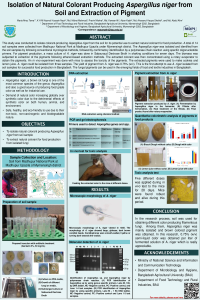
This study was conducted to isolate colorant-producing Aspergillus niger from the soil for its potential use to extract natural colorant for food production. A total of 14 soil samples were collected from Madhupur National Park at Madhupur Upazila under Mymensingh district. The Aspergillus niger was isolated and identified from the soil samples by following conventional mycological methods, followed by confirmatory identification by a polymerase chain reaction using specific oligonucleotide primers. For pigment production, a mass culture of A. niger was done in Sabouraud Dextrose Broth in shaking conditions for seven days. The biomass was subjected to extraction of the pigments following ethanol-based extraction methods. The extracted colorant was then concentrated using a rotary evaporator to obtain the pigments. An in vivo experiment was done with mice to assess the toxicity of the pigments. The extracted pigments were used to make cookies and lemon juice. A. niger could be isolated from three samples. The yield of pigment from A. niger was 0.75% (w/v). This is the first attempt to use A. niger isolated from soil samples for successful food production in Bangladesh. The fungal pigments can be used in the emerging fields of food and textile industries in Bangladesh.
Keywords
Natural colorants
Filamentous fungi
A. niger
PCR
Manuscript
sciforum-036514.pdf
Poster
Fungal pigment poster_Conference poster.pdf
Effects of fruit maturity on physicochemical properties, sugar accumulation and antioxidant capacity of wild harvested Kakadu plum (Terminalia ferdandian)
Phenolic profile of fruit industry byproducts determined by LC-DAD-MS/MS