Event submissions
Published
 10.3390/foods_2020-07821 (registering DOI)
 This submission belongs to the session 9. Innovative Food Additives and Ingredients of the event 1st International Electronic Conference on Food Science and Functional Foods
Published date
10 Nov, 2020
Citation
Letricia Barbosa-Pereira, Mariana Andrade, Cássia Barbosa, Fernanda Vilarinho, Ana Sanches-Silva, Ana Rodriguez-Bernaldo de Quirós, Raquel Sendón, Phenolic profile of fruit industry byproducts determined by LC-DAD-MS/MS, in Proceedings of 1st International Electronic Conference on Food Science and Functional Foods, 10 November–25 November 2020, MDPI: Basel, Switzerland, doi: 10.3390/foods_2020-07821
Share
Email
Facebook
Twitter
LinkedIn
Phenolic profile of fruit industry byproducts determined by LC-DAD-MS/MS
'%3e%3cpath%20d='M12.6647%2010.9104C12.4176%2010.325%2012.0589%209.7933%2011.6088%209.34485C11.16%208.89511%2010.6283%208.53653%2010.0432%208.28891C10.038%208.28629%2010.0327%208.28498%2010.0275%208.28236C10.8437%207.69282%2011.3743%206.73252%2011.3743%205.64907C11.3743%203.85423%209.92005%202.40002%208.12522%202.40002C6.33038%202.40002%204.87618%203.85423%204.87618%205.64907C4.87618%206.73252%205.40677%207.69282%206.22296%208.28367C6.21772%208.28629%206.21248%208.2876%206.20724%208.29022C5.62031%208.53783%205.09365%208.89287%204.64167%209.34616C4.19192%209.79496%203.83334%2010.3266%203.58573%2010.9117C3.34247%2011.4846%203.21128%2012.0987%203.19925%2012.721C3.1989%2012.735%203.20135%2012.7489%203.20646%2012.7619C3.21157%2012.7749%203.21924%2012.7868%203.22901%2012.7968C3.23877%2012.8068%203.25045%2012.8148%203.26334%2012.8202C3.27623%2012.8256%203.29007%2012.8284%203.30406%2012.8284H4.09012C4.14776%2012.8284%204.19362%2012.7825%204.19493%2012.7262C4.22113%2011.7148%204.62726%2010.7676%205.34519%2010.0497C6.08802%209.30686%207.07452%208.89811%208.12522%208.89811C9.17592%208.89811%2010.1624%209.30686%2010.9052%2010.0497C11.6232%2010.7676%2012.0293%2011.7148%2012.0555%2012.7262C12.0568%2012.7839%2012.1027%2012.8284%2012.1603%2012.8284H12.9464C12.9604%2012.8284%2012.9742%2012.8256%2012.9871%2012.8202C13%2012.8148%2013.0117%2012.8068%2013.0214%2012.7968C13.0312%2012.7868%2013.0389%2012.7749%2013.044%2012.7619C13.0491%2012.7489%2013.0515%2012.735%2013.0512%2012.721C13.0381%2012.0947%2012.9084%2011.4856%2012.6647%2010.9104ZM8.12522%207.90243C7.52388%207.90243%206.95792%207.66793%206.53214%207.24215C6.10636%206.81636%205.87185%206.2504%205.87185%205.64907C5.87185%205.04773%206.10636%204.48177%206.53214%204.05599C6.95792%203.63021%207.52388%203.3957%208.12522%203.3957C8.72655%203.3957%209.29252%203.63021%209.7183%204.05599C10.1441%204.48177%2010.3786%205.04773%2010.3786%205.64907C10.3786%206.2504%2010.1441%206.81636%209.7183%207.24215C9.29252%207.66793%208.72655%207.90243%208.12522%207.90243Z'%20fill='%235D1EE1'/%3e%3c/g%3e%3c/svg%3e)
Letricia Barbosa-Pereira 1

Mariana Andrade 2
Cássia Barbosa 3
Fernanda Vilarinho 3

Ana Sanches-Silva 4
Ana Rodriguez-Bernaldo de Quirós 1

Raquel Sendón 1
1. Department of Analytical Chemistry, Nutrition and Food Science, Faculty of Pharmacy, University of Santiago de Compostela, Santiago de Compostela, Spain
2. Department of Food and Nutrition, National Institute of Health Dr Ricardo Jorge (INSA), I.P., Lisbon, Portugal
REQUIMTE/LAQV, Faculty of Pharmacy, University of Coimbra, Coimbra, Azinhaga de Santa Comba, 3000-548 Coimbra, Portugal
3. Department of Food and Nutrition, National Institute of Health Dr Ricardo Jorge (INSA), I.P., Lisbon, Portugal
4. National Institute for Agricultural and Veterinary Research (INIAV), I.P., Vairão, Vila do Conde, Portugal
Center for Study in Animal Science (CECA), ICETA, University of Oporto, Oporto, Portugal.
Abstract
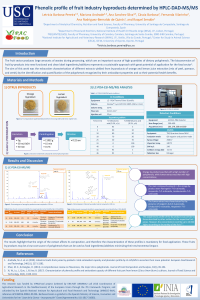
The bioconversion of fruit by-products into new functional and clean label ingredients/additives represents a sustainable approach with great potential of application for the food sector.
The aim of this work was the exhaustive characterization of different extracts yielded from by-products of orange and lemon juice extraction (mix of peel, pomace and seeds) by the identification and quantification of the polyphenols recognized by their antioxidant properties and so their potential health benefits.
Ethanolic extracts were characterized by liquid chromatography coupled to mass spectrometry (LC-MS/MS). Separation was performed on a Kinetex® EVO C18 100 Å (150 x 3mm, 5µm) column using water and methanol acidified with 0.1% formic acid as mobile phase. Liquid chromatography with diode array detector (LC-DAD) was used for the quantification of the main polyphenols.
Orange by-product was that with a high number of polyphenols, while lemon extract was that with high concentrations. The main compounds present in orange by-product were Naringenin-7-O-rutinoside, Hesperetin-7-O-rutinoside, Isosakuranetin-7-O-rutinoside. Lemon extract was characterized by the presence of Apigenin-6,8-di-C-glucoside, Eriodyctiol-O-rutinoside, Hesperetin-7-O-rutinoside. The polyphenolic profile of the by-products was similar to those described by other authors for the respective fruit juices, but the concentration could be up to 10-fold higher according to the variety of the fruit [1, 2]. The results highlight that the origin of the extract affects its composition and therefore its chemical characterization is mandatory for food application. These fruits by-products may be a low-cost source of polyphenols that can be used as food ingredients/additives minimizing their environmental impact.
References:
[1] Khan, M. K., & Dangles, O. (2014). A comprehensive review on flavanones, the major citrus polyphenols. Journal of Food Composition and Analysis, 33(1), 85-104.
[2] Xi, W., Lu, J., Qun, J., & Jiao, B. (2017). Characterization of phenolic profile and antioxidant capacity of different fruit part from lemon (Citrus limon Burm.) cultivars. Journal of food science and technology, 54(5), 1108-1118.
Acknowledgements: This work was financially supported by the VIPACFood project (selected by ERA-NET ARIMNet2 call 2016 (Coordination of Agricultural Research In the Mediterranean) of the European Union through the 7th Framework Programme and funding by the Spanish National Institute for Agricultural and Food Research and Technology (INIA) ref. APCIN2016-00061-00-00 and by the “Consellería de Cultura, Educación e Ordenación Universitaria, Xunta de Galicia”, Ref. No. GRC 2019/030. L. Barbosa-Pereira is grateful to the Spanish Ministry of Science, Innovation and Universities for her “Juan de la Cierva – Incorporación” Grant (Agreement No. IJCI-2017-31665).
Keywords
Fruit by-products
Polyphenols
Food additives/ingredients
LC-DAD
LC-MS/M
Manuscript
sciforum-036884.pdf
Poster
Foods_Barbosa-Pereira et al.pdf
Isolation of Natural Colorant Producing Aspergillus niger from Soil and Extraction of Pigment
Edible Halophytes – A novel Source of Functional Food Ingredients?