Event submissions
Published
 10.3390/foods_2020-07822 (registering DOI)
 This submission belongs to the session 8. Nutraceuticals and Functional Foods of the event 1st International Electronic Conference on Food Science and Functional Foods
Published date
10 Nov, 2020
Citation
Sukirtha Srivarathan, Anh Dao Thi Phan, Yasmina Sultanbawa, Olivia Wright, Michael E Netzel, Edible Halophytes – A novel Source of Functional Food Ingredients?, in Proceedings of 1st International Electronic Conference on Food Science and Functional Foods, 10 November–25 November 2020, MDPI: Basel, Switzerland, doi: 10.3390/foods_2020-07822
Share
Email
Facebook
Twitter
LinkedIn
Edible Halophytes – A novel Source of Functional Food Ingredients?
'%3e%3cpath%20d='M12.6647%2010.9104C12.4176%2010.325%2012.0589%209.7933%2011.6088%209.34485C11.16%208.89511%2010.6283%208.53653%2010.0432%208.28891C10.038%208.28629%2010.0327%208.28498%2010.0275%208.28236C10.8437%207.69282%2011.3743%206.73252%2011.3743%205.64907C11.3743%203.85423%209.92005%202.40002%208.12522%202.40002C6.33038%202.40002%204.87618%203.85423%204.87618%205.64907C4.87618%206.73252%205.40677%207.69282%206.22296%208.28367C6.21772%208.28629%206.21248%208.2876%206.20724%208.29022C5.62031%208.53783%205.09365%208.89287%204.64167%209.34616C4.19192%209.79496%203.83334%2010.3266%203.58573%2010.9117C3.34247%2011.4846%203.21128%2012.0987%203.19925%2012.721C3.1989%2012.735%203.20135%2012.7489%203.20646%2012.7619C3.21157%2012.7749%203.21924%2012.7868%203.22901%2012.7968C3.23877%2012.8068%203.25045%2012.8148%203.26334%2012.8202C3.27623%2012.8256%203.29007%2012.8284%203.30406%2012.8284H4.09012C4.14776%2012.8284%204.19362%2012.7825%204.19493%2012.7262C4.22113%2011.7148%204.62726%2010.7676%205.34519%2010.0497C6.08802%209.30686%207.07452%208.89811%208.12522%208.89811C9.17592%208.89811%2010.1624%209.30686%2010.9052%2010.0497C11.6232%2010.7676%2012.0293%2011.7148%2012.0555%2012.7262C12.0568%2012.7839%2012.1027%2012.8284%2012.1603%2012.8284H12.9464C12.9604%2012.8284%2012.9742%2012.8256%2012.9871%2012.8202C13%2012.8148%2013.0117%2012.8068%2013.0214%2012.7968C13.0312%2012.7868%2013.0389%2012.7749%2013.044%2012.7619C13.0491%2012.7489%2013.0515%2012.735%2013.0512%2012.721C13.0381%2012.0947%2012.9084%2011.4856%2012.6647%2010.9104ZM8.12522%207.90243C7.52388%207.90243%206.95792%207.66793%206.53214%207.24215C6.10636%206.81636%205.87185%206.2504%205.87185%205.64907C5.87185%205.04773%206.10636%204.48177%206.53214%204.05599C6.95792%203.63021%207.52388%203.3957%208.12522%203.3957C8.72655%203.3957%209.29252%203.63021%209.7183%204.05599C10.1441%204.48177%2010.3786%205.04773%2010.3786%205.64907C10.3786%206.2504%2010.1441%206.81636%209.7183%207.24215C9.29252%207.66793%208.72655%207.90243%208.12522%207.90243Z'%20fill='%235D1EE1'/%3e%3c/g%3e%3c/svg%3e)
Sukirtha Srivarathan 1,2
Anh Dao Thi Phan 1

Yasmina Sultanbawa 1

Olivia Wright 1,3

Michael E Netzel 1
1. ARC Industrial Transformation Training Centre for Uniquely Australian Foods, Queensland Alliance for Agriculture and Food Innovation (QAAFI), The University of Queensland, Coopers Plains, QLD 4108, Australia
2. Department of Biosystems Technology, Faculty of Technology, University of Jaffna, Ariviyal Nagar, Kilinochchi (NP), 44000, Sri Lanka
3. School of Human Movement and Nutrition Sciences, The University of Queensland, St. Lucia, QLD 4072 , Australia
Abstract
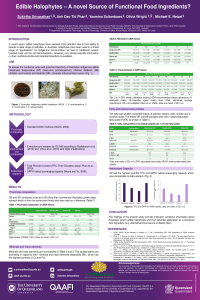
In recent years, edible halophytes have received more attention due to their ability to tolerate a wide range of salinities. In Australia, halophytes are used in a broad range of “applications” by Indigenous Communities: in traditional cuisine, as livestock feed and for soil bioremediation. However, very limited scientific information on their nutritional profile and potential bioactivity is available. Therefore, the present study assessed the nutrient and phytochemical composition of Australian grown Seapurslane (SP) (Sesuvium portulacastrum), oldman Saltbush (SB) (Atriplex nummularia) and Seablite (SBL) (Suaeda arbusculoides) to better understand their nutritional ‘value’ and potential bioactivity. SB and SP contained more (p<0.05) fibre than commercial Australian baby spinach (same plant family) which was used as a reference (41.5 vs. 40.4 vs. 33.4 g/100 g dry weight (DW)). Furthermore, these plants can be considered as valuable sources of essential minerals (Ca, Fe, Mg and Na) and trace elements, specifically SBL had the highest contents of Ca and Fe. SB had the highest protein (20.1 g/100 g DW) and fat (2.7 g/100 g DW) content compared to other studied halophytes. The fatty acid profile consisted mainly of palmitic, stearic, oleic, linoleic and α-linolenic acids. A strong antioxidant capacity (total phenolic content and DPPH radical scavenging capacity) indicated that (poly) phenolic compounds are most likely the predominant phytochemicals in this species. These initial results are promising and suggest that Australian indigenous edible halophytes may have the potential to be utilized as functional food ingredients.
Keywords
Halophytes
Australian grown
Nutritional profile
Bioactive potential
Food
Manuscript
MDPI FOODS-Sukirtha Abstract.pdf
Poster
MDPI poster Sukirtha Srivarathan.pdf
Phenolic profile of fruit industry byproducts determined by LC-DAD-MS/MS
EFFECT OF TIME AND LEGUME TYPE ON GERMINATION-INDUCED PROTEOLYSIS OF LENTILS AND FABA BEAN