Event submissions
Published
 10.3390/foods_2020-07823 (registering DOI)
 This submission belongs to the session 1. Novel Technologies in Food Technology of the event 1st International Electronic Conference on Food Science and Functional Foods
Published date
10 Nov, 2020
Citation
Sara Bautista-Expósito, Elena Peñas, Albert Vandenberg, Juana Frias, Cristina Martínez-Villaluenga, EFFECT OF TIME AND LEGUME TYPE ON GERMINATION-INDUCED PROTEOLYSIS OF LENTILS AND FABA BEAN, in Proceedings of 1st International Electronic Conference on Food Science and Functional Foods, 10 November–25 November 2020, MDPI: Basel, Switzerland, doi: 10.3390/foods_2020-07823
Share
Email
Facebook
Twitter
LinkedIn
EFFECT OF TIME AND LEGUME TYPE ON GERMINATION-INDUCED PROTEOLYSIS OF LENTILS AND FABA BEAN
'%3e%3cpath%20d='M12.6647%2010.9104C12.4176%2010.325%2012.0589%209.7933%2011.6088%209.34485C11.16%208.89511%2010.6283%208.53653%2010.0432%208.28891C10.038%208.28629%2010.0327%208.28498%2010.0275%208.28236C10.8437%207.69282%2011.3743%206.73252%2011.3743%205.64907C11.3743%203.85423%209.92005%202.40002%208.12522%202.40002C6.33038%202.40002%204.87618%203.85423%204.87618%205.64907C4.87618%206.73252%205.40677%207.69282%206.22296%208.28367C6.21772%208.28629%206.21248%208.2876%206.20724%208.29022C5.62031%208.53783%205.09365%208.89287%204.64167%209.34616C4.19192%209.79496%203.83334%2010.3266%203.58573%2010.9117C3.34247%2011.4846%203.21128%2012.0987%203.19925%2012.721C3.1989%2012.735%203.20135%2012.7489%203.20646%2012.7619C3.21157%2012.7749%203.21924%2012.7868%203.22901%2012.7968C3.23877%2012.8068%203.25045%2012.8148%203.26334%2012.8202C3.27623%2012.8256%203.29007%2012.8284%203.30406%2012.8284H4.09012C4.14776%2012.8284%204.19362%2012.7825%204.19493%2012.7262C4.22113%2011.7148%204.62726%2010.7676%205.34519%2010.0497C6.08802%209.30686%207.07452%208.89811%208.12522%208.89811C9.17592%208.89811%2010.1624%209.30686%2010.9052%2010.0497C11.6232%2010.7676%2012.0293%2011.7148%2012.0555%2012.7262C12.0568%2012.7839%2012.1027%2012.8284%2012.1603%2012.8284H12.9464C12.9604%2012.8284%2012.9742%2012.8256%2012.9871%2012.8202C13%2012.8148%2013.0117%2012.8068%2013.0214%2012.7968C13.0312%2012.7868%2013.0389%2012.7749%2013.044%2012.7619C13.0491%2012.7489%2013.0515%2012.735%2013.0512%2012.721C13.0381%2012.0947%2012.9084%2011.4856%2012.6647%2010.9104ZM8.12522%207.90243C7.52388%207.90243%206.95792%207.66793%206.53214%207.24215C6.10636%206.81636%205.87185%206.2504%205.87185%205.64907C5.87185%205.04773%206.10636%204.48177%206.53214%204.05599C6.95792%203.63021%207.52388%203.3957%208.12522%203.3957C8.72655%203.3957%209.29252%203.63021%209.7183%204.05599C10.1441%204.48177%2010.3786%205.04773%2010.3786%205.64907C10.3786%206.2504%2010.1441%206.81636%209.7183%207.24215C9.29252%207.66793%208.72655%207.90243%208.12522%207.90243Z'%20fill='%235D1EE1'/%3e%3c/g%3e%3c/svg%3e)
Sara Bautista-Expósito 1

Elena Peñas 1

Albert Vandenberg 2
Juana Frias 1

Cristina Martínez-Villaluenga 1
1. Department of Food Characterization, Quality and Safety, Institute of Food Science, Technology and Nutrition (ICTAN-CSIC), 28040 Madrid, Spain
2. Department of Plant Sciences, University of Saskatchewan, Saskatoon, SK, S7N 5A8, Canada
Abstract
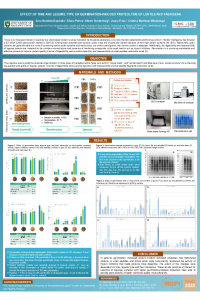
Legumes are alternative protein sources that have been successfully used to develop diverse meatless foods. Although these plant-based products have a lower impact on the environment than equivalent animal-based products they have lower protein digestibility. Germination could be a useful bioprocess to enhance protein digestibility in legumes although its effect at different times of seedling development has been little studied in lentil and faba bean. This work investigated the effect of germination time (4 and 6 days after full seed imbibition) on the proteins of three types of Canadian lentils (“gray zero tannin”, G; “caviar black”, B; and “red dehulled”, D) and faba bean (“zero vicin/convicin”, F). Germination increased total nitrogen (4-14% increase) and total levels of some amino acids: Asp in all the sprouts studied; Ser, Pro, Ala, Cys, His and Lys in G; Met and Tyr in B. A concurrent degradation of the 7S and 11S globulin subunits, accumulation of peptides below 20 kDa and free essential and non-essential amino acids (4 to 6-fold increase) were observed after germination in all the legumes studied. These effects were attributable to the increased protease activity observed after sprouting. Trypsin inhibitory activity was lower in legume sprouts except for D where a small increase was detected. Time, legume type and their interaction showed significant effects on the parameters studied. Germination effects were generally more remarkable at longer stages of seedling development. Among legumes studied, D showed a differential behavior characterized by a faster protein degradation and release of small peptides probably due to its higher protease activity as indicated by principal component analysis. These results evidence the positive effects of germination on protein digestibility of different lentil types and faba bean. Protein quality of plant-based foods could be improved through selection of legumes species with higher germination-induced proteolytic rates and optimized germination times.
This research was funded by University of Saskatcheewan, grant “Lentils for Sustainable and Healthy Proteins (Ref. 20196324)”.
Keywords
Lentil
faba bean
germination time
protein digestibility
protein quality
Manuscript
sciforum-037034.pdf
Poster
Poster Foods 2020_Bautista Exposito.pdf
Edible Halophytes – A novel Source of Functional Food Ingredients?
Recovery of phenolic compounds from edible algae using high hydrostatic pressure: an optimization approach