Event submissions
Published
 10.3390/foods_2020-07825 (registering DOI)
 This submission belongs to the session 1. Novel Technologies in Food Technology of the event 1st International Electronic Conference on Food Science and Functional Foods
Published date
10 Nov, 2020
Citation
Laura Nadal, Pilar Mañas, Guillermo Cebrián, Effect of sublethal shocks on Staphylococcus aureus envelope properties: relationship with the development of cross-resistance to Pulsed Electric Fields, in Proceedings of 1st International Electronic Conference on Food Science and Functional Foods, 10 November–25 November 2020, MDPI: Basel, Switzerland, doi: 10.3390/foods_2020-07825
Share
Email
Facebook
Twitter
LinkedIn
Effect of sublethal shocks on Staphylococcus aureus envelope properties: relationship with the development of cross-resistance to Pulsed Electric Fields
'%3e%3cpath%20d='M12.6647%2010.9104C12.4176%2010.325%2012.0589%209.7933%2011.6088%209.34485C11.16%208.89511%2010.6283%208.53653%2010.0432%208.28891C10.038%208.28629%2010.0327%208.28498%2010.0275%208.28236C10.8437%207.69282%2011.3743%206.73252%2011.3743%205.64907C11.3743%203.85423%209.92005%202.40002%208.12522%202.40002C6.33038%202.40002%204.87618%203.85423%204.87618%205.64907C4.87618%206.73252%205.40677%207.69282%206.22296%208.28367C6.21772%208.28629%206.21248%208.2876%206.20724%208.29022C5.62031%208.53783%205.09365%208.89287%204.64167%209.34616C4.19192%209.79496%203.83334%2010.3266%203.58573%2010.9117C3.34247%2011.4846%203.21128%2012.0987%203.19925%2012.721C3.1989%2012.735%203.20135%2012.7489%203.20646%2012.7619C3.21157%2012.7749%203.21924%2012.7868%203.22901%2012.7968C3.23877%2012.8068%203.25045%2012.8148%203.26334%2012.8202C3.27623%2012.8256%203.29007%2012.8284%203.30406%2012.8284H4.09012C4.14776%2012.8284%204.19362%2012.7825%204.19493%2012.7262C4.22113%2011.7148%204.62726%2010.7676%205.34519%2010.0497C6.08802%209.30686%207.07452%208.89811%208.12522%208.89811C9.17592%208.89811%2010.1624%209.30686%2010.9052%2010.0497C11.6232%2010.7676%2012.0293%2011.7148%2012.0555%2012.7262C12.0568%2012.7839%2012.1027%2012.8284%2012.1603%2012.8284H12.9464C12.9604%2012.8284%2012.9742%2012.8256%2012.9871%2012.8202C13%2012.8148%2013.0117%2012.8068%2013.0214%2012.7968C13.0312%2012.7868%2013.0389%2012.7749%2013.044%2012.7619C13.0491%2012.7489%2013.0515%2012.735%2013.0512%2012.721C13.0381%2012.0947%2012.9084%2011.4856%2012.6647%2010.9104ZM8.12522%207.90243C7.52388%207.90243%206.95792%207.66793%206.53214%207.24215C6.10636%206.81636%205.87185%206.2504%205.87185%205.64907C5.87185%205.04773%206.10636%204.48177%206.53214%204.05599C6.95792%203.63021%207.52388%203.3957%208.12522%203.3957C8.72655%203.3957%209.29252%203.63021%209.7183%204.05599C10.1441%204.48177%2010.3786%205.04773%2010.3786%205.64907C10.3786%206.2504%2010.1441%206.81636%209.7183%207.24215C9.29252%207.66793%208.72655%207.90243%208.12522%207.90243Z'%20fill='%235D1EE1'/%3e%3c/g%3e%3c/svg%3e)
Laura Nadal 1
Pilar Mañas 1
Guillermo Cebrián 1
1. Universidad de Zaragoza
Abstract
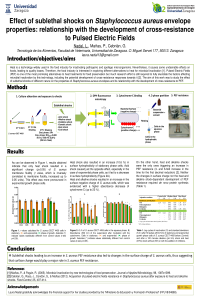
Pulsed Electric Fields (PEF) is one of the most promising alternatives to heat treatments for food preservation but much research effort is still required to fully elucidate the factors affecting microbial inactivation by this technology. The aim of this work was to study the effect of sublethal shocks of different nature on the properties of Staphylococcus aureus envelopes and its relationship with the development of cross-resistance to PEF. S. aureus cells were exposed to sublethal shocks (acid, alkaline, oxidative, osmotic, heat and cold) and then their membrane fluidity (fluorescence anisotropy), surface charge (cytochrome-C binding) and surface hydrophobicity (2-phase partition) were determined. Results obtained indicate that only heat shock resulted in a significant change (p<0.05) of S. aureus membrane fluidity (r value increased up to 0.05 units). Heat shock also resulted in an increase (10.6 %) in surface hydrophobicity. Finally, heat and alkaline shocks resulted in an increase in the surface negative charge (up to a 23 %) of S. aureus cells. On the other hand, heat and alkaline shocks were the only ones triggering an increase in PEF resistance (3- and 6-fold increase in the time for the first decimal reduction). Neither the changes in surface charge nor the heat and alkaline shock-dependent development of PEF resistance required de novo protein synthesis, thus suggesting that surface charge would play a major role in S. aureus PEF resistance.
Keywords
Stress resistance
non-thermal technologies
foodborne pathogens
food preservation
Manuscript
sciforum-037111.pdf
Poster
Laura Nadal POSTER.pdf
Recovery of phenolic compounds from edible algae using high hydrostatic pressure: an optimization approach
Drying of grape pomace by conventional and intermittent processes: mathematical modeling and effect on the phenolic content and antioxidant activity