Event submissions
Published

This submission belongs to the session F. Nanomedicine and Nanobiotechnology of the event The 2nd International Online Conference on Nanomaterials
Published date
11 Nov, 2020
Citation
Sorina Nicoleta Voicu, Miruna Silvia Stan, Ionela Cristina Nica, Mihaela Balas, Juliette Moreau, Cyril Cadiou, Maité Callewaert, Françoise Chuburu, Anca Dinischiotu, Biocompatibility and cellular uptake of fluorescent chitosan nanohydrogels in murine macrophages and B lymphocytes , in Proceedings of The 2nd International Online Conference on Nanomaterials, 15 November–30 November 2020, MDPI: Basel, Switzerland, doi: 10.3390/IOCN2020-07851
Share
Email
Facebook
Twitter
LinkedIn
Biocompatibility and cellular uptake of fluorescent chitosan nanohydrogels in murine macrophages and B lymphocytes
'%3e%3cpath%20d='M12.6647%2010.9104C12.4176%2010.325%2012.0589%209.7933%2011.6088%209.34485C11.16%208.89511%2010.6283%208.53653%2010.0432%208.28891C10.038%208.28629%2010.0327%208.28498%2010.0275%208.28236C10.8437%207.69282%2011.3743%206.73252%2011.3743%205.64907C11.3743%203.85423%209.92005%202.40002%208.12522%202.40002C6.33038%202.40002%204.87618%203.85423%204.87618%205.64907C4.87618%206.73252%205.40677%207.69282%206.22296%208.28367C6.21772%208.28629%206.21248%208.2876%206.20724%208.29022C5.62031%208.53783%205.09365%208.89287%204.64167%209.34616C4.19192%209.79496%203.83334%2010.3266%203.58573%2010.9117C3.34247%2011.4846%203.21128%2012.0987%203.19925%2012.721C3.1989%2012.735%203.20135%2012.7489%203.20646%2012.7619C3.21157%2012.7749%203.21924%2012.7868%203.22901%2012.7968C3.23877%2012.8068%203.25045%2012.8148%203.26334%2012.8202C3.27623%2012.8256%203.29007%2012.8284%203.30406%2012.8284H4.09012C4.14776%2012.8284%204.19362%2012.7825%204.19493%2012.7262C4.22113%2011.7148%204.62726%2010.7676%205.34519%2010.0497C6.08802%209.30686%207.07452%208.89811%208.12522%208.89811C9.17592%208.89811%2010.1624%209.30686%2010.9052%2010.0497C11.6232%2010.7676%2012.0293%2011.7148%2012.0555%2012.7262C12.0568%2012.7839%2012.1027%2012.8284%2012.1603%2012.8284H12.9464C12.9604%2012.8284%2012.9742%2012.8256%2012.9871%2012.8202C13%2012.8148%2013.0117%2012.8068%2013.0214%2012.7968C13.0312%2012.7868%2013.0389%2012.7749%2013.044%2012.7619C13.0491%2012.7489%2013.0515%2012.735%2013.0512%2012.721C13.0381%2012.0947%2012.9084%2011.4856%2012.6647%2010.9104ZM8.12522%207.90243C7.52388%207.90243%206.95792%207.66793%206.53214%207.24215C6.10636%206.81636%205.87185%206.2504%205.87185%205.64907C5.87185%205.04773%206.10636%204.48177%206.53214%204.05599C6.95792%203.63021%207.52388%203.3957%208.12522%203.3957C8.72655%203.3957%209.29252%203.63021%209.7183%204.05599C10.1441%204.48177%2010.3786%205.04773%2010.3786%205.64907C10.3786%206.2504%2010.1441%206.81636%209.7183%207.24215C9.29252%207.66793%208.72655%207.90243%208.12522%207.90243Z'%20fill='%235D1EE1'/%3e%3c/g%3e%3c/svg%3e)
Sorina Nicoleta Voicu 1

Miruna Silvia Stan 1

Ionela Cristina Nica 1

Mihaela Balas 1
Juliette Moreau 2
Cyril Cadiou 2
Maité Callewaert 2
Françoise Chuburu 2

Anca Dinischiotu 1
1. Department of Biochemistry and Molecular Biology, Faculty of Biology, University of Bucharest, 91-95 Splaiul Independentei, 050095 Bucharest, Romania.
2. Institut de Chimie Moléculaire de Reims, CNRS UMR 7312, University of Reims Champagne-Ardenne URCA, 51685 Reims Cedex 2, France.
Abstract
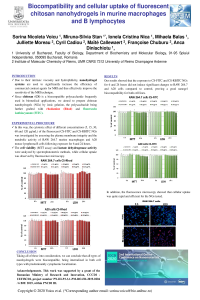
Due to their intrinsic viscosity and hydrophilicity, nanohydrogel systems are used to significantly increase the efficiency of commercial contrast agents for MRI and thus effectively improve the sensitivity of the MRI technique. Since chitosan (CS) is a biocompatible polysaccharide frequently used in biomedical applications, we aimed to prepare chitosan nanohydrogels (NGs) by ionic gelation, the polysaccharide being further grafted with rhodamine (RBITC) and fluorescein isothiocyanate (FITC). In this way, the cytotoxic effect of different concentrations (5, 15, 30, 60 and 120 µg/mL) of the fluorescent CS-FITC and CS-RBITC NGs was investigated by assessing the plasma membrane integrity and the metabolic activity of RAW 264.7 murine macrophages and A20 mouse lymphoma B cells following exposure for 6 and 24 hours. The cell viability (MTT assay) and lactate dehydrogenase activity were analyzed by spectrophotometric methods, while cellular uptake was observed by fluorescence microscopy. Our results showed that the exposure to CS-FITC and CS-RBITC NGs for 6 and 24 hours did not induce significant changes to RAW 264.7 and A20 cells compared to control, proving a good nanogel biocompatibility for both cell lines. In addition, the fluorescence microscopy showed that cellular uptake was quite rapid and efficient for the NGs tested. Taking all of these into consideration, we can conclude that all types of nanohydrogels were biocompatible, being internalized in both cell types with predominantly cytoplasmic localization.
Acknowledgments: This work was supported by a grant of the Romanian Ministry of Research and Innovation, CCCDI-UEFISCDI, project number PN III-P3-3.1-PM-RO-FR-2019-0204/6BM/2019, within PNCDI III
Keywords
nanohydrogels
cellular uptake
murine macrophages
chitosan
B lymphocytes
Manuscript
sciforum-039329 - done.pdf
Poster
Poster_SN Voicu.pdf
Microwave-assisted hydrothermal synthesis of Zn2SnO4 nanostructures for photocatalytic dye degradation
Development of Metal Nanoparticle Based Sensing Platform for Lead in Aqueous Samples