Event submissions
Published

This submission belongs to the session I. Poster of the event The 2nd International Online Conference on Nanomaterials
Published date
11 Nov, 2020
Citation
Joanna Stachowska, Ella Gibbons, Antonios Kelarakis, Marta Krysmann, Photoactive carbogenic nanotracers with remarkable antimicrobial properties for pH-sensing applications, in Proceedings of The 2nd International Online Conference on Nanomaterials, 15 November–30 November 2020, MDPI: Basel, Switzerland, doi: 10.3390/IOCN2020-07856
Share
Email
Facebook
Twitter
LinkedIn
Photoactive carbogenic nanotracers with remarkable antimicrobial properties for pH-sensing applications
'%3e%3cpath%20d='M12.6647%2010.9104C12.4176%2010.325%2012.0589%209.7933%2011.6088%209.34485C11.16%208.89511%2010.6283%208.53653%2010.0432%208.28891C10.038%208.28629%2010.0327%208.28498%2010.0275%208.28236C10.8437%207.69282%2011.3743%206.73252%2011.3743%205.64907C11.3743%203.85423%209.92005%202.40002%208.12522%202.40002C6.33038%202.40002%204.87618%203.85423%204.87618%205.64907C4.87618%206.73252%205.40677%207.69282%206.22296%208.28367C6.21772%208.28629%206.21248%208.2876%206.20724%208.29022C5.62031%208.53783%205.09365%208.89287%204.64167%209.34616C4.19192%209.79496%203.83334%2010.3266%203.58573%2010.9117C3.34247%2011.4846%203.21128%2012.0987%203.19925%2012.721C3.1989%2012.735%203.20135%2012.7489%203.20646%2012.7619C3.21157%2012.7749%203.21924%2012.7868%203.22901%2012.7968C3.23877%2012.8068%203.25045%2012.8148%203.26334%2012.8202C3.27623%2012.8256%203.29007%2012.8284%203.30406%2012.8284H4.09012C4.14776%2012.8284%204.19362%2012.7825%204.19493%2012.7262C4.22113%2011.7148%204.62726%2010.7676%205.34519%2010.0497C6.08802%209.30686%207.07452%208.89811%208.12522%208.89811C9.17592%208.89811%2010.1624%209.30686%2010.9052%2010.0497C11.6232%2010.7676%2012.0293%2011.7148%2012.0555%2012.7262C12.0568%2012.7839%2012.1027%2012.8284%2012.1603%2012.8284H12.9464C12.9604%2012.8284%2012.9742%2012.8256%2012.9871%2012.8202C13%2012.8148%2013.0117%2012.8068%2013.0214%2012.7968C13.0312%2012.7868%2013.0389%2012.7749%2013.044%2012.7619C13.0491%2012.7489%2013.0515%2012.735%2013.0512%2012.721C13.0381%2012.0947%2012.9084%2011.4856%2012.6647%2010.9104ZM8.12522%207.90243C7.52388%207.90243%206.95792%207.66793%206.53214%207.24215C6.10636%206.81636%205.87185%206.2504%205.87185%205.64907C5.87185%205.04773%206.10636%204.48177%206.53214%204.05599C6.95792%203.63021%207.52388%203.3957%208.12522%203.3957C8.72655%203.3957%209.29252%203.63021%209.7183%204.05599C10.1441%204.48177%2010.3786%205.04773%2010.3786%205.64907C10.3786%206.2504%2010.1441%206.81636%209.7183%207.24215C9.29252%207.66793%208.72655%207.90243%208.12522%207.90243Z'%20fill='%235D1EE1'/%3e%3c/g%3e%3c/svg%3e)
Joanna Stachowska 1
Ella Gibbons 1

Antonios Kelarakis 1
Marta Krysmann 1
1. University of Central Lancashire
Abstract
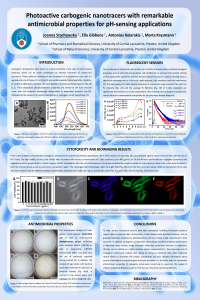
Carbogenic nanoparticles (also known as C-dots) constitute a new class of carbon-based materials, which are easily synthesized via thermal treatments of carbon-rich precursors. These spherical nanoemitters are composed of an amorphous core with an approximate size of below 10 nm and exhibit exquisite biocompatibility, simplicity of surface modification, excellent chemical stability and broad excitation spectra. Their exceptional photoluminescent properties are related to the dual emissive mode with the excitation-wavelength independent or dependent emission, attributed to the presence of organic fluorophores or carbogenic cores, respectively.
To date, several nanomaterials have been developed to measure the intercellular pH, including fluorescent proteins, organic dyes or quantum dots. Among them, C-dots are characterized by resistance to photobleaching, good permeability and lack of toxic metal components in their structure. Moreover, these nanoemitters demonstrate excellent analytical performance in detecting heavy metals, drugs, biological molecules, poisonous reactants or explosives, thus can be applied as highly selective optical nanoprobes. In summary, our results demonstrate the potential to utilize biocompatible carbogenic nanotracers for an early-stage disease diagnosis as well as highlight their remarkable antimicrobial activity against Escherichia coli and Staphylococcus aureus.
Keywords
nanomaterials
nanostructures
carbon dots
Manuscript
Poster J.Stachowska UCLan poster IOCN2020.pdf
Poster
Poster J.Stachowska UCLan poster IOCN2020.pdf
Enzymatic deposition of pseudo-polydopamine thin films: a mild, versatile and low-waste mussel-inspired coating technology
Development of polymeric micelles for in vivo mRNA delivery through stable complexation with flexible block catiomers