Event submissions
Published

This submission belongs to the session I. Poster of the event The 2nd International Online Conference on Nanomaterials
Published date
11 Nov, 2020
Citation
Bazla Siddiqui, Naveed Ahmed, Asim.ur. Rehman, Development and in vitro characterization of diacerein loaded chitosan-chondroitin sulfate nanoemulgel for osteoarthritis, in Proceedings of The 2nd International Online Conference on Nanomaterials, 15 November–30 November 2020, MDPI: Basel, Switzerland, doi: 10.3390/IOCN2020-07859
Share
Email
Facebook
Twitter
LinkedIn
Development and in vitro characterization of diacerein loaded chitosan-chondroitin sulfate nanoemulgel for osteoarthritis

Bazla Siddiqui 1
'%3e%3cpath%20d='M12.6647%2010.9104C12.4176%2010.325%2012.0589%209.7933%2011.6088%209.34485C11.16%208.89511%2010.6283%208.53653%2010.0432%208.28891C10.038%208.28629%2010.0327%208.28498%2010.0275%208.28236C10.8437%207.69282%2011.3743%206.73252%2011.3743%205.64907C11.3743%203.85423%209.92005%202.40002%208.12522%202.40002C6.33038%202.40002%204.87618%203.85423%204.87618%205.64907C4.87618%206.73252%205.40677%207.69282%206.22296%208.28367C6.21772%208.28629%206.21248%208.2876%206.20724%208.29022C5.62031%208.53783%205.09365%208.89287%204.64167%209.34616C4.19192%209.79496%203.83334%2010.3266%203.58573%2010.9117C3.34247%2011.4846%203.21128%2012.0987%203.19925%2012.721C3.1989%2012.735%203.20135%2012.7489%203.20646%2012.7619C3.21157%2012.7749%203.21924%2012.7868%203.22901%2012.7968C3.23877%2012.8068%203.25045%2012.8148%203.26334%2012.8202C3.27623%2012.8256%203.29007%2012.8284%203.30406%2012.8284H4.09012C4.14776%2012.8284%204.19362%2012.7825%204.19493%2012.7262C4.22113%2011.7148%204.62726%2010.7676%205.34519%2010.0497C6.08802%209.30686%207.07452%208.89811%208.12522%208.89811C9.17592%208.89811%2010.1624%209.30686%2010.9052%2010.0497C11.6232%2010.7676%2012.0293%2011.7148%2012.0555%2012.7262C12.0568%2012.7839%2012.1027%2012.8284%2012.1603%2012.8284H12.9464C12.9604%2012.8284%2012.9742%2012.8256%2012.9871%2012.8202C13%2012.8148%2013.0117%2012.8068%2013.0214%2012.7968C13.0312%2012.7868%2013.0389%2012.7749%2013.044%2012.7619C13.0491%2012.7489%2013.0515%2012.735%2013.0512%2012.721C13.0381%2012.0947%2012.9084%2011.4856%2012.6647%2010.9104ZM8.12522%207.90243C7.52388%207.90243%206.95792%207.66793%206.53214%207.24215C6.10636%206.81636%205.87185%206.2504%205.87185%205.64907C5.87185%205.04773%206.10636%204.48177%206.53214%204.05599C6.95792%203.63021%207.52388%203.3957%208.12522%203.3957C8.72655%203.3957%209.29252%203.63021%209.7183%204.05599C10.1441%204.48177%2010.3786%205.04773%2010.3786%205.64907C10.3786%206.2504%2010.1441%206.81636%209.7183%207.24215C9.29252%207.66793%208.72655%207.90243%208.12522%207.90243Z'%20fill='%235D1EE1'/%3e%3c/g%3e%3c/svg%3e)
Naveed Ahmed 2
Asim.ur. Rehman 2
1. PhD Scholar, Department of Pharmacy, Quaid-iAzam University, Islamabad.
2. Assistant Professor, Department of Pharmacy, Quaid-i-Azam University, Islamabad.
Abstract
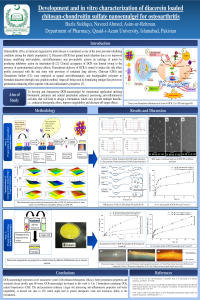
The proficient function of diacerein and anti-inflammatory polymers have been utilized to develop sustained release transdermal diacerein nanoemulgel for long term osteoarthritis treatment, by overcoming the deleterious outcomes of drug associated with the oral route. Chitosan (CHS) and Chondroitin Sulfate (CS) were employed as natural anti-inflammatory and biodegradable polymers to formulate diacerein nanoparticles (DCR-NPs) through ionic gelation method. Optimized nano-formulation was prepared using Design Expert software, by investigating the impact of polymers and surfactant concentrations on particle size, PDI and entrapment efficiency employing Response Surface Methodology (RSM). DCR-NPs formulated using 0.4% CHS, 0.1% CS and 0.015% (w/v) Tween 80 depicted spherical shaped nanoparticles with particle size of 320.0 ± 3 nm having PDI, zeta potential and entrapment efficiency of 0.3 ± 0.07, 40 ± 0.3 mV and 82 ± 4.16% respectively. DCR-NPs were further analyzed for confirmation of electrostatic interactions between polymers and drug through Fourier transform-infrared spectroscopy (FTIR). Through in vitro studies 95% release of DCR in 72 h was exhibited following Korsmeyer-Peppas model. For transdermal application, nanoemulgel of optimized DCR-NPs was formulated utilizing argan oil as permeation enhancer with intrinsic anti-inflammatory properties, providing synergistic effect to the formulation. Nanoemulgel was characterized in terms of visual appearance, spreadability, drug content and rheological behavior providing sustained release of drug up to 96 h following Higuchi model with improved ex vivo permeation, confirmed by fluorescent microscopy. Concisely, DCR-nanoemulgel sustained the release of drug having superior penetration properties with provision of enhanced therapeutic effect owing to the presence of CHS, CS and argan oil possessing indelible anti-inflammatory attributes.
Keywords
Diacerein
Chitosan
Chondroitin Sulfate
Nanoemulgel
Transdermal delivery
Sustained effect.
Manuscript
sciforum-039832-done.pdf
Poster
2020 poster for conference.pdf
Electrospray ion beam deposition of complex molecules on surfaces in the vacuum
A novel one-step green method to synthesis of palladium nanoparticles