Event submissions
EventsThe 1st International Electronic Conference on Forests — Forests for a Better Future: Sustainability, Innovation, Interdisciplinarity
Published

This submission belongs to the session S1. Forest Ecology, Management and Restoration of the event The 1st International Electronic Conference on Forests — Forests for a Better Future: Sustainability, Innovation, Interdisciplinarity
Published date
11 Nov, 2020
Citation
Bayo Alhusaeri Siregar, Abdul Gafur, Budi Tjahjono, Pranita Nuri, Halimah Halimah, Gurdeep Dhan Golani, First report on infection of Eucalyptus pellita seeds by Ralstonia solanacearum, in Proceedings of The 1st International Electronic Conference on Forests — Forests for a Better Future: Sustainability, Innovation, Interdisciplinarity, 15 November–30 November 2020, MDPI: Basel, Switzerland, doi: 10.3390/IECF2020-07904
Share
Email
Facebook
Twitter
LinkedIn
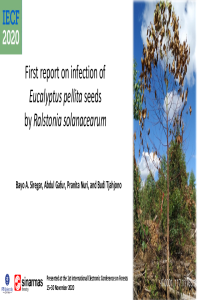
First report on infection of Eucalyptus pellita seeds by Ralstonia solanacearum
'%3e%3cpath%20d='M12.6647%2010.9104C12.4176%2010.325%2012.0589%209.7933%2011.6088%209.34485C11.16%208.89511%2010.6283%208.53653%2010.0432%208.28891C10.038%208.28629%2010.0327%208.28498%2010.0275%208.28236C10.8437%207.69282%2011.3743%206.73252%2011.3743%205.64907C11.3743%203.85423%209.92005%202.40002%208.12522%202.40002C6.33038%202.40002%204.87618%203.85423%204.87618%205.64907C4.87618%206.73252%205.40677%207.69282%206.22296%208.28367C6.21772%208.28629%206.21248%208.2876%206.20724%208.29022C5.62031%208.53783%205.09365%208.89287%204.64167%209.34616C4.19192%209.79496%203.83334%2010.3266%203.58573%2010.9117C3.34247%2011.4846%203.21128%2012.0987%203.19925%2012.721C3.1989%2012.735%203.20135%2012.7489%203.20646%2012.7619C3.21157%2012.7749%203.21924%2012.7868%203.22901%2012.7968C3.23877%2012.8068%203.25045%2012.8148%203.26334%2012.8202C3.27623%2012.8256%203.29007%2012.8284%203.30406%2012.8284H4.09012C4.14776%2012.8284%204.19362%2012.7825%204.19493%2012.7262C4.22113%2011.7148%204.62726%2010.7676%205.34519%2010.0497C6.08802%209.30686%207.07452%208.89811%208.12522%208.89811C9.17592%208.89811%2010.1624%209.30686%2010.9052%2010.0497C11.6232%2010.7676%2012.0293%2011.7148%2012.0555%2012.7262C12.0568%2012.7839%2012.1027%2012.8284%2012.1603%2012.8284H12.9464C12.9604%2012.8284%2012.9742%2012.8256%2012.9871%2012.8202C13%2012.8148%2013.0117%2012.8068%2013.0214%2012.7968C13.0312%2012.7868%2013.0389%2012.7749%2013.044%2012.7619C13.0491%2012.7489%2013.0515%2012.735%2013.0512%2012.721C13.0381%2012.0947%2012.9084%2011.4856%2012.6647%2010.9104ZM8.12522%207.90243C7.52388%207.90243%206.95792%207.66793%206.53214%207.24215C6.10636%206.81636%205.87185%206.2504%205.87185%205.64907C5.87185%205.04773%206.10636%204.48177%206.53214%204.05599C6.95792%203.63021%207.52388%203.3957%208.12522%203.3957C8.72655%203.3957%209.29252%203.63021%209.7183%204.05599C10.1441%204.48177%2010.3786%205.04773%2010.3786%205.64907C10.3786%206.2504%2010.1441%206.81636%209.7183%207.24215C9.29252%207.66793%208.72655%207.90243%208.12522%207.90243Z'%20fill='%235D1EE1'/%3e%3c/g%3e%3c/svg%3e)
Bayo Alhusaeri Siregar 1

Abdul Gafur 1
Budi Tjahjono 1
Pranita Nuri 1
Halimah Halimah 1
Gurdeep Dhan Golani 1
1. Sinarmas Forestry Corporate R&D
Abstract
Forest plantation in Indonesia has been rapidly increasing since the last few decades. Ecologically, forest plantations are able to reduce pressure on natural forests, quickly fix carbon and stimulate the restoration of natural vegetation. However, monoculture plantations are challenged to sustainably manage pest and disease risks. Traditionally, the use of healthy (pathogen-free) seeds is one approach that can be taken to reduce the risk of disease. So far, most of the reports on seed-borne pathogens on forest trees have dealt with fungi only. Information on seed transmission of other pathogens, especially bacteria, was very limited. Take for example the bacterial wilt pathogen of eucalyptus, Ralstonia solanacearum. The pathogen has previously been reported to be a seed-borne pathogen in many agricultural plants including eggplant, tomato, chili, potato, and ginger. However, it was yet to be proved as seed-transmitted in eucalyptus. Bacterial wilt is one of major threats in eucalyptus plantations which can cause significant losses. Until now, study about bacterial wilt on Eucalyptus pellita in Indonesia is still very limited, especially regarding the presence of the pathogen on or in the seeds. This study aims to provide evidence of existence of the R. solanacearum bacterium on or in E. pellita seeds. Result of our study indicated that R. solanacearum can be detected from eucalyptus seeds using early growth seed germination, universal and selective medium in laboratory, nursery growing test, and molecular-based detection using the enrichment-PCR method. The bacterial inoculum is also proven to exist both on the surface of and inside the eucalyptus seeds. This is the first report that R. solanacearum is a seed-borne pathogen in E. pellita seeds. Previous studies in different agricultural systems show that the effective method used to control the pathogen is through seed treatments using biological, physical, and chemical approaches.
Keywords
bacterial wilt
plantation forest
seed-borne
Manuscript
sciforum-034637 MS layout 2.pdf
Poster
Presentation_IECF_Siregar et al.pdf
Modelling of Elevated Temperature Performance of Adhesives Used in Cross Laminated Timber: An Application of ANSYS Mechanical 2020 R1 Structural Analysis Software
Development of Biocontrol Agents to Manage Major Diseases of Tropical Plantation Forests in Indonesia: A Review