Event submissions
Published

This submission belongs to the session C. Graphene & 2D Nanomaterials & Soft Nanomaterials of the event The 2nd International Online Conference on Nanomaterials
Published date
11 Nov, 2020
Citation
Miruna S. Stan, Beatrice Sbarcea, Bogdan Trica, Anca Dinischiotu, Graphene quantum dots: physico-chemical characterization and in vitro biological effects, in Proceedings of The 2nd International Online Conference on Nanomaterials, 15 November–30 November 2020, MDPI: Basel, Switzerland, doi: 10.3390/IOCN2020-07911
Share
Email
Facebook
Twitter
LinkedIn
Graphene quantum dots: physico-chemical characterization and in vitro biological effects

Miruna S. Stan 1
'%3e%3cpath%20d='M12.6647%2010.9104C12.4176%2010.325%2012.0589%209.7933%2011.6088%209.34485C11.16%208.89511%2010.6283%208.53653%2010.0432%208.28891C10.038%208.28629%2010.0327%208.28498%2010.0275%208.28236C10.8437%207.69282%2011.3743%206.73252%2011.3743%205.64907C11.3743%203.85423%209.92005%202.40002%208.12522%202.40002C6.33038%202.40002%204.87618%203.85423%204.87618%205.64907C4.87618%206.73252%205.40677%207.69282%206.22296%208.28367C6.21772%208.28629%206.21248%208.2876%206.20724%208.29022C5.62031%208.53783%205.09365%208.89287%204.64167%209.34616C4.19192%209.79496%203.83334%2010.3266%203.58573%2010.9117C3.34247%2011.4846%203.21128%2012.0987%203.19925%2012.721C3.1989%2012.735%203.20135%2012.7489%203.20646%2012.7619C3.21157%2012.7749%203.21924%2012.7868%203.22901%2012.7968C3.23877%2012.8068%203.25045%2012.8148%203.26334%2012.8202C3.27623%2012.8256%203.29007%2012.8284%203.30406%2012.8284H4.09012C4.14776%2012.8284%204.19362%2012.7825%204.19493%2012.7262C4.22113%2011.7148%204.62726%2010.7676%205.34519%2010.0497C6.08802%209.30686%207.07452%208.89811%208.12522%208.89811C9.17592%208.89811%2010.1624%209.30686%2010.9052%2010.0497C11.6232%2010.7676%2012.0293%2011.7148%2012.0555%2012.7262C12.0568%2012.7839%2012.1027%2012.8284%2012.1603%2012.8284H12.9464C12.9604%2012.8284%2012.9742%2012.8256%2012.9871%2012.8202C13%2012.8148%2013.0117%2012.8068%2013.0214%2012.7968C13.0312%2012.7868%2013.0389%2012.7749%2013.044%2012.7619C13.0491%2012.7489%2013.0515%2012.735%2013.0512%2012.721C13.0381%2012.0947%2012.9084%2011.4856%2012.6647%2010.9104ZM8.12522%207.90243C7.52388%207.90243%206.95792%207.66793%206.53214%207.24215C6.10636%206.81636%205.87185%206.2504%205.87185%205.64907C5.87185%205.04773%206.10636%204.48177%206.53214%204.05599C6.95792%203.63021%207.52388%203.3957%208.12522%203.3957C8.72655%203.3957%209.29252%203.63021%209.7183%204.05599C10.1441%204.48177%2010.3786%205.04773%2010.3786%205.64907C10.3786%206.2504%2010.1441%206.81636%209.7183%207.24215C9.29252%207.66793%208.72655%207.90243%208.12522%207.90243Z'%20fill='%235D1EE1'/%3e%3c/g%3e%3c/svg%3e)
Beatrice Sbarcea 2

Bogdan Trica 3

Anca Dinischiotu 4
1. Departament of Biochemistry and Molecular Biology, Faculty of Biology, University of Bucharest, 91-95 Splaiul Independentei, 050095 Bucharest, Romania
2. Advanced Materials Department, National Institute for R & D in Electrical Engineering (ICPE-CA), Bucharest, Romania
3. The National Institute for Research & Development in Chemistry and Petrochemistry (INCDCP-ICECHIM), Bucharest, Romania
4. Department of Biochemistry and Molecular Biology, Faculty of Biology, University of Bucharest, Romania
Abstract
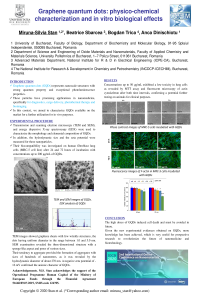
Graphene quantum dots (GQDs) represents nanoscale structures with strong quantum property and exceptional photoluminescence properties. These particles have promising applications in nanomedicine, specifically for diagnostics, cargo delivery, photothermal therapy and bioimaging. In this context, we aimed to characterize GQDs available on the market for a further utilization for in vivo purposes. Transmission and scanning electron microscopy (TEM and SEM), and energy dispersive X-ray spectroscopy (EDX), were used to characterize the morphology and elemental composition of GQDs. In addition, the hydrodynamic size and the zeta potential were measured for these nanoparticles. Their biocompatibility was investigated on human fibroblast lung cells (MRC-5 cell line) after 24 and 72 hours of incubation with concentrations up to 200 μg/mL of GQDs. TEM images showed graphene sheets with few wrinkle structures, the dots having uniform diameter in the range between 1.0 and 5.0 nm. SEM examination revealed the three-dimensional structure with a sponge-like aspect and pores of various sizes. Their tendency to aggregate provided the formation of aggregates with sizes of hundreds of nanometers, as it was revealed by the hydrodynamic diameter of about 270 nm. A negative zeta potential of -16 mV confirmed the anionic character of GQDs. Concentrations up to 50 μg/mL exhibited a low toxicity in lung cells as revealed by MTT assay and fluorescent microscopy of actin cytoskeleton after both time intervals, confirming a potential further testing on animals for clinical purposes. However, the high doses of GQDs induced cell death and must be avoided in future. Given the new experimental evidences obtained on GQDs, more knowledge has been achieved, which is very useful for prospective research to revolutionize the future of nanomedicine and biotechnology.
Acknowledgments M.S. Stan acknowledges the support of the Operational Programme Human Capital of the Ministry of European Funds through the Financial Agreement 51668/09.07.2019, SMIS code 124705.
Keywords
graphene
quantum dots
biocompatibility
Manuscript
sciforum-039218-DONE.pdf
Poster
Poster - MS Stan-graphene.pdf
Green reduction of silver ions to silver nanoparticles using aqueous plant extracts
Antibacterial Activity of Amino Acid-Modified Cationic Dendrimers Loaded with a Mixture of Two Triterpenoid Acids