Event submissions
Published

This submission belongs to the session E. Crystalline Minerals and Biominerals of the event The 2nd International Online Conference on Crystals
Published date
11 Nov, 2020
Citation
Ta Anh Tuan, Elena V. Guseva, Bui Xuan Vuong, Acid-free hydrothermal process for synthesis of bioactive glasses 70SiO₂-(30-x)CaO-xZnO (x=1, 3, 5 mol.%), in Proceedings of The 2nd International Online Conference on Crystals, 10 November–20 November 2020, MDPI: Basel, Switzerland, doi: 10.3390/IOCC_2020-07919
Share
Email
Facebook
Twitter
LinkedIn
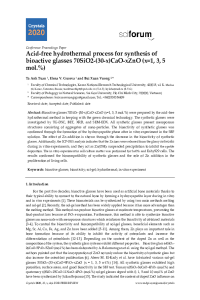
Acid-free hydrothermal process for synthesis of bioactive glasses 70SiO2-(30-x)CaO-xZnO (x=1, 3, 5 mol.%)
'%3e%3cpath%20d='M12.6647%2010.9104C12.4176%2010.325%2012.0589%209.7933%2011.6088%209.34485C11.16%208.89511%2010.6283%208.53653%2010.0432%208.28891C10.038%208.28629%2010.0327%208.28498%2010.0275%208.28236C10.8437%207.69282%2011.3743%206.73252%2011.3743%205.64907C11.3743%203.85423%209.92005%202.40002%208.12522%202.40002C6.33038%202.40002%204.87618%203.85423%204.87618%205.64907C4.87618%206.73252%205.40677%207.69282%206.22296%208.28367C6.21772%208.28629%206.21248%208.2876%206.20724%208.29022C5.62031%208.53783%205.09365%208.89287%204.64167%209.34616C4.19192%209.79496%203.83334%2010.3266%203.58573%2010.9117C3.34247%2011.4846%203.21128%2012.0987%203.19925%2012.721C3.1989%2012.735%203.20135%2012.7489%203.20646%2012.7619C3.21157%2012.7749%203.21924%2012.7868%203.22901%2012.7968C3.23877%2012.8068%203.25045%2012.8148%203.26334%2012.8202C3.27623%2012.8256%203.29007%2012.8284%203.30406%2012.8284H4.09012C4.14776%2012.8284%204.19362%2012.7825%204.19493%2012.7262C4.22113%2011.7148%204.62726%2010.7676%205.34519%2010.0497C6.08802%209.30686%207.07452%208.89811%208.12522%208.89811C9.17592%208.89811%2010.1624%209.30686%2010.9052%2010.0497C11.6232%2010.7676%2012.0293%2011.7148%2012.0555%2012.7262C12.0568%2012.7839%2012.1027%2012.8284%2012.1603%2012.8284H12.9464C12.9604%2012.8284%2012.9742%2012.8256%2012.9871%2012.8202C13%2012.8148%2013.0117%2012.8068%2013.0214%2012.7968C13.0312%2012.7868%2013.0389%2012.7749%2013.044%2012.7619C13.0491%2012.7489%2013.0515%2012.735%2013.0512%2012.721C13.0381%2012.0947%2012.9084%2011.4856%2012.6647%2010.9104ZM8.12522%207.90243C7.52388%207.90243%206.95792%207.66793%206.53214%207.24215C6.10636%206.81636%205.87185%206.2504%205.87185%205.64907C5.87185%205.04773%206.10636%204.48177%206.53214%204.05599C6.95792%203.63021%207.52388%203.3957%208.12522%203.3957C8.72655%203.3957%209.29252%203.63021%209.7183%204.05599C10.1441%204.48177%2010.3786%205.04773%2010.3786%205.64907C10.3786%206.2504%2010.1441%206.81636%209.7183%207.24215C9.29252%207.66793%208.72655%207.90243%208.12522%207.90243Z'%20fill='%235D1EE1'/%3e%3c/g%3e%3c/svg%3e)
Ta Anh Tuan 1
Elena V. Guseva 1
Bui Xuan Vuong 2
1. Kazan National Research Technological University
2. Sai Gon University
Abstract
Bioactive glasses 70SiO2-(30-x)CaO-xZnO (x=1, 3, 5 mol.%) were prepared by the acid-free hydrothermal method in keeping with the green chemical technology. The synthetic glasses were investigated by TG-DSC, BET, XRD, and SEM-EDX. All synthetic glasses present mesoporous structures consisting of aggregates of nano-particles. The bioactivity of synthetic glasses was confirmed through the formation of the hydroxyapatite phase after in vitro experiment in the SBF solution. The effect of Zn addition is shown through the decrease in the bioactivity of synthetic glasses. Additionally, the ICP-OES analysis indicates that the Zn contents were completely released from the glassy networks after 5 days of immersion. The in vitro experiment in cell culture matter was performed for osteoblast cells SaOS2. The results confirmed the biocompatibility of synthetic glasses and the role of Zn addition in the proliferation of living cells.
Keywords
bioactive glasses
bioactivity
sol-gel
hydrothermal
in vitro experiment
Manuscript
sciforum-035054.pdf
Poster
sciforum-035054.pdf
High throughput powder diffraction
Accelerating structure-based design of rapid uncharged reactivators of organophosphate-inhibited human acetylcholinesterase by joint X-ray/neutron mechanistic studies