Event submissions
Published

This submission belongs to the session G. Round Table on Neurodegenerative Disorders of the event 6th International Electronic Conference on Medicinal Chemistry
Published date
11 Nov, 2020
Citation
Pegi Pavletić, Development of a novel class of brain penetrant ligands endowed with high affinity and selectivity for dopamine D4 receptors, in Proceedings of 6th International Electronic Conference on Medicinal Chemistry, 1 November–30 November 2020, MDPI: Basel, Switzerland, doi: 10.3390/ECMC2020-07926
Share
Email
Facebook
Twitter
LinkedIn
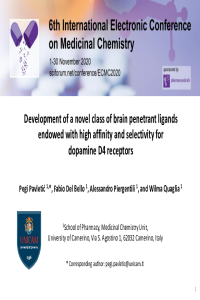
Development of a novel class of brain penetrant ligands endowed with high affinity and selectivity for dopamine D4 receptors

Pegi Pavletić 1
1. University of Camerino, School of Pharmacy
Abstract
Dopamine is a catecholamine neurotransmitter involved in a great variety of physiological functions, through the interaction with five different G-protein-coupled receptors, namely D1-D5 receptors (D1R-D5R). Among dopamine receptors, the D4R subtype has recently emerged as a potential target for the treatment of widespread diseases, such as eating disorders, drug addiction and cancer. For these reasons, it has garnered considerable interest. Classical D4R ligands are characterized by a common pharmacophore, consisting of a lipophilic moiety linked by a spacer to a piperidine or piperazine basic function and an aromatic terminal. It has recently been demonstrated that the known M1 muscarinic bitopic agonist 77-LH-28-1 also behaved as a potent D4R ligand and showed an unexpected D4 selectivity over D2 and D3 subtypes. Interestingly, the structure of 77-LH-28-1 differs from those of other known selective D4R ligands, that are characterized by the presence of a properly substituted aromatic group at position 4 of the piperidine ring. On the contrary, 77-LH-28-1 bears a butyl aliphatic chain. 77-LH-28-1 being the first example of D4R selective ligand with a unique structural feature, an extensive structure-activity relationship study has been undertaken to evaluate the importance of the butyl aliphatic chain for the interaction with D4R. From a preliminary study, potent, selective and brain penetrant D4R antagonists were identified. The promising results prompt us to further investigate the structural requirements of 77-LH-28-1 favoring the selective interaction with the D4R.
Keywords
cancer
D4R
D4 receptors
dopamine
drug addiction
eating disorder
Poster
ECMC_Presentation_Pavletic_Pegi.pdf
Antitumor and osteogenic activity of bisphosphonate-based organic salts and ionic liquids
Induction of mitochondrial-mediated apoptosis by methanol extract of Cajanus cajan