Event submissions
Published

This submission belongs to the session I. Poster of the event The 2nd International Online Conference on Nanomaterials
Published date
11 Nov, 2020
Citation
Helena P. Felgueiras, Natália C. Homem, Ana R. M. Ribeiro, Marta O. Teixeira, Marta A. Teixeira, Joana C. Antunes, M. Teresa P. Amorim, Activity of wet-spun fibers chemically modified with active biomolecules against Gram-positive and Gram-negative bacteria, in Proceedings of The 2nd International Online Conference on Nanomaterials, 15 November–30 November 2020, MDPI: Basel, Switzerland, doi: 10.3390/IOCN2020-07935
Share
Email
Facebook
Twitter
LinkedIn
Activity of wet-spun fibers chemically modified with active biomolecules against Gram-positive and Gram-negative bacteria

Helena P. Felgueiras 1

Natália C. Homem 2

Ana R. M. Ribeiro 2
'%3e%3cpath%20d='M12.6647%2010.9104C12.4176%2010.325%2012.0589%209.7933%2011.6088%209.34485C11.16%208.89511%2010.6283%208.53653%2010.0432%208.28891C10.038%208.28629%2010.0327%208.28498%2010.0275%208.28236C10.8437%207.69282%2011.3743%206.73252%2011.3743%205.64907C11.3743%203.85423%209.92005%202.40002%208.12522%202.40002C6.33038%202.40002%204.87618%203.85423%204.87618%205.64907C4.87618%206.73252%205.40677%207.69282%206.22296%208.28367C6.21772%208.28629%206.21248%208.2876%206.20724%208.29022C5.62031%208.53783%205.09365%208.89287%204.64167%209.34616C4.19192%209.79496%203.83334%2010.3266%203.58573%2010.9117C3.34247%2011.4846%203.21128%2012.0987%203.19925%2012.721C3.1989%2012.735%203.20135%2012.7489%203.20646%2012.7619C3.21157%2012.7749%203.21924%2012.7868%203.22901%2012.7968C3.23877%2012.8068%203.25045%2012.8148%203.26334%2012.8202C3.27623%2012.8256%203.29007%2012.8284%203.30406%2012.8284H4.09012C4.14776%2012.8284%204.19362%2012.7825%204.19493%2012.7262C4.22113%2011.7148%204.62726%2010.7676%205.34519%2010.0497C6.08802%209.30686%207.07452%208.89811%208.12522%208.89811C9.17592%208.89811%2010.1624%209.30686%2010.9052%2010.0497C11.6232%2010.7676%2012.0293%2011.7148%2012.0555%2012.7262C12.0568%2012.7839%2012.1027%2012.8284%2012.1603%2012.8284H12.9464C12.9604%2012.8284%2012.9742%2012.8256%2012.9871%2012.8202C13%2012.8148%2013.0117%2012.8068%2013.0214%2012.7968C13.0312%2012.7868%2013.0389%2012.7749%2013.044%2012.7619C13.0491%2012.7489%2013.0515%2012.735%2013.0512%2012.721C13.0381%2012.0947%2012.9084%2011.4856%2012.6647%2010.9104ZM8.12522%207.90243C7.52388%207.90243%206.95792%207.66793%206.53214%207.24215C6.10636%206.81636%205.87185%206.2504%205.87185%205.64907C5.87185%205.04773%206.10636%204.48177%206.53214%204.05599C6.95792%203.63021%207.52388%203.3957%208.12522%203.3957C8.72655%203.3957%209.29252%203.63021%209.7183%204.05599C10.1441%204.48177%2010.3786%205.04773%2010.3786%205.64907C10.3786%206.2504%2010.1441%206.81636%209.7183%207.24215C9.29252%207.66793%208.72655%207.90243%208.12522%207.90243Z'%20fill='%235D1EE1'/%3e%3c/g%3e%3c/svg%3e)
Marta O. Teixeira 2
Marta A. Teixeira 2

Joana C. Antunes 2
M. Teresa P. Amorim 2
1. Centre for Textile Science and Technology, University of Minho, Portugal
2. Centre for Textile Science and Technology, University of Minho
Abstract
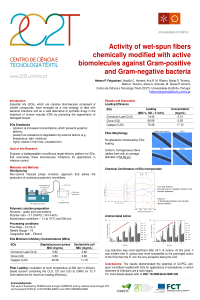
Essential oils (EOs), which are complex biomolecules composed of volatile compounds, have emerged as a new strategy to deal with bacterial infections and as a valid alternative to synthetic drugs. Here, we report the modification of biodegradable wet-spun microfibers composed of cellulose acetate (CA) and polycaprolactone (PCL) with EOs, aiming at their localized, controlled release. Cinnamon leaf oil (CLO), cajeput oil (CJO), and clove oil (CO) were selected from a group of 20 EOs according to their minimal inhibitory concentration (MIC) against Staphylococcus aureus (<22.4 mg/mL) and Escherichia coli (<11.2 mg/mL). CA/PCL prepared at 10% and 14%wt in a 3/1 ratio in acetic acid and acetone were processed in the form of microfibers by wet-spinning at an extrusion rate of 0.5 mL/h directly into an ethanol coagulation bath. Microfibers were modified by immersion in ethanol solutions containing EOs at 2xMIC and ampicillin (control antibiotic). Incorporation was confirmed by UV-VIS, FTIR and TGA. After 72h, fibers contained ampicillin at MIC but only 14%, 66% and 76% of MIC for CLO, CO and CJO, respectively. Unloaded and loaded microfibers were characterized as uniform and homogeneous. Data showed that even at small amounts the EO-modified microfibers were effective against the tested bacteria. Considering the amount immobilized, CLO-containing fibers were deemed the most effective from the group, suggesting a superior affinity of the EOs active groups towards the CA/PCL matrix. These results indicate that CA/PCL microfibers loaded with EOs can be easily produced and applied in scaffolds for biomedical applications.
Keywords
microfibers
biocompatible polymers
essential oils
surface modification
bactericidal effect
localized biomolecule action.
Manuscript
sciforum-038478-done.pdf
Poster
2020.10.05_Nanomaterials Poster.pdf
TGF-β inhibition combined with cytotoxic nanomedicine normalizes the tumor microenvironment and improves immune checkpoint inhibition therapy
Photoresponse study of MWCNTS/insulator/n-type Si/insulator/metal heterostuctures as a function of the density of MWCNTs layer