Event submissions
EventsThe 1st International Electronic Conference on Forests — Forests for a Better Future: Sustainability, Innovation, Interdisciplinarity
Published

This submission belongs to the session S8. Posters of the event The 1st International Electronic Conference on Forests — Forests for a Better Future: Sustainability, Innovation, Interdisciplinarity
Published date
12 Nov, 2020
Citation
Darta Klavina, Lauma Bruna, Astra Zaluma, Natalija Burnevica, Kaspars Polmanis, Talis Gaitnieks, Tuula Piri, Infection and spread of root rot caused by Heterobasidion parviporum in Picea abies stands after thinning: case studies on former pasture and meadow lands, in Proceedings of The 1st International Electronic Conference on Forests — Forests for a Better Future: Sustainability, Innovation, Interdisciplinarity, 15 November–30 November 2020, MDPI: Basel, Switzerland, doi: 10.3390/IECF2020-07950
Share
Email
Facebook
Twitter
LinkedIn
Infection and spread of root rot caused by Heterobasidion parviporum in Picea abies stands after thinning: case studies on former pasture and meadow lands
'%3e%3cpath%20d='M12.6647%2010.9104C12.4176%2010.325%2012.0589%209.7933%2011.6088%209.34485C11.16%208.89511%2010.6283%208.53653%2010.0432%208.28891C10.038%208.28629%2010.0327%208.28498%2010.0275%208.28236C10.8437%207.69282%2011.3743%206.73252%2011.3743%205.64907C11.3743%203.85423%209.92005%202.40002%208.12522%202.40002C6.33038%202.40002%204.87618%203.85423%204.87618%205.64907C4.87618%206.73252%205.40677%207.69282%206.22296%208.28367C6.21772%208.28629%206.21248%208.2876%206.20724%208.29022C5.62031%208.53783%205.09365%208.89287%204.64167%209.34616C4.19192%209.79496%203.83334%2010.3266%203.58573%2010.9117C3.34247%2011.4846%203.21128%2012.0987%203.19925%2012.721C3.1989%2012.735%203.20135%2012.7489%203.20646%2012.7619C3.21157%2012.7749%203.21924%2012.7868%203.22901%2012.7968C3.23877%2012.8068%203.25045%2012.8148%203.26334%2012.8202C3.27623%2012.8256%203.29007%2012.8284%203.30406%2012.8284H4.09012C4.14776%2012.8284%204.19362%2012.7825%204.19493%2012.7262C4.22113%2011.7148%204.62726%2010.7676%205.34519%2010.0497C6.08802%209.30686%207.07452%208.89811%208.12522%208.89811C9.17592%208.89811%2010.1624%209.30686%2010.9052%2010.0497C11.6232%2010.7676%2012.0293%2011.7148%2012.0555%2012.7262C12.0568%2012.7839%2012.1027%2012.8284%2012.1603%2012.8284H12.9464C12.9604%2012.8284%2012.9742%2012.8256%2012.9871%2012.8202C13%2012.8148%2013.0117%2012.8068%2013.0214%2012.7968C13.0312%2012.7868%2013.0389%2012.7749%2013.044%2012.7619C13.0491%2012.7489%2013.0515%2012.735%2013.0512%2012.721C13.0381%2012.0947%2012.9084%2011.4856%2012.6647%2010.9104ZM8.12522%207.90243C7.52388%207.90243%206.95792%207.66793%206.53214%207.24215C6.10636%206.81636%205.87185%206.2504%205.87185%205.64907C5.87185%205.04773%206.10636%204.48177%206.53214%204.05599C6.95792%203.63021%207.52388%203.3957%208.12522%203.3957C8.72655%203.3957%209.29252%203.63021%209.7183%204.05599C10.1441%204.48177%2010.3786%205.04773%2010.3786%205.64907C10.3786%206.2504%2010.1441%206.81636%209.7183%207.24215C9.29252%207.66793%208.72655%207.90243%208.12522%207.90243Z'%20fill='%235D1EE1'/%3e%3c/g%3e%3c/svg%3e)
Darta Klavina 1
Lauma Bruna 1
Astra Zaluma 1

Natalija Burnevica 1
Kaspars Polmanis 1
Talis Gaitnieks 1
Tuula Piri 2
1. Latvian State Forest Research Institute Silava, Rigas 111, Salaspils LV 2169, Latvia
2. Natural Resources Institute Finland (Luke), Management and Production of Renewable Resources Latokartanonkaari 9, FI-00790 Helsinki, Finland
Abstract
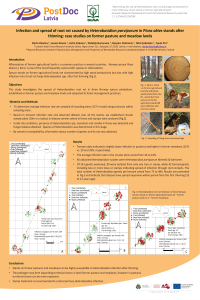
Afforestation of former agricultural lands is well established practice in several countries. It is beneficial to avoid previous-generation forest diseases and expand forest areas. However, several biotic and abiotic risks have been reported for such stands, also higher risk of Heterobasidion root rot after thinning. Therefore, this study investigates the spread patterns of Heterobasidion root rot in three Picea abies (L.) Karst. plantations established on former pasture and meadow lands and subjected to forest management practices. First of all, to get an insight of average infection rate we sampled all standing trees (157 in total) within transect all along sampling area. It showed slightly lower infection in pastures and higher in former meadows (16 % vs. 29 and 33%, respectively). Based on those data and observed dieback all over the stand we established circle sample plots in disease centres where all trees and stumps were analysed and average infection rate there was from 34 to 41%. All obtained Heterobasidion isolates belonged to Heterobasidion parviporum Niemelä & Korhonen. Isolates were paired to detect genotype sizes and infection origin. Of 141 genets examined, 99 were single-tree indicating primary infection and 42 formed territorial clones (160 trees and (or) stumps) indicating spread of infection through root contacts. The following conclusions were reached: ((i) on average, primary infection in such stands is essential but with a stand age secondary infection dominates; (ii) H. parviporum can form large (up to 137 m2) territorial clones in forests on former pasture and meadow lands causing extensive tree dieback and mortality. This study was financially supported by European Regional Development Fund's Post-doctoral Research project No. 1.1.1.2/VIAA/2/18/298 “Determining the risk of Heterobasidion root-rot and fungal communities in roots of Norway spruce stands on former agricultural land”.
Keywords
Norway spruce
Heterobasidion root rot
primary infection
secondary infection
first rotation forest
afforestation.
Manuscript
sciforum-037483-abstract.pdf
Poster
Klavina-et-al-poster.pdf
Models to estimate the bark volume for Larix sp. in Poland
Invertebrate Community of Scots’ pine Coarse Woody Debris in the Southwestern Pyrenees under different thinning intensities and tree species