Event submissions
EventsThe 1st International Electronic Conference on Forests — Forests for a Better Future: Sustainability, Innovation, Interdisciplinarity
Published

This submission belongs to the session S3. Forest and Urban Forest Sustainability of the event The 1st International Electronic Conference on Forests — Forests for a Better Future: Sustainability, Innovation, Interdisciplinarity
Published date
12 Nov, 2020
Citation
Giuseppe Pignatti, Gianni Facciotto, Giampiero Incollu, Sara Maltoni, Mauro Marongiu, Giulio Sperandio, Stefano Verani, Michele Puxeddu, Sustainable forest management in radiata pine plantations: a study case in Sardinia (Italy), in Proceedings of The 1st International Electronic Conference on Forests — Forests for a Better Future: Sustainability, Innovation, Interdisciplinarity, 15 November–30 November 2020, MDPI: Basel, Switzerland, doi: 10.3390/IECF2020-07958
Share
Email
Facebook
Twitter
LinkedIn
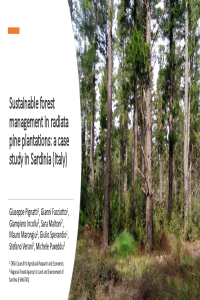
Sustainable forest management in radiata pine plantations: a study case in Sardinia (Italy)
'%3e%3cpath%20d='M12.6647%2010.9104C12.4176%2010.325%2012.0589%209.7933%2011.6088%209.34485C11.16%208.89511%2010.6283%208.53653%2010.0432%208.28891C10.038%208.28629%2010.0327%208.28498%2010.0275%208.28236C10.8437%207.69282%2011.3743%206.73252%2011.3743%205.64907C11.3743%203.85423%209.92005%202.40002%208.12522%202.40002C6.33038%202.40002%204.87618%203.85423%204.87618%205.64907C4.87618%206.73252%205.40677%207.69282%206.22296%208.28367C6.21772%208.28629%206.21248%208.2876%206.20724%208.29022C5.62031%208.53783%205.09365%208.89287%204.64167%209.34616C4.19192%209.79496%203.83334%2010.3266%203.58573%2010.9117C3.34247%2011.4846%203.21128%2012.0987%203.19925%2012.721C3.1989%2012.735%203.20135%2012.7489%203.20646%2012.7619C3.21157%2012.7749%203.21924%2012.7868%203.22901%2012.7968C3.23877%2012.8068%203.25045%2012.8148%203.26334%2012.8202C3.27623%2012.8256%203.29007%2012.8284%203.30406%2012.8284H4.09012C4.14776%2012.8284%204.19362%2012.7825%204.19493%2012.7262C4.22113%2011.7148%204.62726%2010.7676%205.34519%2010.0497C6.08802%209.30686%207.07452%208.89811%208.12522%208.89811C9.17592%208.89811%2010.1624%209.30686%2010.9052%2010.0497C11.6232%2010.7676%2012.0293%2011.7148%2012.0555%2012.7262C12.0568%2012.7839%2012.1027%2012.8284%2012.1603%2012.8284H12.9464C12.9604%2012.8284%2012.9742%2012.8256%2012.9871%2012.8202C13%2012.8148%2013.0117%2012.8068%2013.0214%2012.7968C13.0312%2012.7868%2013.0389%2012.7749%2013.044%2012.7619C13.0491%2012.7489%2013.0515%2012.735%2013.0512%2012.721C13.0381%2012.0947%2012.9084%2011.4856%2012.6647%2010.9104ZM8.12522%207.90243C7.52388%207.90243%206.95792%207.66793%206.53214%207.24215C6.10636%206.81636%205.87185%206.2504%205.87185%205.64907C5.87185%205.04773%206.10636%204.48177%206.53214%204.05599C6.95792%203.63021%207.52388%203.3957%208.12522%203.3957C8.72655%203.3957%209.29252%203.63021%209.7183%204.05599C10.1441%204.48177%2010.3786%205.04773%2010.3786%205.64907C10.3786%206.2504%2010.1441%206.81636%209.7183%207.24215C9.29252%207.66793%208.72655%207.90243%208.12522%207.90243Z'%20fill='%235D1EE1'/%3e%3c/g%3e%3c/svg%3e)
Giuseppe Pignatti 1
Gianni Facciotto 1
Giampiero Incollu 2
Sara Maltoni 2
Mauro Marongiu 2

Giulio Sperandio 3
Stefano Verani 1
Michele Puxeddu 2
1. CREA - Council for Agricultural Research and Economics, Research Centre for Forestry and Wood
2. FORESTAS Agency
3. CREA - Council for Agricultural Research and Economics, Research Centre for Engineering and Agro-Food Processing
Abstract
Pinus radiata Don. (radiata pine) was planted in Italy mainly in Sardinia (11,000 ha), where it grows best on acidic soils, in medium mountain-Mediterranean conditions. Plantations were established about 50 years ago, in heavily grazed areas originally occupied by Mediterranean scrub vegetation, as part of extensive reforestation projects carried out with public funds and intended to deliver cellulose pulp to the paper industry. Since the request from the national paper industry ended, fewer exotic species were used, and plantations were often left without thinning and affected by wildfires.
We report a study case in central-eastern Sardinia (Ogliastra, Idòlo Mountain forest, belonging to the municipality of Arzana) where radiata pine stands, in about 45 years of growth, achieve an average production of 21 m3 ha-1 yr-1. Under these conditions, the regional forestry agency supports active forest management with the aim to produce timber (suitable as carpentry timber, for packaging industry, firewood and wood chips) and to start natural processes of regeneration. In order to regulate stand density, two thinning methods (production and crown thinning) and an expanding gap silvicultural system were compared. Traditional mechanization was used for felling and extraction (chainsaw and tractor with forest winch) as well as a harvester (for delimbing and bucking trees) and woodchipper.
The management of the fast-growing radiata pine, as observed in this study case, allows to achieve multiple benefits that are at the heart of forest sustainability: profitable and sustainable wood production (by activating the local economy linked to work timber, firewood and small packaging industry), biodiversity (restoring native forest species and natural regeneration processes), land degradation mitigation (improvement of soil conditions under continuous cover forest conditions), climate change (sequestration of atmospheric carbon and bioenergy production) and social aspects (local occupation).
Keywords
Pinus radiata
plantations
sustainable forest management
Mediterranean
Sardinia
Manuscript
sciforum-036362.pdf
Poster
presentation.pdf
AGE DISTRIBUTION OF OAK STANDS WITHIN THE LEFT-BANK FOREST-STEPPE, UKRAINE, BROKEN DOWN BY FOREST CATEGORIES
Manipulating mammal herbivory in South Patagonia forests: effects on plant species assemblage, survival and short-term growth response of Nothofagus antarctica seedlings