Event submissions
EventsThe 1st International Electronic Conference on Forests — Forests for a Better Future: Sustainability, Innovation, Interdisciplinarity
Published

This submission belongs to the session S1. Forest Ecology, Management and Restoration of the event The 1st International Electronic Conference on Forests — Forests for a Better Future: Sustainability, Innovation, Interdisciplinarity
Published date
12 Nov, 2020
Citation
Julia G. de Aledo, Frans Bongers, Luis Cayuela, Manuel J. Macía, Connecting Indigenous and Scientific Ecological Knowledge in the Madidi National Park, Bolivia, in Proceedings of The 1st International Electronic Conference on Forests — Forests for a Better Future: Sustainability, Innovation, Interdisciplinarity, 15 November–30 November 2020, MDPI: Basel, Switzerland, doi: 10.3390/IECF2020-07963
Share
Email
Facebook
Twitter
LinkedIn
Connecting Indigenous and Scientific Ecological Knowledge in the Madidi National Park, Bolivia
'%3e%3cpath%20d='M12.6647%2010.9104C12.4176%2010.325%2012.0589%209.7933%2011.6088%209.34485C11.16%208.89511%2010.6283%208.53653%2010.0432%208.28891C10.038%208.28629%2010.0327%208.28498%2010.0275%208.28236C10.8437%207.69282%2011.3743%206.73252%2011.3743%205.64907C11.3743%203.85423%209.92005%202.40002%208.12522%202.40002C6.33038%202.40002%204.87618%203.85423%204.87618%205.64907C4.87618%206.73252%205.40677%207.69282%206.22296%208.28367C6.21772%208.28629%206.21248%208.2876%206.20724%208.29022C5.62031%208.53783%205.09365%208.89287%204.64167%209.34616C4.19192%209.79496%203.83334%2010.3266%203.58573%2010.9117C3.34247%2011.4846%203.21128%2012.0987%203.19925%2012.721C3.1989%2012.735%203.20135%2012.7489%203.20646%2012.7619C3.21157%2012.7749%203.21924%2012.7868%203.22901%2012.7968C3.23877%2012.8068%203.25045%2012.8148%203.26334%2012.8202C3.27623%2012.8256%203.29007%2012.8284%203.30406%2012.8284H4.09012C4.14776%2012.8284%204.19362%2012.7825%204.19493%2012.7262C4.22113%2011.7148%204.62726%2010.7676%205.34519%2010.0497C6.08802%209.30686%207.07452%208.89811%208.12522%208.89811C9.17592%208.89811%2010.1624%209.30686%2010.9052%2010.0497C11.6232%2010.7676%2012.0293%2011.7148%2012.0555%2012.7262C12.0568%2012.7839%2012.1027%2012.8284%2012.1603%2012.8284H12.9464C12.9604%2012.8284%2012.9742%2012.8256%2012.9871%2012.8202C13%2012.8148%2013.0117%2012.8068%2013.0214%2012.7968C13.0312%2012.7868%2013.0389%2012.7749%2013.044%2012.7619C13.0491%2012.7489%2013.0515%2012.735%2013.0512%2012.721C13.0381%2012.0947%2012.9084%2011.4856%2012.6647%2010.9104ZM8.12522%207.90243C7.52388%207.90243%206.95792%207.66793%206.53214%207.24215C6.10636%206.81636%205.87185%206.2504%205.87185%205.64907C5.87185%205.04773%206.10636%204.48177%206.53214%204.05599C6.95792%203.63021%207.52388%203.3957%208.12522%203.3957C8.72655%203.3957%209.29252%203.63021%209.7183%204.05599C10.1441%204.48177%2010.3786%205.04773%2010.3786%205.64907C10.3786%206.2504%2010.1441%206.81636%209.7183%207.24215C9.29252%207.66793%208.72655%207.90243%208.12522%207.90243Z'%20fill='%235D1EE1'/%3e%3c/g%3e%3c/svg%3e)
Julia G. de Aledo 1
Frans Bongers 2
Luis Cayuela 3

Manuel J. Macía 1
1. Universidad Autónoma de Madrid
2. Wageningen University
3. Universidad Rey Juan Carlos
Abstract
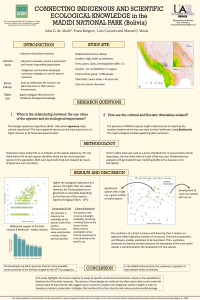
Across the Amazonian basin, indigenous communities are part of the ecosystem functioning. They harbour a deep understanding of their surrounding ecosystem. Ethnobotany is the practice that aims for the preservation of the traditional botanical knowledge, wisdom, and reality. However, the extent to which humans depend on ecosystem services across different population groups and spatial scales prevail poorly understood. The purpose of this study is to understand the role of ecological processes and patterns in determining and responding to human use of plants of the Tacana people in Madidi National Park (Bolivia). Two different theories are tested (1) species availability influences plant use and (2) biodiversity shapes forest use. The data were compiled in a total of 44 plots (0.1 ha) within five different regions distributed among submontane and lowland forests. Results showed that 1) the availability of a resource plays a significant role in the human choice of plant species, 2) the maximal use of a forest is dependent on intermediate levels of plant diversity. Both ecological and ethnobotanical factors are intertwined shaping the human resources’ use. Therefore, the integration of indigenous perception in conservation strategies is crucial as the ecology of the Amazon basin is shaped by the long-lasting effects of its ancient and modern inhabitants.
Keywords
ethnobotany
traditional plant knowledge
forest tropical ecology
biodiversity
cultural conservation
Amazonia
Manuscript
sciforum-036415.pdf
Poster
Poster_JGA_Connecting.pdf
Effect of Competition and Climatic conditions on the growth of beech in the mixed pine beech stand: Lithuanian case study
Carbon stock in forest stands of Ukrainian Eastern Forest-Steppe: forest monitoring data