Event submissions
Published

This submission belongs to the session I. Poster of the event The 2nd International Online Conference on Nanomaterials
Published date
12 Nov, 2020
Citation
Hafiz Abbas, Kamal Sapkota, Md Akherul Islam, Md Abu Hanif, Jeasmin Akter, Jae Hahn, Structural Transformation in Liquid Tellurium from Stillinger-Weber Potential , in Proceedings of The 2nd International Online Conference on Nanomaterials, 15 November–30 November 2020, MDPI: Basel, Switzerland, doi: 10.3390/IOCN2020-07971
Share
Email
Facebook
Twitter
LinkedIn
Structural Transformation in Liquid Tellurium from Stillinger-Weber Potential
'%3e%3cpath%20d='M12.6647%2010.9104C12.4176%2010.325%2012.0589%209.7933%2011.6088%209.34485C11.16%208.89511%2010.6283%208.53653%2010.0432%208.28891C10.038%208.28629%2010.0327%208.28498%2010.0275%208.28236C10.8437%207.69282%2011.3743%206.73252%2011.3743%205.64907C11.3743%203.85423%209.92005%202.40002%208.12522%202.40002C6.33038%202.40002%204.87618%203.85423%204.87618%205.64907C4.87618%206.73252%205.40677%207.69282%206.22296%208.28367C6.21772%208.28629%206.21248%208.2876%206.20724%208.29022C5.62031%208.53783%205.09365%208.89287%204.64167%209.34616C4.19192%209.79496%203.83334%2010.3266%203.58573%2010.9117C3.34247%2011.4846%203.21128%2012.0987%203.19925%2012.721C3.1989%2012.735%203.20135%2012.7489%203.20646%2012.7619C3.21157%2012.7749%203.21924%2012.7868%203.22901%2012.7968C3.23877%2012.8068%203.25045%2012.8148%203.26334%2012.8202C3.27623%2012.8256%203.29007%2012.8284%203.30406%2012.8284H4.09012C4.14776%2012.8284%204.19362%2012.7825%204.19493%2012.7262C4.22113%2011.7148%204.62726%2010.7676%205.34519%2010.0497C6.08802%209.30686%207.07452%208.89811%208.12522%208.89811C9.17592%208.89811%2010.1624%209.30686%2010.9052%2010.0497C11.6232%2010.7676%2012.0293%2011.7148%2012.0555%2012.7262C12.0568%2012.7839%2012.1027%2012.8284%2012.1603%2012.8284H12.9464C12.9604%2012.8284%2012.9742%2012.8256%2012.9871%2012.8202C13%2012.8148%2013.0117%2012.8068%2013.0214%2012.7968C13.0312%2012.7868%2013.0389%2012.7749%2013.044%2012.7619C13.0491%2012.7489%2013.0515%2012.735%2013.0512%2012.721C13.0381%2012.0947%2012.9084%2011.4856%2012.6647%2010.9104ZM8.12522%207.90243C7.52388%207.90243%206.95792%207.66793%206.53214%207.24215C6.10636%206.81636%205.87185%206.2504%205.87185%205.64907C5.87185%205.04773%206.10636%204.48177%206.53214%204.05599C6.95792%203.63021%207.52388%203.3957%208.12522%203.3957C8.72655%203.3957%209.29252%203.63021%209.7183%204.05599C10.1441%204.48177%2010.3786%205.04773%2010.3786%205.64907C10.3786%206.2504%2010.1441%206.81636%209.7183%207.24215C9.29252%207.66793%208.72655%207.90243%208.12522%207.90243Z'%20fill='%235D1EE1'/%3e%3c/g%3e%3c/svg%3e)
Hafiz Abbas 1
Kamal Sapkota 2
Md Akherul Islam 3

Md Abu Hanif 3
Jeasmin Akter 2
Jae Hahn 4
1. Department of Nanoscience and Technology, Research Institute of Physics and Chemistry, Jeonbuk National University, Jeonju 54896, Korea
2. Department of Chemistry, Research Institute of Physics and Chemistry, Jeonbuk National University, Jeonju 54896, Korea
3. Department of Bioactive Material Sciences, Jeonbuk National University, Jeonju 54896, Korea
4. Textile Engineering, Chemistry and Science, North Carolina State University, 2401 Research Dr., Raleigh, NC 27695-8301, USA
Abstract
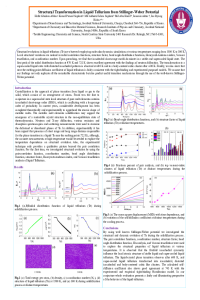
Structural evolutions in liquid tellurium (Te) are observed employing molecular dynamics simulations at various temperatures ranging from 1500 K to 300 K. Local structural variations are noticed in radial correlation functions, structure factor, bond angle distribution functions, Honeycutt-Anderson index, Voronoi tessellation, and coordination number. Upon quenching, we find that icosahedral short-range motifs dominate in a stable and supercooled liquid state. The first peak of the radial distribution function at 970 K and 722 K shows excellent agreement with the findings of neutron diffraction. The transformation to a super-cooled liquid state with distorted icosahedral patterns is observed at 600 K and to a body-centred cubic cluster after 600 K. Finally, we also show that near the melting point diffusion coefficient of liquid tellurium is fairly consistent with the tight-binding and experimental purposed models. We assume that our findings not only replicate all the remarkable characteristic but also predict useful transition mechanisms through the use of the well-known Stillinger-Weber potential.
Keywords
Liquid Tellurium
Stillinger-Weber Potential
molecular dynamics simulations
super-cooled liquid state
Manuscript
abbas_poster.pdf
Poster
abbas_poster.pdf
Cytotoxic Activity of Dendrimer Nanoparticles and Dendrimer Drugs Formulations on Human Neuroblastoma Cells: Our Recent Update
An Efficient Preparation Method of ZnO Nanoparticles toward Enhanced Photocatalytic and Antibacterial Activity