Event submissions
Published

This submission belongs to the session I. Poster of the event The 2nd International Online Conference on Nanomaterials
Published date
12 Nov, 2020
Citation
Md. Abu Hanif, Jeasmin Akter, Md. Akherul Islam, Kamal Sapkota, Hafiz Abbas, Jae Hahn, An Efficient Preparation Method of ZnO Nanoparticles toward Enhanced Photocatalytic and Antibacterial Activity, in Proceedings of The 2nd International Online Conference on Nanomaterials, 15 November–30 November 2020, MDPI: Basel, Switzerland, doi: 10.3390/IOCN2020-07972
Share
Email
Facebook
Twitter
LinkedIn
An Efficient Preparation Method of ZnO Nanoparticles toward Enhanced Photocatalytic and Antibacterial Activity

Md. Abu Hanif 1
'%3e%3cpath%20d='M12.6647%2010.9104C12.4176%2010.325%2012.0589%209.7933%2011.6088%209.34485C11.16%208.89511%2010.6283%208.53653%2010.0432%208.28891C10.038%208.28629%2010.0327%208.28498%2010.0275%208.28236C10.8437%207.69282%2011.3743%206.73252%2011.3743%205.64907C11.3743%203.85423%209.92005%202.40002%208.12522%202.40002C6.33038%202.40002%204.87618%203.85423%204.87618%205.64907C4.87618%206.73252%205.40677%207.69282%206.22296%208.28367C6.21772%208.28629%206.21248%208.2876%206.20724%208.29022C5.62031%208.53783%205.09365%208.89287%204.64167%209.34616C4.19192%209.79496%203.83334%2010.3266%203.58573%2010.9117C3.34247%2011.4846%203.21128%2012.0987%203.19925%2012.721C3.1989%2012.735%203.20135%2012.7489%203.20646%2012.7619C3.21157%2012.7749%203.21924%2012.7868%203.22901%2012.7968C3.23877%2012.8068%203.25045%2012.8148%203.26334%2012.8202C3.27623%2012.8256%203.29007%2012.8284%203.30406%2012.8284H4.09012C4.14776%2012.8284%204.19362%2012.7825%204.19493%2012.7262C4.22113%2011.7148%204.62726%2010.7676%205.34519%2010.0497C6.08802%209.30686%207.07452%208.89811%208.12522%208.89811C9.17592%208.89811%2010.1624%209.30686%2010.9052%2010.0497C11.6232%2010.7676%2012.0293%2011.7148%2012.0555%2012.7262C12.0568%2012.7839%2012.1027%2012.8284%2012.1603%2012.8284H12.9464C12.9604%2012.8284%2012.9742%2012.8256%2012.9871%2012.8202C13%2012.8148%2013.0117%2012.8068%2013.0214%2012.7968C13.0312%2012.7868%2013.0389%2012.7749%2013.044%2012.7619C13.0491%2012.7489%2013.0515%2012.735%2013.0512%2012.721C13.0381%2012.0947%2012.9084%2011.4856%2012.6647%2010.9104ZM8.12522%207.90243C7.52388%207.90243%206.95792%207.66793%206.53214%207.24215C6.10636%206.81636%205.87185%206.2504%205.87185%205.64907C5.87185%205.04773%206.10636%204.48177%206.53214%204.05599C6.95792%203.63021%207.52388%203.3957%208.12522%203.3957C8.72655%203.3957%209.29252%203.63021%209.7183%204.05599C10.1441%204.48177%2010.3786%205.04773%2010.3786%205.64907C10.3786%206.2504%2010.1441%206.81636%209.7183%207.24215C9.29252%207.66793%208.72655%207.90243%208.12522%207.90243Z'%20fill='%235D1EE1'/%3e%3c/g%3e%3c/svg%3e)
Jeasmin Akter 2
Md. Akherul Islam 1
Kamal Sapkota 2
Hafiz Abbas 3
Jae Hahn 4
1. Department of Bioactive Material Sciences, Jeonbuk National University, Jeonju 54896, Korea
2. Department of Chemistry, Jeonbuk National University, Jeonju 54896, Republic of Korea
3. Department of Nanoscience and Technology, Research Institute of Physics and Chemistry, Jeonbuk National University, Jeonju 54896, Korea
4. Textile Engineering, Chemistry and Science, North Carolina State University, 2401 Research Dr., Raleigh, NC 27695-8301, USA
Abstract
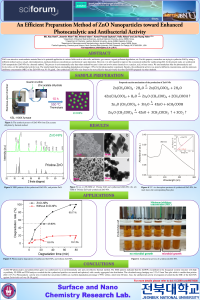
ZnO is an attractive semiconductor material due to its potential application in various fields such as solar cells, antibiotics, gas sensors, organic pollutant degradation, etc. For this purpose, researchers are trying to synthesize ZnO by using a different method such as sol-gel, electrodeposition, mechanochemical, sonochemical, and chemical vapor deposition. However, it is still required to improve the economical method for synthesizing ZnO. In the present study, we synthesized ZnO nanoparticles (ZnO-NPs) by a thermal method. The process is environmentally safer than other methods because it does not involve more chemicals or a catalyst, acid, or base source. We used methylene blue for photocatalytic and Escherichia coli for antibacterial activity tests. The results found that an outstanding degradation percentage (⁓99%) for the photocatalytic experiment. Besides, the antibacterial activity was tested at different concentrations, and the minimum inhibitory concentration (MIC) of the ZnO-NPs was 30⁓50 μg/mL. Our synthesized ZnO-NPs were found to be more effective than previously described ZnO-NPs prepared via other methods.
Keywords
ZnO Nanoparticles
Photocatalytic Activity
Antibacterial Activity
Manuscript
Poster_Md. Abu Hanif_IOCN 2020.pdf
Poster
Poster_Md. Abu Hanif_IOCN 2020.pdf
Structural Transformation in Liquid Tellurium from Stillinger-Weber Potential
A nanocomposite of silver nanoparticles and carbon nanospheres for photocatalytic degradation of methylene blue under UV irradiation