Event submissions
Published

This submission belongs to the session I. Poster of the event The 2nd International Online Conference on Nanomaterials
Published date
12 Nov, 2020
Citation
Madalina Andreea Badea, Mihaela Balas, Florentina Gina Cojocaru, Daniela Ionita, Anca Dinischiotu, Nanoconjugates based on cisplatin and single-walled carbon nanotubes for therapy of triple negative breast cancer, in Proceedings of The 2nd International Online Conference on Nanomaterials, 15 November–30 November 2020, MDPI: Basel, Switzerland, doi: 10.3390/IOCN2020-07989
Share
Email
Facebook
Twitter
LinkedIn
Nanoconjugates based on cisplatin and single-walled carbon nanotubes for therapy of triple negative breast cancer
'%3e%3cpath%20d='M12.6647%2010.9104C12.4176%2010.325%2012.0589%209.7933%2011.6088%209.34485C11.16%208.89511%2010.6283%208.53653%2010.0432%208.28891C10.038%208.28629%2010.0327%208.28498%2010.0275%208.28236C10.8437%207.69282%2011.3743%206.73252%2011.3743%205.64907C11.3743%203.85423%209.92005%202.40002%208.12522%202.40002C6.33038%202.40002%204.87618%203.85423%204.87618%205.64907C4.87618%206.73252%205.40677%207.69282%206.22296%208.28367C6.21772%208.28629%206.21248%208.2876%206.20724%208.29022C5.62031%208.53783%205.09365%208.89287%204.64167%209.34616C4.19192%209.79496%203.83334%2010.3266%203.58573%2010.9117C3.34247%2011.4846%203.21128%2012.0987%203.19925%2012.721C3.1989%2012.735%203.20135%2012.7489%203.20646%2012.7619C3.21157%2012.7749%203.21924%2012.7868%203.22901%2012.7968C3.23877%2012.8068%203.25045%2012.8148%203.26334%2012.8202C3.27623%2012.8256%203.29007%2012.8284%203.30406%2012.8284H4.09012C4.14776%2012.8284%204.19362%2012.7825%204.19493%2012.7262C4.22113%2011.7148%204.62726%2010.7676%205.34519%2010.0497C6.08802%209.30686%207.07452%208.89811%208.12522%208.89811C9.17592%208.89811%2010.1624%209.30686%2010.9052%2010.0497C11.6232%2010.7676%2012.0293%2011.7148%2012.0555%2012.7262C12.0568%2012.7839%2012.1027%2012.8284%2012.1603%2012.8284H12.9464C12.9604%2012.8284%2012.9742%2012.8256%2012.9871%2012.8202C13%2012.8148%2013.0117%2012.8068%2013.0214%2012.7968C13.0312%2012.7868%2013.0389%2012.7749%2013.044%2012.7619C13.0491%2012.7489%2013.0515%2012.735%2013.0512%2012.721C13.0381%2012.0947%2012.9084%2011.4856%2012.6647%2010.9104ZM8.12522%207.90243C7.52388%207.90243%206.95792%207.66793%206.53214%207.24215C6.10636%206.81636%205.87185%206.2504%205.87185%205.64907C5.87185%205.04773%206.10636%204.48177%206.53214%204.05599C6.95792%203.63021%207.52388%203.3957%208.12522%203.3957C8.72655%203.3957%209.29252%203.63021%209.7183%204.05599C10.1441%204.48177%2010.3786%205.04773%2010.3786%205.64907C10.3786%206.2504%2010.1441%206.81636%209.7183%207.24215C9.29252%207.66793%208.72655%207.90243%208.12522%207.90243Z'%20fill='%235D1EE1'/%3e%3c/g%3e%3c/svg%3e)
Madalina Andreea Badea 1

Mihaela Balas 1
Florentina Gina Cojocaru 2

Daniela Ionita 3

Anca Dinischiotu 1
1. University of Bucharest, Faculty of Biology, Department of Biochemistry and Molecular Biology, 91-95 Splaiul Independentei, R-050095, Bucharest, Romania
2. University of Bucharest, Faculty of Biology, Department of Anatomy, Physiology and Biophysics, 91-95 Splaiul Independentei, R-050095, Bucharest, Romania
3. Politehnica University of Bucharest, Faculty of Applied Chemistry and Materials Science, Department of General Chemistry, 313 Splaiul Independentei, 060042, Bucharest, Romania
Abstract
Triple negative breast cancer had a phenotype characterized by the absence of progesterone and estrogen receptors and lack of HER2 overexpression. In order to find new strategies for treatment, single-walled carbon nanotubes (SWCNT) in combination with chemotherapeutics were studied and tested as new therapeutic tools. The objective of this study was to evaluate the efficiency of SWCNT in the transport of cisplatin (CDDP) for improving its cytotoxic effects on MDA-MB-231 cells.
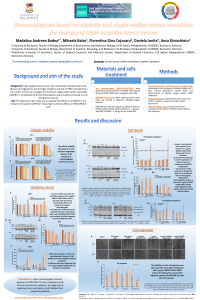
The nanoconjugates SWCNT-COOH-CDDP were obtained by functionalization of SWCNT with carboxyl groups (SWCNT-COOH) and conjugation with CDDP. MDA-MB-231 cells were exposed to different doses of SWCNT-COOH, SWCNT-COOH-CDDP (0.01 – 2 µg/mL) and CDDP (0.00632 – 1.26 µg/mL) for 24 and 48 h. Cellular viability was monitored through MTT test. The level of reactive oxygen species (ROS) and reduced glutathione (GSH) were evaluated using fluorescence and spectrophotometric methods, respectively. The expressions of Nrf2, caspase-3, caspase-8 and Bid proteins were assessed by immunoblotting in the presence of 0.5 and 1 µg/mL nanoconjugates. Also, the effects of SWCNT-COOH-CDDP on cell migration were monitored using Wound healing assay.
The cellular viability decreased, respectively ROS level increased in a time and dose-dependent manner in the presence of nanoconjugates relative to control. Moreover, the level of GSH raised after 24 and 48 h of exposure to 0.5 µg/mL SWCNT-COOH-CDDP, while a decrease until 78.31% was recorded after 48 h in the presence of 1 µg/mL nanoconjugates. The expression of Nrf2 decreased until 33% after 24 h of treatment with 1 µg/mL SWCNT-COOH-CDDP and increased until 80% compared to control (100%) after 48 h. Up-regulation of caspase-3 and caspase-8 and down-regulation of Bid post-exposure to 1 µg/mL SWCNT-COOH-CDDP was noticed. The inhibition of the cell migration was observed after 24 and 48 h of exposure with 1 µg/mL SWCNT-COOH-CDDP. In conclusion, these nanoconjugates induced apoptosis in MDA-MB-231 cells, probably by both intrinsic and extrinsic pathways, by triggering the oxidative stress mechanisms, and inhibited their migration potential.
Keywords
breast cancer
carbon nanotubes
cisplatin
apoptosis
Manuscript
poster_Badea_Madalina_Andreea.pdf
Poster
poster_Badea_Madalina_Andreea.pdf
Mechanistic analyses of polymer/lipid-based gene transfection processes through membrane integrity assay using proton sensing transistor
Characterization of hydrogels for their application in tissue regeneration