Event submissions
Published

This submission belongs to the session I. Poster of the event The 2nd International Online Conference on Nanomaterials
Published date
12 Nov, 2020
Citation
Aleksandra Lach, Kinga Pielichowska, The influence of nanohydroxyapatite on selected properties of polyurethane-based bone scaffold, in Proceedings of The 2nd International Online Conference on Nanomaterials, 15 November–30 November 2020, MDPI: Basel, Switzerland, doi: 10.3390/IOCN2020-07995
Share
Email
Facebook
Twitter
LinkedIn
The influence of nanohydroxyapatite on selected properties of polyurethane-based bone scaffold
'%3e%3cpath%20d='M12.6647%2010.9104C12.4176%2010.325%2012.0589%209.7933%2011.6088%209.34485C11.16%208.89511%2010.6283%208.53653%2010.0432%208.28891C10.038%208.28629%2010.0327%208.28498%2010.0275%208.28236C10.8437%207.69282%2011.3743%206.73252%2011.3743%205.64907C11.3743%203.85423%209.92005%202.40002%208.12522%202.40002C6.33038%202.40002%204.87618%203.85423%204.87618%205.64907C4.87618%206.73252%205.40677%207.69282%206.22296%208.28367C6.21772%208.28629%206.21248%208.2876%206.20724%208.29022C5.62031%208.53783%205.09365%208.89287%204.64167%209.34616C4.19192%209.79496%203.83334%2010.3266%203.58573%2010.9117C3.34247%2011.4846%203.21128%2012.0987%203.19925%2012.721C3.1989%2012.735%203.20135%2012.7489%203.20646%2012.7619C3.21157%2012.7749%203.21924%2012.7868%203.22901%2012.7968C3.23877%2012.8068%203.25045%2012.8148%203.26334%2012.8202C3.27623%2012.8256%203.29007%2012.8284%203.30406%2012.8284H4.09012C4.14776%2012.8284%204.19362%2012.7825%204.19493%2012.7262C4.22113%2011.7148%204.62726%2010.7676%205.34519%2010.0497C6.08802%209.30686%207.07452%208.89811%208.12522%208.89811C9.17592%208.89811%2010.1624%209.30686%2010.9052%2010.0497C11.6232%2010.7676%2012.0293%2011.7148%2012.0555%2012.7262C12.0568%2012.7839%2012.1027%2012.8284%2012.1603%2012.8284H12.9464C12.9604%2012.8284%2012.9742%2012.8256%2012.9871%2012.8202C13%2012.8148%2013.0117%2012.8068%2013.0214%2012.7968C13.0312%2012.7868%2013.0389%2012.7749%2013.044%2012.7619C13.0491%2012.7489%2013.0515%2012.735%2013.0512%2012.721C13.0381%2012.0947%2012.9084%2011.4856%2012.6647%2010.9104ZM8.12522%207.90243C7.52388%207.90243%206.95792%207.66793%206.53214%207.24215C6.10636%206.81636%205.87185%206.2504%205.87185%205.64907C5.87185%205.04773%206.10636%204.48177%206.53214%204.05599C6.95792%203.63021%207.52388%203.3957%208.12522%203.3957C8.72655%203.3957%209.29252%203.63021%209.7183%204.05599C10.1441%204.48177%2010.3786%205.04773%2010.3786%205.64907C10.3786%206.2504%2010.1441%206.81636%209.7183%207.24215C9.29252%207.66793%208.72655%207.90243%208.12522%207.90243Z'%20fill='%235D1EE1'/%3e%3c/g%3e%3c/svg%3e)
Aleksandra Lach 1

Kinga Pielichowska 1
1. AGH University of Science and Technology, Faculty of Materials Science and Ceramics,
Department of Biomaterials and Composites, Al. Mickiewicza 30, 30-059 Krakow, Poland
Abstract
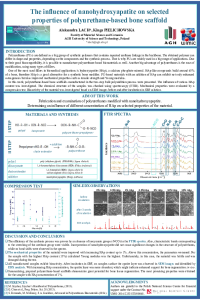
Polyurethanes (PUs) are defined as a big group of synthetic polymers that contain repeated urethane linkage in the backbone. The obtained polymer can differ in shape and properties, depending on the components and the synthesis process. That is why PUs are widely used in a big range of applications. Due to their good biocompatibility, it is possible to manufacture polyurethane-based biomaterials as well. Another big advantage of polyurethanes is the ease of modification, using many types of fillers.
One of the most commonly used fillers in biomedical applications is hydroxyapatite (HAp), a calcium phosphate mineral. HAp-like compounds build around 65% of a bone, therefore HAp is a good alternative for a synthetic bone modifier. PU-based materials with an addition of HAp can exhibit not only enhanced osteogenesis but also improved mechanical properties such as tensile strength and Young modulus.
In this work, polyurethane-based bone scaffolds manufactured in the two-step bulk polyaddition process were presented. The influence of various HAp content was investigated. The chemical structure of the samples was checked using spectroscopy (FTIR). Mechanical properties were evaluated by a compression test. Bioactivity of the material was investigated based on SEM images before and after incubation in SBF solution.
Keywords
nanohydroxyapatite
polyurethane
bone scaffold
Manuscript
Poster_Online Conference on Nanomaterials_Lach.pdf
Poster
Poster_Online Conference on Nanomaterials_Lach.pdf
Synthesis and characterisation of dimeric bolaamphiphilic dehydrodipeptides for biomedical applications.
Dehydropeptide-based self-assembled hydrogels with incorporated Gd3+ chelates: potential Contrast Agents for MRI?