Event submissions
Published

This submission belongs to the session I. Poster of the event The 2nd International Online Conference on Nanomaterials
Published date
12 Nov, 2020
Citation
Teresa Pereira, José Alberto Martins, Paula Margarida Ferreira, Loic Hilliou, Manuel Bañobre-López, Juan Gallo, Dehydropeptide-based self-assembled hydrogels with incorporated Gd³⁺ chelates: potential Contrast Agents for MRI?, in Proceedings of The 2nd International Online Conference on Nanomaterials, 15 November–30 November 2020, MDPI: Basel, Switzerland, doi: 10.3390/IOCN2020-07996
Share
Email
Facebook
Twitter
LinkedIn
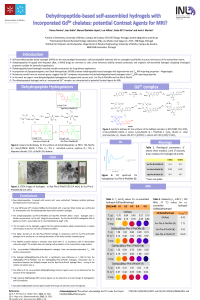
Dehydropeptide-based self-assembled hydrogels with incorporated Gd3+ chelates: potential Contrast Agents for MRI?
'%3e%3cpath%20d='M12.6647%2010.9104C12.4176%2010.325%2012.0589%209.7933%2011.6088%209.34485C11.16%208.89511%2010.6283%208.53653%2010.0432%208.28891C10.038%208.28629%2010.0327%208.28498%2010.0275%208.28236C10.8437%207.69282%2011.3743%206.73252%2011.3743%205.64907C11.3743%203.85423%209.92005%202.40002%208.12522%202.40002C6.33038%202.40002%204.87618%203.85423%204.87618%205.64907C4.87618%206.73252%205.40677%207.69282%206.22296%208.28367C6.21772%208.28629%206.21248%208.2876%206.20724%208.29022C5.62031%208.53783%205.09365%208.89287%204.64167%209.34616C4.19192%209.79496%203.83334%2010.3266%203.58573%2010.9117C3.34247%2011.4846%203.21128%2012.0987%203.19925%2012.721C3.1989%2012.735%203.20135%2012.7489%203.20646%2012.7619C3.21157%2012.7749%203.21924%2012.7868%203.22901%2012.7968C3.23877%2012.8068%203.25045%2012.8148%203.26334%2012.8202C3.27623%2012.8256%203.29007%2012.8284%203.30406%2012.8284H4.09012C4.14776%2012.8284%204.19362%2012.7825%204.19493%2012.7262C4.22113%2011.7148%204.62726%2010.7676%205.34519%2010.0497C6.08802%209.30686%207.07452%208.89811%208.12522%208.89811C9.17592%208.89811%2010.1624%209.30686%2010.9052%2010.0497C11.6232%2010.7676%2012.0293%2011.7148%2012.0555%2012.7262C12.0568%2012.7839%2012.1027%2012.8284%2012.1603%2012.8284H12.9464C12.9604%2012.8284%2012.9742%2012.8256%2012.9871%2012.8202C13%2012.8148%2013.0117%2012.8068%2013.0214%2012.7968C13.0312%2012.7868%2013.0389%2012.7749%2013.044%2012.7619C13.0491%2012.7489%2013.0515%2012.735%2013.0512%2012.721C13.0381%2012.0947%2012.9084%2011.4856%2012.6647%2010.9104ZM8.12522%207.90243C7.52388%207.90243%206.95792%207.66793%206.53214%207.24215C6.10636%206.81636%205.87185%206.2504%205.87185%205.64907C5.87185%205.04773%206.10636%204.48177%206.53214%204.05599C6.95792%203.63021%207.52388%203.3957%208.12522%203.3957C8.72655%203.3957%209.29252%203.63021%209.7183%204.05599C10.1441%204.48177%2010.3786%205.04773%2010.3786%205.64907C10.3786%206.2504%2010.1441%206.81636%209.7183%207.24215C9.29252%207.66793%208.72655%207.90243%208.12522%207.90243Z'%20fill='%235D1EE1'/%3e%3c/g%3e%3c/svg%3e)
Teresa Pereira 1
José Alberto Martins 2
Paula Margarida Ferreira 2
Loic Hilliou 3
Manuel Bañobre-López 4

Juan Gallo 4
1. centro de química da universidade do Minho
2. centro de quimica da universidade do minho
3. departamento de engenharia de polimeros da universidade do Minho
4. Laboratório ibérico internacional de nanotecnologia (INL)
Abstract
Magnetic Resonance Imaging (MRI) is at the forefront of clinical imaging. Paramagnetic relaxers (Gd3+ and Mn2+ chelates, iron oxide nanoparticles) shorten the relaxation times (T1,2) i.e. enhance the relaxation rates (R1,2= 1/T1,2) of the water protons in their vicinity yielding significant contrast enhancements-contrast agents. Supramolecular (self-assembled) hydrogels based on low molecular weight peptides are the new paradigm biomaterials: porous soft biocompatible materials made of highly hydrated fibrous 3D nanostructures, reminiscent of the extracellular matrix. Our research group developed self-assembled hydrogels based on dehydrodipeptides N-capped with naproxen (Npx, a NSAID drug). Dehydropeptide-based hydrogels exhibit resistance to proteolysis, are biocompatible and suitable nanocarriers for delivery of incorporated drugs. Recently, we demonstrated that incorporation of SPION endows dehydropeptide-based hydrogels with magnetic properties (magnetogels): hyperthermia and MRI reporting properties. In this communication we report novel supramolecular hydrogels prepared by co-assembly of dehydropeptides and Gd3+ chelates. The hydrogels are characterised regarding co-assembly (fluorescence, CD spectroscopy) and micro- nano-structure (STEM) and rehologial properties. The co-assembled hydrogels are characterized also as Contrast Agents for MRI by 1H relaxometry (60 MHz, 37ºC) and MRI (120 MHz, 37 ºC).
Keywords
hydrogels
dehydropeptides
supramolecular
gadolinium
self-assembled
MRI.
Manuscript
Abstract_Teresa_Pereira_Nanomaterials.pdf
Poster
POSTER_nanomaterials_TERESA.pdf
The influence of nanohydroxyapatite on selected properties of polyurethane-based bone scaffold
Porcine small intestinal submucosa (SIS) and graphene oxide/reduced graphene oxide scaffolds for potential application in electrostimulation therapy: preliminary formulation and characterization