Event submissions
Published

This submission belongs to the session I. Poster of the event The 2nd International Online Conference on Nanomaterials
Published date
12 Nov, 2020
Citation
Javier Cifuentes, Julian Andres Serna, Carolina Muñoz-Camargo, Juan Carlos Cruz, Porcine small intestinal submucosa (SIS) and graphene oxide/reduced graphene oxide scaffolds for potential application in electrostimulation therapy: preliminary formulation and characterization, in Proceedings of The 2nd International Online Conference on Nanomaterials, 15 November–30 November 2020, MDPI: Basel, Switzerland, doi: 10.3390/IOCN2020-07997
Share
Email
Facebook
Twitter
LinkedIn
Porcine small intestinal submucosa (SIS) and graphene oxide/reduced graphene oxide scaffolds for potential application in electrostimulation therapy: preliminary formulation and characterization

Javier Cifuentes 1
'%3e%3cpath%20d='M12.6647%2010.9104C12.4176%2010.325%2012.0589%209.7933%2011.6088%209.34485C11.16%208.89511%2010.6283%208.53653%2010.0432%208.28891C10.038%208.28629%2010.0327%208.28498%2010.0275%208.28236C10.8437%207.69282%2011.3743%206.73252%2011.3743%205.64907C11.3743%203.85423%209.92005%202.40002%208.12522%202.40002C6.33038%202.40002%204.87618%203.85423%204.87618%205.64907C4.87618%206.73252%205.40677%207.69282%206.22296%208.28367C6.21772%208.28629%206.21248%208.2876%206.20724%208.29022C5.62031%208.53783%205.09365%208.89287%204.64167%209.34616C4.19192%209.79496%203.83334%2010.3266%203.58573%2010.9117C3.34247%2011.4846%203.21128%2012.0987%203.19925%2012.721C3.1989%2012.735%203.20135%2012.7489%203.20646%2012.7619C3.21157%2012.7749%203.21924%2012.7868%203.22901%2012.7968C3.23877%2012.8068%203.25045%2012.8148%203.26334%2012.8202C3.27623%2012.8256%203.29007%2012.8284%203.30406%2012.8284H4.09012C4.14776%2012.8284%204.19362%2012.7825%204.19493%2012.7262C4.22113%2011.7148%204.62726%2010.7676%205.34519%2010.0497C6.08802%209.30686%207.07452%208.89811%208.12522%208.89811C9.17592%208.89811%2010.1624%209.30686%2010.9052%2010.0497C11.6232%2010.7676%2012.0293%2011.7148%2012.0555%2012.7262C12.0568%2012.7839%2012.1027%2012.8284%2012.1603%2012.8284H12.9464C12.9604%2012.8284%2012.9742%2012.8256%2012.9871%2012.8202C13%2012.8148%2013.0117%2012.8068%2013.0214%2012.7968C13.0312%2012.7868%2013.0389%2012.7749%2013.044%2012.7619C13.0491%2012.7489%2013.0515%2012.735%2013.0512%2012.721C13.0381%2012.0947%2012.9084%2011.4856%2012.6647%2010.9104ZM8.12522%207.90243C7.52388%207.90243%206.95792%207.66793%206.53214%207.24215C6.10636%206.81636%205.87185%206.2504%205.87185%205.64907C5.87185%205.04773%206.10636%204.48177%206.53214%204.05599C6.95792%203.63021%207.52388%203.3957%208.12522%203.3957C8.72655%203.3957%209.29252%203.63021%209.7183%204.05599C10.1441%204.48177%2010.3786%205.04773%2010.3786%205.64907C10.3786%206.2504%2010.1441%206.81636%209.7183%207.24215C9.29252%207.66793%208.72655%207.90243%208.12522%207.90243Z'%20fill='%235D1EE1'/%3e%3c/g%3e%3c/svg%3e)
Julian Andres Serna 1
Carolina Muñoz-Camargo 1
Juan Carlos Cruz 1,2
1. Universidad de los Andes
2. The University of Adelaide
Abstract
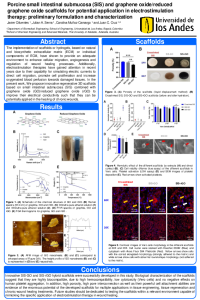
Chronic wounds are a health problem of enormous magnitude that affects millions of patients around the world. The most promising treatments for chronic wounds healing are the therapies related to the development of biomimetic technologies that successfully improve cell migration, growth and proliferation. The implementation of scaffolds or hydrogels, based on natural and biosynthetic extracellular matrix (ECM) or individual components of ECM, have shown to provide an adequate environment to enhance cellular migration, angiogenesis and regulation of wound healing processes. Additionally, electrostimulation therapies have gained attention in recent years due to their capability for simulating electric currents to direct cell migration, promote cell proliferation and increase oxygenated blood perfusion towards damaged tissues. In the present work, we propose innovative regenerative 3D scaffolds based on small intestinal submucosa (SIS) combined with graphene oxide (GO)/reduced graphene oxide (rGO) to improve their electrical conductivity such that they can be potentially applied in the healing of chronic wounds. To achieve this, decellularized SIS was obtained and mixed with GO flakes to make 3D scaffolds that were chemically crosslinked and reduced in-situ. GO and rGO were characterized by thermogravimetric analysis (TGA), Fourier transform infrared spectroscopy (FTIR), Raman spectroscopy, atomic force microscopy (AFM) and the four-point probe conductivity method. These techniques confirmed the effective synthesis of GO, the reduction to rGO and the improvement of electrical conductivity. Crosslinked SIS, SIS-GO and SIS-rGO scaffolds were characterized by FTIR, TGA, SEM, Raman spectroscopy and liquid displacement method. In addition, the biocompatibility of scaffolds was carried out via hemolysis activity, platelet aggregation, and cytotoxicity in Vero cells. Experiments revealed high hemocompatibility, low cytotoxicity and no significant impact on platelet aggregation. Finally, microscopic structure characteristics and cell attachment abilities demonstrated the potential of the developed technology for multiple applications in tissue engineering and regenerative medicine.
Keywords
Graphene oxide
reduced graphene oxide
extracellular matrix
electrostimulation therapy
wound healing
regenerative scaffolds
Manuscript
Poster_Nanomaterials.pdf
Poster
Poster_Nanomaterials.pdf
Dehydropeptide-based self-assembled hydrogels with incorporated Gd3+ chelates: potential Contrast Agents for MRI?
Synthesis and Characterization of graphene-oxide reinforced copper matrix composite