Event submissions
Published

This submission belongs to the session E. Round Table on Natural Products of the event 6th International Electronic Conference on Medicinal Chemistry
Published date
12 Nov, 2020
Citation
Sonia Nuñez, Cristina Moliner, Marta Sofia Valero, Carlota Gomez-Rincón, Víctor López, Antidiabetic and antioxidant properties of Tagetes erecta, in Proceedings of 6th International Electronic Conference on Medicinal Chemistry, 1 November–30 November 2020, MDPI: Basel, Switzerland, doi: 10.3390/ECMC2020-08022
Share
Email
Facebook
Twitter
LinkedIn
Antidiabetic and antioxidant properties of Tagetes erecta

Sonia Nuñez 1
'%3e%3cpath%20d='M12.6647%2010.9104C12.4176%2010.325%2012.0589%209.7933%2011.6088%209.34485C11.16%208.89511%2010.6283%208.53653%2010.0432%208.28891C10.038%208.28629%2010.0327%208.28498%2010.0275%208.28236C10.8437%207.69282%2011.3743%206.73252%2011.3743%205.64907C11.3743%203.85423%209.92005%202.40002%208.12522%202.40002C6.33038%202.40002%204.87618%203.85423%204.87618%205.64907C4.87618%206.73252%205.40677%207.69282%206.22296%208.28367C6.21772%208.28629%206.21248%208.2876%206.20724%208.29022C5.62031%208.53783%205.09365%208.89287%204.64167%209.34616C4.19192%209.79496%203.83334%2010.3266%203.58573%2010.9117C3.34247%2011.4846%203.21128%2012.0987%203.19925%2012.721C3.1989%2012.735%203.20135%2012.7489%203.20646%2012.7619C3.21157%2012.7749%203.21924%2012.7868%203.22901%2012.7968C3.23877%2012.8068%203.25045%2012.8148%203.26334%2012.8202C3.27623%2012.8256%203.29007%2012.8284%203.30406%2012.8284H4.09012C4.14776%2012.8284%204.19362%2012.7825%204.19493%2012.7262C4.22113%2011.7148%204.62726%2010.7676%205.34519%2010.0497C6.08802%209.30686%207.07452%208.89811%208.12522%208.89811C9.17592%208.89811%2010.1624%209.30686%2010.9052%2010.0497C11.6232%2010.7676%2012.0293%2011.7148%2012.0555%2012.7262C12.0568%2012.7839%2012.1027%2012.8284%2012.1603%2012.8284H12.9464C12.9604%2012.8284%2012.9742%2012.8256%2012.9871%2012.8202C13%2012.8148%2013.0117%2012.8068%2013.0214%2012.7968C13.0312%2012.7868%2013.0389%2012.7749%2013.044%2012.7619C13.0491%2012.7489%2013.0515%2012.735%2013.0512%2012.721C13.0381%2012.0947%2012.9084%2011.4856%2012.6647%2010.9104ZM8.12522%207.90243C7.52388%207.90243%206.95792%207.66793%206.53214%207.24215C6.10636%206.81636%205.87185%206.2504%205.87185%205.64907C5.87185%205.04773%206.10636%204.48177%206.53214%204.05599C6.95792%203.63021%207.52388%203.3957%208.12522%203.3957C8.72655%203.3957%209.29252%203.63021%209.7183%204.05599C10.1441%204.48177%2010.3786%205.04773%2010.3786%205.64907C10.3786%206.2504%2010.1441%206.81636%209.7183%207.24215C9.29252%207.66793%208.72655%207.90243%208.12522%207.90243Z'%20fill='%235D1EE1'/%3e%3c/g%3e%3c/svg%3e)
Cristina Moliner 1

Marta Sofia Valero 2,3
Carlota Gomez-Rincón 1,3

Víctor López 1,3
1. Department of Pharmacy, Health Sciences Faculty, Universidad San Jorge, Villanueva de Gállego, Zaragoza
2. Department of Pharmacology and Physiology, Universidad de Zaragoza
3. Instituto Agroalimentario de Aragón, IA2, Universidad de Zaragoza-CITA
Abstract
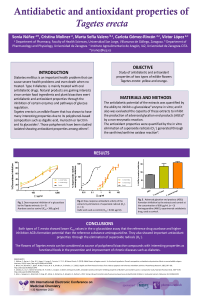
Diabetes mellitus is an important health problem in our society that can cause severe complications or even death when untreated. Type II diabetes (T2D) is mainly treated with oral antidiabetic drugs.
α-glucosidase is an intestinal enzyme secreted to degrade and assimilate the carbohydrates ingested, thus drugs that inhibit this enzyme can help controlling blood glucose levels. Oxidative stress has also proved to play a key role in the development of T2D, being xanthine oxidase a major source of ROS in this condition. Advanced glycation end products (AGEs) are very unstable reactive compounds that contribute to endothelial and vascular complications in T2D.
It has been shown that edible flowers own interesting properties that could make them suitable for developing new drugs. Tagetes erecta has shown to have many interesting properties due to its polyphenol-based composition.
The antidiabetic potential of the extracts was quantified by in vitro inhibition of α-glucosidase; the capacity of these extracts to inhibit AGEs formation by a non-enzymatic reaction was also evaluated. The antioxidant properties were quantified by in vitro elimination of superoxide radicals generated through the xanthine/xanthine oxidase reaction. Both types of T. erecta showed lower IC50 values in the α-glucosidase assay than the reference drug acarbose and higher inhibition AGEs formation potential than the reference substance aminoguanidine, they also obtained important values of antiradical activity.
The flowers of Tagetes erecta can be considered as source of polyphenol bioactive compounds with interesting properties as functional foods in the prevention and improvement of chronic diseases such as diabetes.
Keywords
AGEs
antidiabetic
antioxidant
diabetes mellitus
edible flowers
Tagetes erecta
Poster
Antidiabetic and antioxidant properties of Tagetes erecta.pdf
Advanced preclinical studies in canine leishmaniasis drug development
Blood pressure lowering and antidyslipidemic and nitric oxide modulatory effects of methanol extract of Struchium sparganophora leaves on dexamethasone-salt model of hypertension in rats