Event submissions
EventsThe 1st International Electronic Conference on Forests — Forests for a Better Future: Sustainability, Innovation, Interdisciplinarity
Published

This submission belongs to the session S8. Posters of the event The 1st International Electronic Conference on Forests — Forests for a Better Future: Sustainability, Innovation, Interdisciplinarity
Published date
13 Nov, 2020
Citation
Timothy Thrippleton, Clemens Blattert, Reinhard Mey, Jürgen Zell, Esther Thürig, Janine Schweier, A decision support system for sustainable forest management and ecosystem service provisioning at the enterprise scale, in Proceedings of The 1st International Electronic Conference on Forests — Forests for a Better Future: Sustainability, Innovation, Interdisciplinarity, 15 November–30 November 2020, MDPI: Basel, Switzerland, doi: 10.3390/IECF2020-08051
Share
Email
Facebook
Twitter
LinkedIn
A decision support system for sustainable forest management and ecosystem service provisioning at the enterprise scale
'%3e%3cpath%20d='M12.6647%2010.9104C12.4176%2010.325%2012.0589%209.7933%2011.6088%209.34485C11.16%208.89511%2010.6283%208.53653%2010.0432%208.28891C10.038%208.28629%2010.0327%208.28498%2010.0275%208.28236C10.8437%207.69282%2011.3743%206.73252%2011.3743%205.64907C11.3743%203.85423%209.92005%202.40002%208.12522%202.40002C6.33038%202.40002%204.87618%203.85423%204.87618%205.64907C4.87618%206.73252%205.40677%207.69282%206.22296%208.28367C6.21772%208.28629%206.21248%208.2876%206.20724%208.29022C5.62031%208.53783%205.09365%208.89287%204.64167%209.34616C4.19192%209.79496%203.83334%2010.3266%203.58573%2010.9117C3.34247%2011.4846%203.21128%2012.0987%203.19925%2012.721C3.1989%2012.735%203.20135%2012.7489%203.20646%2012.7619C3.21157%2012.7749%203.21924%2012.7868%203.22901%2012.7968C3.23877%2012.8068%203.25045%2012.8148%203.26334%2012.8202C3.27623%2012.8256%203.29007%2012.8284%203.30406%2012.8284H4.09012C4.14776%2012.8284%204.19362%2012.7825%204.19493%2012.7262C4.22113%2011.7148%204.62726%2010.7676%205.34519%2010.0497C6.08802%209.30686%207.07452%208.89811%208.12522%208.89811C9.17592%208.89811%2010.1624%209.30686%2010.9052%2010.0497C11.6232%2010.7676%2012.0293%2011.7148%2012.0555%2012.7262C12.0568%2012.7839%2012.1027%2012.8284%2012.1603%2012.8284H12.9464C12.9604%2012.8284%2012.9742%2012.8256%2012.9871%2012.8202C13%2012.8148%2013.0117%2012.8068%2013.0214%2012.7968C13.0312%2012.7868%2013.0389%2012.7749%2013.044%2012.7619C13.0491%2012.7489%2013.0515%2012.735%2013.0512%2012.721C13.0381%2012.0947%2012.9084%2011.4856%2012.6647%2010.9104ZM8.12522%207.90243C7.52388%207.90243%206.95792%207.66793%206.53214%207.24215C6.10636%206.81636%205.87185%206.2504%205.87185%205.64907C5.87185%205.04773%206.10636%204.48177%206.53214%204.05599C6.95792%203.63021%207.52388%203.3957%208.12522%203.3957C8.72655%203.3957%209.29252%203.63021%209.7183%204.05599C10.1441%204.48177%2010.3786%205.04773%2010.3786%205.64907C10.3786%206.2504%2010.1441%206.81636%209.7183%207.24215C9.29252%207.66793%208.72655%207.90243%208.12522%207.90243Z'%20fill='%235D1EE1'/%3e%3c/g%3e%3c/svg%3e)
Timothy Thrippleton 1
Clemens Blattert 2
Reinhard Mey 3
Jürgen Zell 3
Esther Thürig 3

Janine Schweier 1
1. Sustainable Forestry, Forest Resources and Management, WSL Birmensdorf, Switzerland
2. Natural Resources and Environment, Department of Biological and Environmental Science, University of Jyväskylä, Finnland
3. Resource Analysis, Forest Resources and Management, WSL Birmensdorf, Switzerland
Abstract
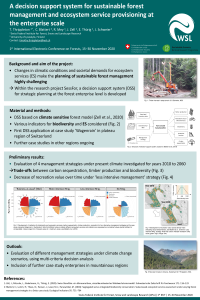
Forest management is becoming increasingly complex due to increasing demands in ecosystem service provisioning and future climate change impacts. For a sustainable forest management, scientifically well-founded decision support is therefore urgently required. Within the project SessFor, a decision support system for strategic planning at the forest enterprise level is being developed, based on the climate sensitive forest model SwissStandSim and initialized from forest inventory data. The system is currently applied to the forest enterprise Wagenrain (440 ha), located in the Swiss Plateau region. Indicators for biodiversity and ecosystem service provisioning (timber production, recreation value and carbon sequestration) are calculated for different management strategies and evaluated using a multi-criteria decision analysis. Preliminary results demonstrate the suitability of the system to evaluate ecosystem service provisioning under different management strategies and to identify the best management strategy, based on criteria defined by the forest manager. Furthermore, results show how the system can be used to assess developments for time-scales of 50-100 years under different climate change scenarios. In the ongoing project, the system will be applied to other case study regions, including mountain forests, which are of key importance in Switzerland and other alpine areas.
Keywords
sustainable forest management
decision support system
forest development
biodiversity conservation
ecosystem service provisioning
multi-criteria decision analysis
climate change
Manuscript
sciforum-035986 ms layout.pdf
Poster
IECF2020_Poster_Thrippleton.pdf
MODELING SPATIAL VARIATIONS OF THE INVASIBILIITY OF SLASH PINE FLATWOODS TO CHINESE TALLOW (Triadica sebifera) INVASION: MECHANISMS AND KEY FACTORS AT THE MICROSCALE
Growth and silvicultural potentiality of Lomatia hirsuta forests from stump shoots in the valley of El Manso/ Patagonia/ Argentina