Event submissions
EventsThe 1st International Electronic Conference on Forests — Forests for a Better Future: Sustainability, Innovation, Interdisciplinarity
Published

This submission belongs to the session S1. Forest Ecology, Management and Restoration of the event The 1st International Electronic Conference on Forests — Forests for a Better Future: Sustainability, Innovation, Interdisciplinarity
Published date
13 Nov, 2020
Citation
Henti Hendalastuti Rachmat, Kirsfianti Linda Ginoga, Yunita Lisnawati, Asep Hidayat, Rizki Ary Fambayun, Kusumadewi Sri Yulita, Arida Susilowati, What can native trees provide in re-vegetating tropical degraded land? An experience of man-made Dipterocarp forest in Indonesia, in Proceedings of The 1st International Electronic Conference on Forests — Forests for a Better Future: Sustainability, Innovation, Interdisciplinarity, 15 November–30 November 2020, MDPI: Basel, Switzerland, doi: 10.3390/IECF2020-08069
Share
Email
Facebook
Twitter
LinkedIn
What can native trees provide in re-vegetating tropical degraded land? An experience of man-made Dipterocarp forest in Indonesia

Henti Hendalastuti Rachmat 1
'%3e%3cpath%20d='M12.6647%2010.9104C12.4176%2010.325%2012.0589%209.7933%2011.6088%209.34485C11.16%208.89511%2010.6283%208.53653%2010.0432%208.28891C10.038%208.28629%2010.0327%208.28498%2010.0275%208.28236C10.8437%207.69282%2011.3743%206.73252%2011.3743%205.64907C11.3743%203.85423%209.92005%202.40002%208.12522%202.40002C6.33038%202.40002%204.87618%203.85423%204.87618%205.64907C4.87618%206.73252%205.40677%207.69282%206.22296%208.28367C6.21772%208.28629%206.21248%208.2876%206.20724%208.29022C5.62031%208.53783%205.09365%208.89287%204.64167%209.34616C4.19192%209.79496%203.83334%2010.3266%203.58573%2010.9117C3.34247%2011.4846%203.21128%2012.0987%203.19925%2012.721C3.1989%2012.735%203.20135%2012.7489%203.20646%2012.7619C3.21157%2012.7749%203.21924%2012.7868%203.22901%2012.7968C3.23877%2012.8068%203.25045%2012.8148%203.26334%2012.8202C3.27623%2012.8256%203.29007%2012.8284%203.30406%2012.8284H4.09012C4.14776%2012.8284%204.19362%2012.7825%204.19493%2012.7262C4.22113%2011.7148%204.62726%2010.7676%205.34519%2010.0497C6.08802%209.30686%207.07452%208.89811%208.12522%208.89811C9.17592%208.89811%2010.1624%209.30686%2010.9052%2010.0497C11.6232%2010.7676%2012.0293%2011.7148%2012.0555%2012.7262C12.0568%2012.7839%2012.1027%2012.8284%2012.1603%2012.8284H12.9464C12.9604%2012.8284%2012.9742%2012.8256%2012.9871%2012.8202C13%2012.8148%2013.0117%2012.8068%2013.0214%2012.7968C13.0312%2012.7868%2013.0389%2012.7749%2013.044%2012.7619C13.0491%2012.7489%2013.0515%2012.735%2013.0512%2012.721C13.0381%2012.0947%2012.9084%2011.4856%2012.6647%2010.9104ZM8.12522%207.90243C7.52388%207.90243%206.95792%207.66793%206.53214%207.24215C6.10636%206.81636%205.87185%206.2504%205.87185%205.64907C5.87185%205.04773%206.10636%204.48177%206.53214%204.05599C6.95792%203.63021%207.52388%203.3957%208.12522%203.3957C8.72655%203.3957%209.29252%203.63021%209.7183%204.05599C10.1441%204.48177%2010.3786%205.04773%2010.3786%205.64907C10.3786%206.2504%2010.1441%206.81636%209.7183%207.24215C9.29252%207.66793%208.72655%207.90243%208.12522%207.90243Z'%20fill='%235D1EE1'/%3e%3c/g%3e%3c/svg%3e)
Kirsfianti Linda Ginoga 1

Yunita Lisnawati 1

Asep Hidayat 1
Rizki Ary Fambayun 1
Kusumadewi Sri Yulita 2
Arida Susilowati 3
1. Forest Research and Development Center – Indonesia Ministry of Environment and Forestry
2. Research Centre for Biology, Indonesian Institute of Sciences
3. Departement of Silviculture, Faculty of Forestry – Universitas Sumatera Utara, Indonesia
Abstract
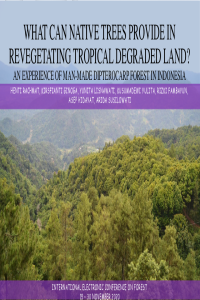
Revegetation is a major activity undertaken to restore degraded landscapes. The environmental benefits of revegetation include ecosystem services provided by the successful planted vegetations. This paper described a successful initiative on revegetation of tropical degraded land using several native trees. More than 300 hectares of intact landscape in Gunung Dahu, West Java - Indonesia have been successfully revegetated using 32 Dipterocarp species. The success of this 20-years-old revegetated landscape was revealed by timber volume, natural regeneration, soil characteristics, ectomycorrhiza fruiting body’s occurrence, and ecotourism potential. The results showed that the average diameter and height were varied from 12 cm to 43 cm and 10 m to 23 m; diameter mean annual increment were at 0.6 cm/year to 2.1 cm/year; standing stock per hectares were at 10 m3/ha - 215 m3/ha. The major causes of the variations might due to the differences of planted species, spacing distance and planting technique. The natural regeneration success was observed by the offspring’s occurrence from six Shorea species and supported by mycorrhiza fruiting bodies predominantly by the genus Rusula. Planted trees also improved the availability of organic materials to the soils as described by good total soil porosity (51,06%-52,32%) and infiltration rate 120-155,33 mm/hr at the site. The landscape also provided springs with continuous water supply and allowed tourists to experience the serenity of the tropical forest. Hence, revegetation using native tree is prospective and proven to deliver wider benefit in ecological, economic, and social aspect.
Keywords
dipterocarp
ectomycorrhiza
increment
native species
revegetation
soil characteristics
Manuscript
sciforum-036368 ms layout.pdf
Poster
IECF 2020_Rachmat et al_presentation.pdf
Determination of the Safest Route for Logging Trucks based on Road Types and Conditions
Provisioning Ecosystem Services of Rhododendron rich forests in Western Himalayas