Event submissions
EventsThe 1st International Electronic Conference on Forests — Forests for a Better Future: Sustainability, Innovation, Interdisciplinarity
Published

This submission belongs to the session S8. Posters of the event The 1st International Electronic Conference on Forests — Forests for a Better Future: Sustainability, Innovation, Interdisciplinarity
Published date
13 Nov, 2020
Citation
Tomás Pineda, Eulogio Flores, Andrés Flores, Enrique Buendía, Vidal Guerra, Fabián Islas, Seedling quality from six Pinus species produced in polyethylene bag, in Proceedings of The 1st International Electronic Conference on Forests — Forests for a Better Future: Sustainability, Innovation, Interdisciplinarity, 15 November–30 November 2020, MDPI: Basel, Switzerland, doi: 10.3390/IECF2020-08106
Share
Email
Facebook
Twitter
LinkedIn
Seedling quality from six Pinus species produced in polyethylene bag
'%3e%3cpath%20d='M12.6647%2010.9104C12.4176%2010.325%2012.0589%209.7933%2011.6088%209.34485C11.16%208.89511%2010.6283%208.53653%2010.0432%208.28891C10.038%208.28629%2010.0327%208.28498%2010.0275%208.28236C10.8437%207.69282%2011.3743%206.73252%2011.3743%205.64907C11.3743%203.85423%209.92005%202.40002%208.12522%202.40002C6.33038%202.40002%204.87618%203.85423%204.87618%205.64907C4.87618%206.73252%205.40677%207.69282%206.22296%208.28367C6.21772%208.28629%206.21248%208.2876%206.20724%208.29022C5.62031%208.53783%205.09365%208.89287%204.64167%209.34616C4.19192%209.79496%203.83334%2010.3266%203.58573%2010.9117C3.34247%2011.4846%203.21128%2012.0987%203.19925%2012.721C3.1989%2012.735%203.20135%2012.7489%203.20646%2012.7619C3.21157%2012.7749%203.21924%2012.7868%203.22901%2012.7968C3.23877%2012.8068%203.25045%2012.8148%203.26334%2012.8202C3.27623%2012.8256%203.29007%2012.8284%203.30406%2012.8284H4.09012C4.14776%2012.8284%204.19362%2012.7825%204.19493%2012.7262C4.22113%2011.7148%204.62726%2010.7676%205.34519%2010.0497C6.08802%209.30686%207.07452%208.89811%208.12522%208.89811C9.17592%208.89811%2010.1624%209.30686%2010.9052%2010.0497C11.6232%2010.7676%2012.0293%2011.7148%2012.0555%2012.7262C12.0568%2012.7839%2012.1027%2012.8284%2012.1603%2012.8284H12.9464C12.9604%2012.8284%2012.9742%2012.8256%2012.9871%2012.8202C13%2012.8148%2013.0117%2012.8068%2013.0214%2012.7968C13.0312%2012.7868%2013.0389%2012.7749%2013.044%2012.7619C13.0491%2012.7489%2013.0515%2012.735%2013.0512%2012.721C13.0381%2012.0947%2012.9084%2011.4856%2012.6647%2010.9104ZM8.12522%207.90243C7.52388%207.90243%206.95792%207.66793%206.53214%207.24215C6.10636%206.81636%205.87185%206.2504%205.87185%205.64907C5.87185%205.04773%206.10636%204.48177%206.53214%204.05599C6.95792%203.63021%207.52388%203.3957%208.12522%203.3957C8.72655%203.3957%209.29252%203.63021%209.7183%204.05599C10.1441%204.48177%2010.3786%205.04773%2010.3786%205.64907C10.3786%206.2504%2010.1441%206.81636%209.7183%207.24215C9.29252%207.66793%208.72655%207.90243%208.12522%207.90243Z'%20fill='%235D1EE1'/%3e%3c/g%3e%3c/svg%3e)
Tomás Pineda 1
Eulogio Flores 2
Andrés Flores 3
Enrique Buendía 1
Vidal Guerra 4
Fabián Islas 2
1. INIFAP-CEVAMEX, Department of Forest Plantations, Highway Los Reyes-Texcoco km 13.5. Coatlinchán, Texcoco, Estado de México, 56250, Mexico
2. INIFAP-CEVAMEX, Department of Forest Management, Highway Los Reyes-Texcoco km 13.5. Coatlinchán, Texcoco, Estado de México, 56250, Mexico
3. INIFAP-CENID-COMEF, Department of Forest Plantations, Progreso 5, Coyoacán 04010, Mexico
4. INIFAP-Sitio Experimental Tlaxcala, Department of Forest Management, Chiautempan 90800, Tlaxcala, Mexico
Abstract
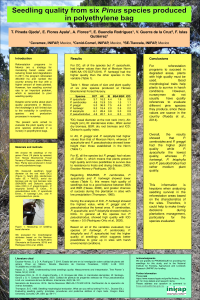
The restorers of degraded areas require high quality plants, with ideal morphological attributes to be able to establish successfully on the plantation sites, even if the site conditions are adverse. In order to know the plant quality of six pine species, that will be used for reforestation and restoration of forest lands in the state of México, we evaluated five morphological attributes based on the Mexican Norm NMX-AA-170-SCFI-2016 and Rodríguez-Ortiz et al. (2020). At the Heroes Bicentennial Forest Nursery of Tecámac, we measured seedling’s basal diameter (at the root neck (DC)), height, from the base to the apical bud (Alt), slenderness index (IE = Alt/DC), aerial dry biomass and dry root biomass ratio (BSA/BSR) and Dickson's quality index (ICD). For DC, the results showed that all species but Pinus ayacahuite, had high quality. In Alt, P. greggii and P. leiophylla had the best quality; while in IE, all the species but P. greggii, showed high quality. For the BSA/BSR ratio, P. cembroides, P. ayacahuite and P. hartwegii were the best, and for ICD, P. hartwegii had the highest quality value. Considering all the morphological indicators together, we determined that P. cembroides and P. greggii had the best plant quality. This information is key to analyze the seedling’s survival in the field and make timely decisions in land restoration management.
Keywords
Morphological attributes in Pinus
increased survival
PROBOSQUE
nursery plant production
reforestation
forest restoration
Manuscript
Seedling quality from six Pinus species produced in polyethylene bag-2.pdf
Poster
Seedling quality from six Pinus species produced in polyethylene bag.pdf
Title: Disturbs to the ground and to the stand in beech forest due to thinning treatment performed by different levels of mechanisation
Mapping Forest Fire Risk in the Mediterranean forests—A Case Study of Provence-Alpes-Côte d'Azur region (France)