Event submissions
Published
 10.3390/foods_2020-08123 (registering DOI)
 This submission belongs to the session 8. Nutraceuticals and Functional Foods of the event 1st International Electronic Conference on Food Science and Functional Foods
Published date
13 Nov, 2020
Citation
Ana Barros, Irene Gouvinhas, Evaluation of phytochemical composition of Portuguese beers for rationale marketable selection, in Proceedings of 1st International Electronic Conference on Food Science and Functional Foods, 10 November–25 November 2020, MDPI: Basel, Switzerland, doi: 10.3390/foods_2020-08123
Share
Email
Facebook
Twitter
LinkedIn
Evaluation of phytochemical composition of Portuguese beers for rationale marketable selection

Ana Barros 1

Irene Gouvinhas 2
1. Mesosystem, Portugal
2. Centre for the Research and Technology of Agro-Environmental and Biological Sciences (CITAB),
University of Trás-os-Montes and Alto Douro (UTAD), 5000-801, Vila Real, Portugal.
Abstract
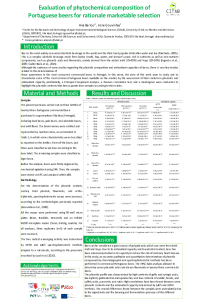
Beer has been highly appreciated due to its phenolic composition and antioxidant capacity conjugated with its low alcohol content. Although the existence of some studies regarding the phenolic composition and antioxidant capacities of beers, there is no studies related to the determination of these parameters in the most consumed commercial beers in Portugal. The phenolic composition and antioxidant capacity of twenty-three Portuguese commercial beers of different styles and types from, was studied for the first time. The total phenolic content, ortho-diphenols, and flavonoids ranged between 0.15 ± 0.01 and 0.82 ± 0.07g GA /L; 0.07 ± 0.02 and 1.80 ± 0.09 g GA/ L, and 0.02 ± 0.00 and 0.15 ± 0.02 g CAT/L, respectively. An accurate quantitative phenolic analysis was also performed, and the compound identified in higher amount was gallic acid, followed by the syringic acid. Concerning flavonoids, gallocatechin was the most abundant compound identified (from 21.44±2.87 and 144.00±10.93 µg/mL). A significant correlation between ortho-diphenols and the antiradical capacity (ABTS and DPPH) was found, being the latter negatively correlated. Flavonoids content was also positively correlated with total phenols and antiradical capacity determined by the ABTS assay. These results evidence that phenolic composition is affected by several factors inherent to beers, namely ingredients, fermentation type, and brewing process.
Acknowledgments
This work was supported by National Funds by FCT - Portuguese Foundation for Science and Technology, under the project UIDB/04033/2020, and FEDER-Interreg España-Portugal programme for financial support through the project 0377_Iberphenol_6_E.
Keywords
Commercial beers
Phenolic composition
HPLC-DAD
Antioxidant capacity
Correlation
Manuscript
sciforum-037058.pdf
Poster
poster AB.pdf
Multivariate analysis for the classification of chocolate according to its percentage of cocoa by using Terahertz Time-domain Spectroscopy (THz-TDS)
New products and consumer's preferences: an eye tracking experiment on labels and packaging for olive oil based dressing