Event submissions
Published

This submission belongs to the session S2. Air Quality of the event The 3rd International Electronic Conference on Atmospheric Sciences
Published date
13 Nov, 2020
Citation
Seth Lyman, Emissions of Reactive Organics from Oil and Gas-Related Combustion Sources, in Proceedings of The 3rd International Electronic Conference on Atmospheric Sciences, 16 November–30 November 2020, MDPI: Basel, Switzerland, doi: 10.3390/ecas2020-08152
Share
Email
Facebook
Twitter
LinkedIn
Emissions of Reactive Organics from Oil and Gas-Related Combustion Sources

Seth Lyman 1
1. Utah State University
Abstract
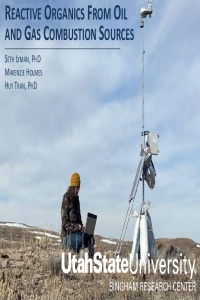
While methane emissions from oil and gas operations have been the focus of many recent studies, less work has been carried out to understand oil and gas-related emissions of non-methane organics. Much of the available information on this topic is decades old, contains few samples, and does not include the full speciation needed to understand the air quality and human health impacts of these important emission sources. We have engaged in several recent projects to better understand the magnitude and speciation of non-methane organic compound emissions from oil and gas sources. This presentation focuses on findings from deployments of 17 portable sample collection stations around Utah’s Uinta Basin. We used these stations to collect hundreds of atmospheric samples in several deployment configurations over two years and analyzed the samples for a suite of 72 volatile organics, including hydrocarbons, alcohols, and carbonyls.
We found that concentrations of reactive organics, including alkenes and aldehydes, were higher in areas dominated by oil development compared to areas dominated by gas development. Ethylene and propylene stood out in particular, with a few samples exhibiting ethylene+propylene concentrations higher than the sum of all alkanes. Overall, alkenes were more than 10% of total organics in oil-dominated areas, compared with just 2% in gas-dominated areas, and aldehydes were significantly higher in oil-dominated areas as well. What is more, light alkenes were responsible for about 40% of the total ozone reactivity of atmospheric organics in the oil-producing Uinta Basin, and carbonyls accounted for 10%.
Most oil wells in the Uinta Basin utilize two-stroke, rich-burning artificial lift engines to bring oil to the surface, while gas wells do not. Combustion processes like those from engines are known to emit alkenes and aldehydes, and rich-burn conditions are associated with incomplete combustion and increased emissions of reactive organics. Recent direct emissions measurements also point to artificial lift engines as the probable source of elevated alkenes and aldehydes in the oil-producing Uinta Basin. These lines of evidence together show that emissions of reactive organics from oilfield engines are likely higher than has previously been assumed.
Keywords
oil and gas
emissions
alkenes
winter ozone
Manuscript
e-conf on air quality.pdf
Poster
e-conf on air quality.pdf
Optical Properties and Direct Radiative Effects of Aerosol Species at Global Scale Based on the Synergistic Use of MERRA-2 Optical Properties and the Forth Radiative Transfer Model
The causal relationship between agricultural practices, climate change and greenhouse gas recovery