Event submissions
Published

This submission belongs to the session S6. Student Session of the event 7th International Electronic Conference on Sensors and Applications
Published date
14 Nov, 2020
Citation
Marco César Prado Soares, Thiago Destri Cabral, Beatriz Ferreira Mendes, Vitor Anastacio da Silva, Elias Basile Tambourgi, Eric Fujiwara, Technical and Economic Viability Analysis of Optical Fiber Sensors for Monitoring Industrial Bioreactors, in Proceedings of 7th International Electronic Conference on Sensors and Applications, 15 November–30 November 2020, MDPI: Basel, Switzerland, doi: 10.3390/ecsa-7-08161
Share
Email
Facebook
Twitter
LinkedIn
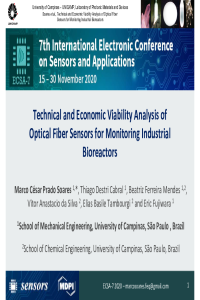
Technical and Economic Viability Analysis of Optical Fiber Sensors for Monitoring Industrial Bioreactors

Marco César Prado Soares 1,2

Thiago Destri Cabral 2
'%3e%3cpath%20d='M12.6647%2010.9104C12.4176%2010.325%2012.0589%209.7933%2011.6088%209.34485C11.16%208.89511%2010.6283%208.53653%2010.0432%208.28891C10.038%208.28629%2010.0327%208.28498%2010.0275%208.28236C10.8437%207.69282%2011.3743%206.73252%2011.3743%205.64907C11.3743%203.85423%209.92005%202.40002%208.12522%202.40002C6.33038%202.40002%204.87618%203.85423%204.87618%205.64907C4.87618%206.73252%205.40677%207.69282%206.22296%208.28367C6.21772%208.28629%206.21248%208.2876%206.20724%208.29022C5.62031%208.53783%205.09365%208.89287%204.64167%209.34616C4.19192%209.79496%203.83334%2010.3266%203.58573%2010.9117C3.34247%2011.4846%203.21128%2012.0987%203.19925%2012.721C3.1989%2012.735%203.20135%2012.7489%203.20646%2012.7619C3.21157%2012.7749%203.21924%2012.7868%203.22901%2012.7968C3.23877%2012.8068%203.25045%2012.8148%203.26334%2012.8202C3.27623%2012.8256%203.29007%2012.8284%203.30406%2012.8284H4.09012C4.14776%2012.8284%204.19362%2012.7825%204.19493%2012.7262C4.22113%2011.7148%204.62726%2010.7676%205.34519%2010.0497C6.08802%209.30686%207.07452%208.89811%208.12522%208.89811C9.17592%208.89811%2010.1624%209.30686%2010.9052%2010.0497C11.6232%2010.7676%2012.0293%2011.7148%2012.0555%2012.7262C12.0568%2012.7839%2012.1027%2012.8284%2012.1603%2012.8284H12.9464C12.9604%2012.8284%2012.9742%2012.8256%2012.9871%2012.8202C13%2012.8148%2013.0117%2012.8068%2013.0214%2012.7968C13.0312%2012.7868%2013.0389%2012.7749%2013.044%2012.7619C13.0491%2012.7489%2013.0515%2012.735%2013.0512%2012.721C13.0381%2012.0947%2012.9084%2011.4856%2012.6647%2010.9104ZM8.12522%207.90243C7.52388%207.90243%206.95792%207.66793%206.53214%207.24215C6.10636%206.81636%205.87185%206.2504%205.87185%205.64907C5.87185%205.04773%206.10636%204.48177%206.53214%204.05599C6.95792%203.63021%207.52388%203.3957%208.12522%203.3957C8.72655%203.3957%209.29252%203.63021%209.7183%204.05599C10.1441%204.48177%2010.3786%205.04773%2010.3786%205.64907C10.3786%206.2504%2010.1441%206.81636%209.7183%207.24215C9.29252%207.66793%208.72655%207.90243%208.12522%207.90243Z'%20fill='%235D1EE1'/%3e%3c/g%3e%3c/svg%3e)
Beatriz Ferreira Mendes 2
Vitor Anastacio da Silva 2
Elias Basile Tambourgi 2
Eric Fujiwara 1,2
1. School of Mechanical Engineering
2. University of Campinas
Abstract
Bioreactors are employed in several industries, such as pharmaceutics, energy, biomedic and food. To ensure the proper operation of these bioreactors, Enzyme-Linked Immunosorbent Assay (ELISA) and High-Performance Liquid Chromatography (HPLC) systems are commonly used. Although ELISA and HPLC provide very precise results, they are incapable of real-time monitoring and present high operational costs. Given this context, in this work we discuss the technical and economic viability of implementing fiber optics based monitoring systems in lieu of traditional ELISA and HPLC systems. We have selected fed-batch ethanol fermentative systems for our analysis, as fermentative system are not only very prevalent in different industries, but ethanol production represents a major sector of the Brazilian economy, with an annual production in excess of 35 billion liters. A simple fiber sensing system for measuring the refractive index of the fermentation broth, capable of real-time monitoring the fermentation process, is proposed and the advantages of real-time process control are discussed. Afterwards, we present the long-term economic gains of implementing such a system. We estimate that, by using readily commercially available components, the typical Brazilian ethanol plant will see a return for their investment in a time as short as 50 days, and a 5-year Internal Rate of Return (IRR) of 742% by setting up a fiber optic monitoring system over HPLC. With the provided list of components, these numbers can be easily adjusted for industries worldwide, providing incredibly attractive economic prospects.
Keywords
optical fiber sensors
bioreactor monitoring
fed-batch fermentation
high-performance liquid chromatography
technical-economic analysis
Manuscript
sciforum_033310-done.pdf
Poster
ECSA-7- Sensor Tech Econom Analysis - MCP Soares.pdf
Intelligent plant disease identification system using Machine Learning
Analysis of preload effect in the axisymmetric damped steel wire using ultrasonic guided wave monitoring