Event submissions
EventsThe 1st International Electronic Conference on Forests — Forests for a Better Future: Sustainability, Innovation, Interdisciplinarity
Published

This submission belongs to the session S8. Posters of the event The 1st International Electronic Conference on Forests — Forests for a Better Future: Sustainability, Innovation, Interdisciplinarity
Published date
14 Nov, 2020
Citation
Włodzimierz Buraczyk, Agata Konecka, Jerzy Sacharczuk, Agnieszka Ledochowicz, Seed production and its quality on Norway spruce (Picea abies (L.) H. Karst) seed orchard originated from the Białowieża Primeval Forest, in Proceedings of The 1st International Electronic Conference on Forests — Forests for a Better Future: Sustainability, Innovation, Interdisciplinarity, 15 November–30 November 2020, MDPI: Basel, Switzerland, doi: 10.3390/IECF2020-08165
Share
Email
Facebook
Twitter
LinkedIn
Seed production and its quality on Norway spruce (Picea abies (L.) H. Karst) seed orchard originated from the Białowieża Primeval Forest
'%3e%3cpath%20d='M12.6647%2010.9104C12.4176%2010.325%2012.0589%209.7933%2011.6088%209.34485C11.16%208.89511%2010.6283%208.53653%2010.0432%208.28891C10.038%208.28629%2010.0327%208.28498%2010.0275%208.28236C10.8437%207.69282%2011.3743%206.73252%2011.3743%205.64907C11.3743%203.85423%209.92005%202.40002%208.12522%202.40002C6.33038%202.40002%204.87618%203.85423%204.87618%205.64907C4.87618%206.73252%205.40677%207.69282%206.22296%208.28367C6.21772%208.28629%206.21248%208.2876%206.20724%208.29022C5.62031%208.53783%205.09365%208.89287%204.64167%209.34616C4.19192%209.79496%203.83334%2010.3266%203.58573%2010.9117C3.34247%2011.4846%203.21128%2012.0987%203.19925%2012.721C3.1989%2012.735%203.20135%2012.7489%203.20646%2012.7619C3.21157%2012.7749%203.21924%2012.7868%203.22901%2012.7968C3.23877%2012.8068%203.25045%2012.8148%203.26334%2012.8202C3.27623%2012.8256%203.29007%2012.8284%203.30406%2012.8284H4.09012C4.14776%2012.8284%204.19362%2012.7825%204.19493%2012.7262C4.22113%2011.7148%204.62726%2010.7676%205.34519%2010.0497C6.08802%209.30686%207.07452%208.89811%208.12522%208.89811C9.17592%208.89811%2010.1624%209.30686%2010.9052%2010.0497C11.6232%2010.7676%2012.0293%2011.7148%2012.0555%2012.7262C12.0568%2012.7839%2012.1027%2012.8284%2012.1603%2012.8284H12.9464C12.9604%2012.8284%2012.9742%2012.8256%2012.9871%2012.8202C13%2012.8148%2013.0117%2012.8068%2013.0214%2012.7968C13.0312%2012.7868%2013.0389%2012.7749%2013.044%2012.7619C13.0491%2012.7489%2013.0515%2012.735%2013.0512%2012.721C13.0381%2012.0947%2012.9084%2011.4856%2012.6647%2010.9104ZM8.12522%207.90243C7.52388%207.90243%206.95792%207.66793%206.53214%207.24215C6.10636%206.81636%205.87185%206.2504%205.87185%205.64907C5.87185%205.04773%206.10636%204.48177%206.53214%204.05599C6.95792%203.63021%207.52388%203.3957%208.12522%203.3957C8.72655%203.3957%209.29252%203.63021%209.7183%204.05599C10.1441%204.48177%2010.3786%205.04773%2010.3786%205.64907C10.3786%206.2504%2010.1441%206.81636%209.7183%207.24215C9.29252%207.66793%208.72655%207.90243%208.12522%207.90243Z'%20fill='%235D1EE1'/%3e%3c/g%3e%3c/svg%3e)
Włodzimierz Buraczyk 1
Agata Konecka 1
Jerzy Sacharczuk 2
Agnieszka Ledochowicz 3
1. Institute of Forest Sciences, Warsaw University of Life Sciences, Poland
2. Bielsk Forest District, The State Forests in Poland
3. -
Abstract
Climate changes, also taking place in Poland, have a very negative impact on populations of many tree species. An example of a highly endangered and, at the same time, very valuable origin is the population of Norway spruce from Białowieża Primeval Forest. One of the protection methods a perishing population is to preserve its genetic pool in the form of seed orchards (ex situ method).
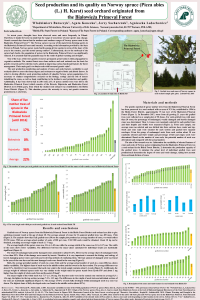
The genetic material of spruce mother trees from the Białowieża Primeval Forest has been preserved in a seed orchard with an area of 9.74 ha, established in 1996 in the Bielsk Forest District (approximately 35 km west of the Białowieża Primeval Forest). In December 2017, cones from all growing grafted trees were collected on a sample plot of 50 clones. An extensive analysis of the health of cones, seed yield from cones, parameters of cones and seeds was carried out, and the relationship between seed quality and position in the cone was determined. The number of cones on the analyzed trees ranged from 29 to 1766, with the average equal to 405 cones per clone. The greatest threat limiting seed production were insects that damaged seeds in cones. No dieback of grafted trees was recorded due to the presence of the spruce bark beetle. No dieback of grafted trees was detected as the effect of activity of European spruce bark beetle. The share of undamaged and poorly damaged cones amounted to about 88%. However, the average share of undamaged seeds is less than 50%.
Our surveys showed that the approximately 25-year-old plantation is able to give satisfying economic result and assure the preservation of the genetic pool of Norway spruce from the population of the Białowieża Forest.
Keywords
Norway spruce
clones
seed orchard
seed production
Manuscript
sciforum-038264 ms layout.pdf
Poster
Seed production and its quality on Norway spruce (Picea abies (L.) H. Karst) seed orchard originated from the Białowieża Primeval Forest_poster_corrected.pdf
Early detection of decline in tree health. Could the pace of stem water be an effective indicator?
The needles and shoots structure variability in Polish populations of Scots pine (Pinus sylvestris L.) at a 50-year provenance plot in Central Poland