Event submissions
EventsThe 1st International Electronic Conference on Forests — Forests for a Better Future: Sustainability, Innovation, Interdisciplinarity
Published

This submission belongs to the session S2. Forest Genetics, Ecophysiology and Biology of the event The 1st International Electronic Conference on Forests — Forests for a Better Future: Sustainability, Innovation, Interdisciplinarity
Published date
14 Nov, 2020
Citation
Meena Choudhary, Uttar kumar Tomar, Seed parameters study in Commiphora wightii (Arnott)– an important medicinal tree of arid and semi-arid regions of India, in Proceedings of The 1st International Electronic Conference on Forests — Forests for a Better Future: Sustainability, Innovation, Interdisciplinarity, 15 November–30 November 2020, MDPI: Basel, Switzerland, doi: 10.3390/IECF2020-08189
Share
Email
Facebook
Twitter
LinkedIn
Seed parameters study in Commiphora wightii (Arnott)– an important medicinal tree of arid and semi-arid regions of India
'%3e%3cpath%20d='M12.6647%2010.9104C12.4176%2010.325%2012.0589%209.7933%2011.6088%209.34485C11.16%208.89511%2010.6283%208.53653%2010.0432%208.28891C10.038%208.28629%2010.0327%208.28498%2010.0275%208.28236C10.8437%207.69282%2011.3743%206.73252%2011.3743%205.64907C11.3743%203.85423%209.92005%202.40002%208.12522%202.40002C6.33038%202.40002%204.87618%203.85423%204.87618%205.64907C4.87618%206.73252%205.40677%207.69282%206.22296%208.28367C6.21772%208.28629%206.21248%208.2876%206.20724%208.29022C5.62031%208.53783%205.09365%208.89287%204.64167%209.34616C4.19192%209.79496%203.83334%2010.3266%203.58573%2010.9117C3.34247%2011.4846%203.21128%2012.0987%203.19925%2012.721C3.1989%2012.735%203.20135%2012.7489%203.20646%2012.7619C3.21157%2012.7749%203.21924%2012.7868%203.22901%2012.7968C3.23877%2012.8068%203.25045%2012.8148%203.26334%2012.8202C3.27623%2012.8256%203.29007%2012.8284%203.30406%2012.8284H4.09012C4.14776%2012.8284%204.19362%2012.7825%204.19493%2012.7262C4.22113%2011.7148%204.62726%2010.7676%205.34519%2010.0497C6.08802%209.30686%207.07452%208.89811%208.12522%208.89811C9.17592%208.89811%2010.1624%209.30686%2010.9052%2010.0497C11.6232%2010.7676%2012.0293%2011.7148%2012.0555%2012.7262C12.0568%2012.7839%2012.1027%2012.8284%2012.1603%2012.8284H12.9464C12.9604%2012.8284%2012.9742%2012.8256%2012.9871%2012.8202C13%2012.8148%2013.0117%2012.8068%2013.0214%2012.7968C13.0312%2012.7868%2013.0389%2012.7749%2013.044%2012.7619C13.0491%2012.7489%2013.0515%2012.735%2013.0512%2012.721C13.0381%2012.0947%2012.9084%2011.4856%2012.6647%2010.9104ZM8.12522%207.90243C7.52388%207.90243%206.95792%207.66793%206.53214%207.24215C6.10636%206.81636%205.87185%206.2504%205.87185%205.64907C5.87185%205.04773%206.10636%204.48177%206.53214%204.05599C6.95792%203.63021%207.52388%203.3957%208.12522%203.3957C8.72655%203.3957%209.29252%203.63021%209.7183%204.05599C10.1441%204.48177%2010.3786%205.04773%2010.3786%205.64907C10.3786%206.2504%2010.1441%206.81636%209.7183%207.24215C9.29252%207.66793%208.72655%207.90243%208.12522%207.90243Z'%20fill='%235D1EE1'/%3e%3c/g%3e%3c/svg%3e)
Meena Choudhary 1
Uttar kumar Tomar 1
1. Genetics and Tree Improvement Division, Arid Forest Research Institute, Jodhpur-342005, Rajasthan, India
Abstract
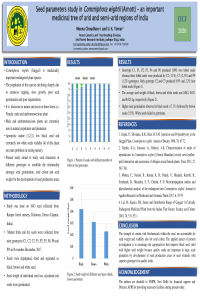
Commiphora wightii (Arnott) is a critically endangered, dioecious plant and commonly known as Guggal. It has tremendous pharmaceutical and medicinal importance. The sex ratio is extremely skewed towards female plants and male plants are extremely rare. Slow growth, poor seed germination and extremely poor regeneration are some of the contributing factors causing decline in its population. The objective of the present work was to study the seed characters in different genotypes to establish the relationship amongst seed germination, seed colour and seed weight. Guggal plants produce seeds throughout the year but seed yield and viability are higher for seeds produced in winter. Total 1643 mature seeds were collected from nine genotypes (C1, C2, C3, P1, P2, P3, P4, P6 and P9) from Deesa (Gujarat, India) in November-December, 2017. The pooled seed weight data showed that seed weight of black seeds (41.89 gm) was higher than that of brown (30.57 gm) and white seeds (23.34 gm). Seed germination was also higher in black seeds (17.2%) than in brown seeds (5.5%) whereas white seeds failed to germinate. A significant positive correlation was also observed between seed germination and seed weight. The study on percentage of different seed lobes for each genotype revealed that four lobed seeds were found only in C2 (8.9%) and C3 (3.2%), whereas three lobed seeds were produced by C2 (1.1%), C3 (2.3%) and P9 (1.2%). Other six genotypes produced 100% two lobed seeds. The above results indicated that the seed colour and seed weight influence the seed viability as well as germination. Superior genotypes can be selected on the basis of the seed quality for establishing seed orchard and plantations as conservation strategy.
Keywords
seed viability
dioecious plant
guggal
genotypes
Manuscript
sciforum-038144.pdf
Poster
GUGGAL POSTER 2.pdf
The needles and shoots structure variability in Polish populations of Scots pine (Pinus sylvestris L.) at a 50-year provenance plot in Central Poland
Accuracy of photo-optical measurement of wood piles