Event submissions
Published

This submission belongs to the session D. Applications of the event 7th International Electronic Conference on Sensors and Applications
Published date
14 Nov, 2020
Citation
Jiri Pribil, Anna Pribilova, Ivan Frollo, Comparative Measurement of the PPG Signal on Different Human Body Positions by Sensors Working in Reflexive and Transmission Modes, in Proceedings of 7th International Electronic Conference on Sensors and Applications, 15 November–30 November 2020, MDPI: Basel, Switzerland, doi: 10.3390/ecsa-7-08204
Share
Email
Facebook
Twitter
LinkedIn
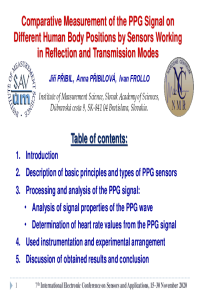
Comparative Measurement of the PPG Signal on Different Human Body Positions by Sensors Working in Reflexive and Transmission Modes

Jiri Pribil 1
'%3e%3cpath%20d='M12.6647%2010.9104C12.4176%2010.325%2012.0589%209.7933%2011.6088%209.34485C11.16%208.89511%2010.6283%208.53653%2010.0432%208.28891C10.038%208.28629%2010.0327%208.28498%2010.0275%208.28236C10.8437%207.69282%2011.3743%206.73252%2011.3743%205.64907C11.3743%203.85423%209.92005%202.40002%208.12522%202.40002C6.33038%202.40002%204.87618%203.85423%204.87618%205.64907C4.87618%206.73252%205.40677%207.69282%206.22296%208.28367C6.21772%208.28629%206.21248%208.2876%206.20724%208.29022C5.62031%208.53783%205.09365%208.89287%204.64167%209.34616C4.19192%209.79496%203.83334%2010.3266%203.58573%2010.9117C3.34247%2011.4846%203.21128%2012.0987%203.19925%2012.721C3.1989%2012.735%203.20135%2012.7489%203.20646%2012.7619C3.21157%2012.7749%203.21924%2012.7868%203.22901%2012.7968C3.23877%2012.8068%203.25045%2012.8148%203.26334%2012.8202C3.27623%2012.8256%203.29007%2012.8284%203.30406%2012.8284H4.09012C4.14776%2012.8284%204.19362%2012.7825%204.19493%2012.7262C4.22113%2011.7148%204.62726%2010.7676%205.34519%2010.0497C6.08802%209.30686%207.07452%208.89811%208.12522%208.89811C9.17592%208.89811%2010.1624%209.30686%2010.9052%2010.0497C11.6232%2010.7676%2012.0293%2011.7148%2012.0555%2012.7262C12.0568%2012.7839%2012.1027%2012.8284%2012.1603%2012.8284H12.9464C12.9604%2012.8284%2012.9742%2012.8256%2012.9871%2012.8202C13%2012.8148%2013.0117%2012.8068%2013.0214%2012.7968C13.0312%2012.7868%2013.0389%2012.7749%2013.044%2012.7619C13.0491%2012.7489%2013.0515%2012.735%2013.0512%2012.721C13.0381%2012.0947%2012.9084%2011.4856%2012.6647%2010.9104ZM8.12522%207.90243C7.52388%207.90243%206.95792%207.66793%206.53214%207.24215C6.10636%206.81636%205.87185%206.2504%205.87185%205.64907C5.87185%205.04773%206.10636%204.48177%206.53214%204.05599C6.95792%203.63021%207.52388%203.3957%208.12522%203.3957C8.72655%203.3957%209.29252%203.63021%209.7183%204.05599C10.1441%204.48177%2010.3786%205.04773%2010.3786%205.64907C10.3786%206.2504%2010.1441%206.81636%209.7183%207.24215C9.29252%207.66793%208.72655%207.90243%208.12522%207.90243Z'%20fill='%235D1EE1'/%3e%3c/g%3e%3c/svg%3e)
Anna Pribilova 1
Ivan Frollo 1
1. Institute of Measurement Science, Slovak Academy of Sciences, Bratislava, Slovak Republic.
Abstract
The paper is focused on the analysis of use of the photoplethysmographic (PPG) optical sensor for non-invasive acquisition of vital information about the cardiovascular system from different parts (finger, ear, wrist, etc.) of the human skin surface. For description and comparison of PPG signal properties the energetic and temporal parameters were determined. The PPG waveform was next used to determine the instantaneous heart rate (HR). Mapping of spectral features and stability of HR values was evaluated by their statistical parameters. In our experiments, two basic types of PPG sensors working in transmission and reflection modes were tested. Two realizations of the transmission-type PPG sensor (finger-ring and ear-clip) were first used in our experiments. Then, the reflection PPG sensor was applied for PPG signal measurement. This type of the PPG sensor is more universal, we test practical placement on fingers (from pinkie to thumb) and on a wrist. In all these experiments, the analog interface connected by a cable to the PC as a storage device was used for PPG signal recording. In the third comparison, we test the reflection PPG sensor integrated in a smart watch device which can display HR values on a smartphone with the running remote application. The final aim was to find conditions, limitations, and general recommendations for development of a wearable PPG sensor with wireless connection enabling measurement in the magnetic field environment with radio-frequency and electromagnetic disturbance. This situation occurs when a tested person is examined in the scanning area of the running magnetic resonance tomograph.
Keywords
photoplethysmographic sensor
transmission and reflection modes
PPG signal analysis and processing.
Manuscript
sciforum_036373_original_ECSA_7_paper_0d3-done.pdf
Poster
ECSA-7_0b.pdf
Electrospray printing of graphene layers for chemiresistive gas sensors
Design of an embedded broadband thermoelectric power sensor in InP DHBT technology