Event submissions
Published

This submission belongs to the session P. Posters of the event 7th International Electronic Conference on Sensors and Applications
Published date
14 Nov, 2020
Citation
Anna Herrera-Chacon, Andreu González-Calabuig, Manel del Valle, Comparative study of two Electronic Tongues for the detection of ethylphenols by MIP-based and chemically modified voltammetric sensors, in Proceedings of 7th International Electronic Conference on Sensors and Applications, 15 November–30 November 2020, MDPI: Basel, Switzerland, doi: 10.3390/ecsa-7-08237
Share
Email
Facebook
Twitter
LinkedIn
Comparative study of two Electronic Tongues for the detection of ethylphenols by MIP-based and chemically modified voltammetric sensors
'%3e%3cpath%20d='M12.6647%2010.9104C12.4176%2010.325%2012.0589%209.7933%2011.6088%209.34485C11.16%208.89511%2010.6283%208.53653%2010.0432%208.28891C10.038%208.28629%2010.0327%208.28498%2010.0275%208.28236C10.8437%207.69282%2011.3743%206.73252%2011.3743%205.64907C11.3743%203.85423%209.92005%202.40002%208.12522%202.40002C6.33038%202.40002%204.87618%203.85423%204.87618%205.64907C4.87618%206.73252%205.40677%207.69282%206.22296%208.28367C6.21772%208.28629%206.21248%208.2876%206.20724%208.29022C5.62031%208.53783%205.09365%208.89287%204.64167%209.34616C4.19192%209.79496%203.83334%2010.3266%203.58573%2010.9117C3.34247%2011.4846%203.21128%2012.0987%203.19925%2012.721C3.1989%2012.735%203.20135%2012.7489%203.20646%2012.7619C3.21157%2012.7749%203.21924%2012.7868%203.22901%2012.7968C3.23877%2012.8068%203.25045%2012.8148%203.26334%2012.8202C3.27623%2012.8256%203.29007%2012.8284%203.30406%2012.8284H4.09012C4.14776%2012.8284%204.19362%2012.7825%204.19493%2012.7262C4.22113%2011.7148%204.62726%2010.7676%205.34519%2010.0497C6.08802%209.30686%207.07452%208.89811%208.12522%208.89811C9.17592%208.89811%2010.1624%209.30686%2010.9052%2010.0497C11.6232%2010.7676%2012.0293%2011.7148%2012.0555%2012.7262C12.0568%2012.7839%2012.1027%2012.8284%2012.1603%2012.8284H12.9464C12.9604%2012.8284%2012.9742%2012.8256%2012.9871%2012.8202C13%2012.8148%2013.0117%2012.8068%2013.0214%2012.7968C13.0312%2012.7868%2013.0389%2012.7749%2013.044%2012.7619C13.0491%2012.7489%2013.0515%2012.735%2013.0512%2012.721C13.0381%2012.0947%2012.9084%2011.4856%2012.6647%2010.9104ZM8.12522%207.90243C7.52388%207.90243%206.95792%207.66793%206.53214%207.24215C6.10636%206.81636%205.87185%206.2504%205.87185%205.64907C5.87185%205.04773%206.10636%204.48177%206.53214%204.05599C6.95792%203.63021%207.52388%203.3957%208.12522%203.3957C8.72655%203.3957%209.29252%203.63021%209.7183%204.05599C10.1441%204.48177%2010.3786%205.04773%2010.3786%205.64907C10.3786%206.2504%2010.1441%206.81636%209.7183%207.24215C9.29252%207.66793%208.72655%207.90243%208.12522%207.90243Z'%20fill='%235D1EE1'/%3e%3c/g%3e%3c/svg%3e)
Anna Herrera-Chacon 1
Andreu González-Calabuig 1

Manel del Valle 1
1. Sensors and Biosensors Group, Chemistry Department, Universitat Autònoma de Barcelona, 08193 Bellaterra, Barcelona, Spain
Abstract
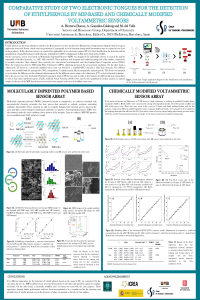
This work reports the comparison of two different Electronic Tongues (ETs) approaches for the detection and quantification of the main chemicals responsible of Brett character in wines, namely 4-Ethylphenol (4-EP), 4-Ethylguaiacol (4-EG) and 4-Ethylcatechol (4-EC).
On the one hand, a sensor array based on Molecularly Imprinted Polymers (MIPs) was designed to be individually selective to each of the analytes which give the Brett character, i.e., 4-EP, 4-EG and 4-EC. These polymers were designed and synthesised using each of the analytes, respectively, as template molecules. Once obtained, these materials were characterised and integrated onto the Graphite Epoxy Composites sensors (GECs). Then, the readout was done by Differential Pulse Voltammetry (DPV), optimizing previously the measurement conditions. On the other hand, the voltammetric ET based on a chemically modified sensor array, was formed by 5 modified-GECs and 1 GEC, as bare electrode. The different sensors were modified with Cu nanoparticles, WO3 nanoparticles, Co phtalocyanine, Bi2O3 nanoparticles and polypyrrole. This choice was intended as to maximize the differences in the obtained voltammograms for the different sensors using cyclic voltammetry (CV) as electrochemical technique.
Once the sensor arrays were developed Principal Component Analysis (PCAs) were done in order to discriminate the phenols among other interferent species. Finally, Artificial Neural Networks (ANNs) were used for the quantification of these analytes in aqueous samples in the case of the MIPs-based sensor array and in wine samples in the case of modified sensor array.
Keywords
Molecularly Imprinted Polymers
Brett Character
Artificial Neural Networks
Electronic Tongues
Wine
Manuscript
sciforum_036677 - final.pdf
Poster
poster_ecsa7_v8_final.pdf
Nonlinear Filter for a System with Randomly Delayed Measurements and Inputs
Modelling the Influence of the Electromagnetic Field on the User of Wearable Internet of Things (IoT) Device for Monitoring Hazards in the Work Environment