Event submissions
Published

This submission belongs to the session P. Posters of the event 7th International Electronic Conference on Sensors and Applications
Published date
14 Nov, 2020
Citation
Munmi Sarma, Noelia Romero, Xavier Cetó, Manel del Valle, Use of clusterization metrics for optimization of sensors to be used in a voltammetric electronic tongue, in Proceedings of 7th International Electronic Conference on Sensors and Applications, 15 November–30 November 2020, MDPI: Basel, Switzerland, doi: 10.3390/ecsa-7-08241
Share
Email
Facebook
Twitter
LinkedIn
Use of clusterization metrics for optimization of sensors to be used in a voltammetric electronic tongue
'%3e%3cpath%20d='M12.6647%2010.9104C12.4176%2010.325%2012.0589%209.7933%2011.6088%209.34485C11.16%208.89511%2010.6283%208.53653%2010.0432%208.28891C10.038%208.28629%2010.0327%208.28498%2010.0275%208.28236C10.8437%207.69282%2011.3743%206.73252%2011.3743%205.64907C11.3743%203.85423%209.92005%202.40002%208.12522%202.40002C6.33038%202.40002%204.87618%203.85423%204.87618%205.64907C4.87618%206.73252%205.40677%207.69282%206.22296%208.28367C6.21772%208.28629%206.21248%208.2876%206.20724%208.29022C5.62031%208.53783%205.09365%208.89287%204.64167%209.34616C4.19192%209.79496%203.83334%2010.3266%203.58573%2010.9117C3.34247%2011.4846%203.21128%2012.0987%203.19925%2012.721C3.1989%2012.735%203.20135%2012.7489%203.20646%2012.7619C3.21157%2012.7749%203.21924%2012.7868%203.22901%2012.7968C3.23877%2012.8068%203.25045%2012.8148%203.26334%2012.8202C3.27623%2012.8256%203.29007%2012.8284%203.30406%2012.8284H4.09012C4.14776%2012.8284%204.19362%2012.7825%204.19493%2012.7262C4.22113%2011.7148%204.62726%2010.7676%205.34519%2010.0497C6.08802%209.30686%207.07452%208.89811%208.12522%208.89811C9.17592%208.89811%2010.1624%209.30686%2010.9052%2010.0497C11.6232%2010.7676%2012.0293%2011.7148%2012.0555%2012.7262C12.0568%2012.7839%2012.1027%2012.8284%2012.1603%2012.8284H12.9464C12.9604%2012.8284%2012.9742%2012.8256%2012.9871%2012.8202C13%2012.8148%2013.0117%2012.8068%2013.0214%2012.7968C13.0312%2012.7868%2013.0389%2012.7749%2013.044%2012.7619C13.0491%2012.7489%2013.0515%2012.735%2013.0512%2012.721C13.0381%2012.0947%2012.9084%2011.4856%2012.6647%2010.9104ZM8.12522%207.90243C7.52388%207.90243%206.95792%207.66793%206.53214%207.24215C6.10636%206.81636%205.87185%206.2504%205.87185%205.64907C5.87185%205.04773%206.10636%204.48177%206.53214%204.05599C6.95792%203.63021%207.52388%203.3957%208.12522%203.3957C8.72655%203.3957%209.29252%203.63021%209.7183%204.05599C10.1441%204.48177%2010.3786%205.04773%2010.3786%205.64907C10.3786%206.2504%2010.1441%206.81636%209.7183%207.24215C9.29252%207.66793%208.72655%207.90243%208.12522%207.90243Z'%20fill='%235D1EE1'/%3e%3c/g%3e%3c/svg%3e)
Munmi Sarma 1
Noelia Romero 2

Xavier Cetó 2

Manel del Valle 2
1. Universitat Autonoma de Barcelona
2. Sensors and biosensors group, Department of chemistry. Autonomous university of Barcelona
Abstract
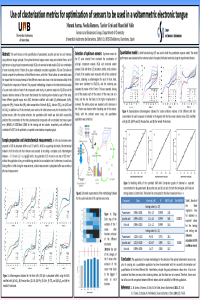
This work focuses on the quantification of paracetamol, ascorbic acid and uric acid mixtures using electronic tongue principle. Five optimal electronic tongue sensors array were selected from a set of eight sensors using principal component analysis (PCA) and canonical variate analysis (CVA) in a combination of some clustering metric (F factor) for a given multianalyte resolution application. PCA and CVA allow to visually compare the performance of the different sensors, while the F factor allows to numerically assess the impact that the inclusion/removal of the different sensors does have in the discrimination ability of the ET towards the compounds of interest. The proposed methodology is based on the electrochemical analysis of a pure stock solution of each of the compounds under study, its posterior analysis by PCA/CVA and the stepwise iterative removal of the sensors that demote the clustering when retained as part of the array. Seven different graphite epoxy resin (GEC) electrodes modified with cobalt (II) phthalocyanine (CoPc), polypyrrole (PPy), Prussian blue (PB), oxide nanoparticles of bismuth (Bi2O3), titanium (TiO2), zinc (ZnO) and tin (SnO2) in addition to a Pt disc electrode, were used as the initial sensors array for the selection of five optimal sensors. After the optimal selection, the quantitative ANN model was built which successfully predicted the concentration of the three pharmaceutical compounds with a normalized root mean square error (NRMSE) of 0.00378and 0.0368 for the training and test subsets, respectively, and coefficient of correlation R2 ≥0.971 in the predicted vs. expected concentrations comparison graph.
Keywords
electronic tongue
voltammetric sensors
principal component analysis
artificial neural networks
discrete wavelet transform
Manuscript
ECSA-7..MS_XC.pdf
Poster
036707 ECSA-7..MS_XC.pdf
Evaluation of SAR in Human Body Models Exposed to EMF emitted from UHF RFID Readers working in Internet of Things (IoT) System
Evaluation of Feature Selection Techniques in a Multifrequency Large Amplitude Pulse Voltammetric Electronic Tongue