Event submissions
Published

This submission belongs to the session P. Posters of the event 7th International Electronic Conference on Sensors and Applications
Published date
14 Nov, 2020
Citation
Thomas Rieck, Katie Rieck, STEP COUNT ACCURACY OF SEVERAL COMMERCIAL ACTIVITY TRACKERS WHILE RIDING A MOTORCYCLE, in Proceedings of 7th International Electronic Conference on Sensors and Applications, 15 November–30 November 2020, MDPI: Basel, Switzerland, doi: 10.3390/ecsa-7-08249
Share
Email
Facebook
Twitter
LinkedIn
STEP COUNT ACCURACY OF SEVERAL COMMERCIAL ACTIVITY TRACKERS WHILE RIDING A MOTORCYCLE
'%3e%3cpath%20d='M12.6647%2010.9104C12.4176%2010.325%2012.0589%209.7933%2011.6088%209.34485C11.16%208.89511%2010.6283%208.53653%2010.0432%208.28891C10.038%208.28629%2010.0327%208.28498%2010.0275%208.28236C10.8437%207.69282%2011.3743%206.73252%2011.3743%205.64907C11.3743%203.85423%209.92005%202.40002%208.12522%202.40002C6.33038%202.40002%204.87618%203.85423%204.87618%205.64907C4.87618%206.73252%205.40677%207.69282%206.22296%208.28367C6.21772%208.28629%206.21248%208.2876%206.20724%208.29022C5.62031%208.53783%205.09365%208.89287%204.64167%209.34616C4.19192%209.79496%203.83334%2010.3266%203.58573%2010.9117C3.34247%2011.4846%203.21128%2012.0987%203.19925%2012.721C3.1989%2012.735%203.20135%2012.7489%203.20646%2012.7619C3.21157%2012.7749%203.21924%2012.7868%203.22901%2012.7968C3.23877%2012.8068%203.25045%2012.8148%203.26334%2012.8202C3.27623%2012.8256%203.29007%2012.8284%203.30406%2012.8284H4.09012C4.14776%2012.8284%204.19362%2012.7825%204.19493%2012.7262C4.22113%2011.7148%204.62726%2010.7676%205.34519%2010.0497C6.08802%209.30686%207.07452%208.89811%208.12522%208.89811C9.17592%208.89811%2010.1624%209.30686%2010.9052%2010.0497C11.6232%2010.7676%2012.0293%2011.7148%2012.0555%2012.7262C12.0568%2012.7839%2012.1027%2012.8284%2012.1603%2012.8284H12.9464C12.9604%2012.8284%2012.9742%2012.8256%2012.9871%2012.8202C13%2012.8148%2013.0117%2012.8068%2013.0214%2012.7968C13.0312%2012.7868%2013.0389%2012.7749%2013.044%2012.7619C13.0491%2012.7489%2013.0515%2012.735%2013.0512%2012.721C13.0381%2012.0947%2012.9084%2011.4856%2012.6647%2010.9104ZM8.12522%207.90243C7.52388%207.90243%206.95792%207.66793%206.53214%207.24215C6.10636%206.81636%205.87185%206.2504%205.87185%205.64907C5.87185%205.04773%206.10636%204.48177%206.53214%204.05599C6.95792%203.63021%207.52388%203.3957%208.12522%203.3957C8.72655%203.3957%209.29252%203.63021%209.7183%204.05599C10.1441%204.48177%2010.3786%205.04773%2010.3786%205.64907C10.3786%206.2504%2010.1441%206.81636%209.7183%207.24215C9.29252%207.66793%208.72655%207.90243%208.12522%207.90243Z'%20fill='%235D1EE1'/%3e%3c/g%3e%3c/svg%3e)
Thomas Rieck 1
Katie Rieck 1
1. Mayo Clinic
Abstract
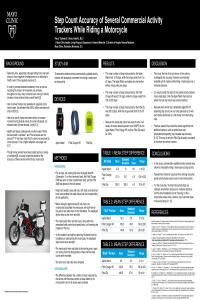
Commercially-available activity trackers have recently exploded in popularity. Use of an activity tracker has been shown to increase physical activity for some individuals, but abandonment of these devices is high. Many of these activity trackers have been found to be accurate at tracking exercise, though concerns remain about how well these devices track non-traditional movement. This study compares several models of activity trackers for accuracy in step counts while riding a motorcycle a moderate distance.
A motorcyclist wore an Apple Watch (Generation 1) (AW), Fitbit Charge HR (FCH), and a Fitbit Zip (FZ) while completing ten, 14-mile out-and-back trip trials. Step counts of each device were recorded after each trial, and the difference between the number of steps measured by the devices and the actual step counts (zero in all cases) were calculated. All trials contained miscounted steps by all the devices. The average miscounted steps for the AW were 12.9 steps (P<0.05), the FCH miscounted 211.0 steps (P<0.05), and the FZ miscounted 305.3 steps (P<0.05). The range of miscounted steps varied from 2 miscounted steps for the AW to 811 miscounted steps for the FZ. There were also noted differences in step counts between the “out” and “back” portions of the trips. In this study, commercially-available activity trackers were shown to misrepresent riding a motorcycle as step activity. Reported step counts, and therefore distance and calorie information, from these activity trackers should be interpreted with caution among motorcyclists.
Keywords
wearable sensors
activity trackers
step count
motorcycle
motorcycling
Manuscript
Rieck_Motorcycle_Activity.pdf
Poster
036907Rieck_Motorcycle_Activity.pdf
The Influence Of Plasticizers On Determination of Cationic Surfactants In Pharmaceutical Disinfectants By Direct Potentiometric Surfactant Sensor
A NIR-spectroscopy-based approach for detection of fluids in rectangular glass micro-capillaries