Event submissions
Published

This submission belongs to the session D. Polymer and Supramolecular Chemistry of the event The 24th International Electronic Conference on Synthetic Organic Chemistry
Published date
14 Nov, 2020
Citation
Sofía Carla Santamarina, Daniel A. Heredia, Andrés M. Durantini, Edgardo Néstor Durantini, Synthesis of conjugated polymer based in Zn(II) porphyrin bearing terminal alkynyl groups as photosensitizer, in Proceedings of The 24th International Electronic Conference on Synthetic Organic Chemistry, 15 November–15 December 2020, MDPI: Basel, Switzerland, doi: 10.3390/ecsoc-24-08317
Share
Email
Facebook
Twitter
LinkedIn
Synthesis of conjugated polymer based in Zn(II) porphyrin bearing terminal alkynyl groups as photosensitizer
'%3e%3cpath%20d='M12.6647%2010.9104C12.4176%2010.325%2012.0589%209.7933%2011.6088%209.34485C11.16%208.89511%2010.6283%208.53653%2010.0432%208.28891C10.038%208.28629%2010.0327%208.28498%2010.0275%208.28236C10.8437%207.69282%2011.3743%206.73252%2011.3743%205.64907C11.3743%203.85423%209.92005%202.40002%208.12522%202.40002C6.33038%202.40002%204.87618%203.85423%204.87618%205.64907C4.87618%206.73252%205.40677%207.69282%206.22296%208.28367C6.21772%208.28629%206.21248%208.2876%206.20724%208.29022C5.62031%208.53783%205.09365%208.89287%204.64167%209.34616C4.19192%209.79496%203.83334%2010.3266%203.58573%2010.9117C3.34247%2011.4846%203.21128%2012.0987%203.19925%2012.721C3.1989%2012.735%203.20135%2012.7489%203.20646%2012.7619C3.21157%2012.7749%203.21924%2012.7868%203.22901%2012.7968C3.23877%2012.8068%203.25045%2012.8148%203.26334%2012.8202C3.27623%2012.8256%203.29007%2012.8284%203.30406%2012.8284H4.09012C4.14776%2012.8284%204.19362%2012.7825%204.19493%2012.7262C4.22113%2011.7148%204.62726%2010.7676%205.34519%2010.0497C6.08802%209.30686%207.07452%208.89811%208.12522%208.89811C9.17592%208.89811%2010.1624%209.30686%2010.9052%2010.0497C11.6232%2010.7676%2012.0293%2011.7148%2012.0555%2012.7262C12.0568%2012.7839%2012.1027%2012.8284%2012.1603%2012.8284H12.9464C12.9604%2012.8284%2012.9742%2012.8256%2012.9871%2012.8202C13%2012.8148%2013.0117%2012.8068%2013.0214%2012.7968C13.0312%2012.7868%2013.0389%2012.7749%2013.044%2012.7619C13.0491%2012.7489%2013.0515%2012.735%2013.0512%2012.721C13.0381%2012.0947%2012.9084%2011.4856%2012.6647%2010.9104ZM8.12522%207.90243C7.52388%207.90243%206.95792%207.66793%206.53214%207.24215C6.10636%206.81636%205.87185%206.2504%205.87185%205.64907C5.87185%205.04773%206.10636%204.48177%206.53214%204.05599C6.95792%203.63021%207.52388%203.3957%208.12522%203.3957C8.72655%203.3957%209.29252%203.63021%209.7183%204.05599C10.1441%204.48177%2010.3786%205.04773%2010.3786%205.64907C10.3786%206.2504%2010.1441%206.81636%209.7183%207.24215C9.29252%207.66793%208.72655%207.90243%208.12522%207.90243Z'%20fill='%235D1EE1'/%3e%3c/g%3e%3c/svg%3e)
Sofía Carla Santamarina 1

Daniel A. Heredia 1
Andrés M. Durantini 1
Edgardo Néstor Durantini 1
1. IDAS-CONICET, Departamento de Química, Facultad de Ciencias Exactas, Físico-Químicas y Naturales, Universidad Nacional de Río Cuarto, Ruta Nacional 36 Km 601, X5804BYA Río Cuarto, Córdoba, Argentina.
Abstract
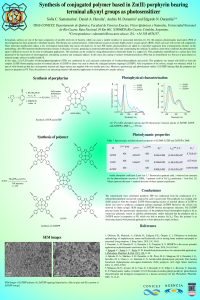
Porphyrins immobilized on a surface have been proposed for the photodynamic inactivation of microorganisms, considering economic and ecological subjects. In hospitals, surfaces are one of the main components of possible reservoirs of bacteria, which can cause a notable incidence in nosocomial infections. In this sense, the coating of surfaces with photosensitizers that are immobilized in a film are of great interest to maintain aseptic surfaces in public health.
In this study, 5,10,15,20-tetrakis-[4-(ethynyl)phenyl]porphyrin (TEP) was synthesized from the condensation of 4-(ethynyl)benzaldehyde and pyrrole catalyzed by boron trifluoride diethyl etherate in dichloromethane (DCM). After oxidation with 2,3-dichloro-5,6-dicyano-1,4-benzoquinone and purification, TEP was obtained in 38% yield. This porphyrin was metaled with zinc(II) acetate in DCM/methanol to produce the complex ZnTEP in 98% yield. Homocoupling reaction of terminal alkynes of ZnTEP to diynes was used to synthesize conjugated polymer organogel cocatalyzed by PdCl2(PPh3)2 and CuI in THF. Solvent was evaporated to obtain xerogel and the SEM images showed microporous structure. In addition, spectroscopic and photodynamic studies indicated that the porphyrin unit retains its properties as photosensitizer. Thus, this polymer is an interesting material with potential applications to form photoactive aseptic surfaces.
Keywords
polymer
porphyrin
alkyne
oxidative homocoupling
photosensitizer
Manuscript
sciforum-039160.pdf
Poster
Presentation Santamarina SC.pdf
Microwave-assisted Asinger synthesis of thiazolines
Stokesia aster ethanolic extract activity on the normal and malignant murine cell line viability L969 and B16