Event submissions
Published

This submission belongs to the session S1. Aerosols of the event The 3rd International Electronic Conference on Atmospheric Sciences
Published date
15 Nov, 2020
Citation
Yidi Hou, Petrina Jun Yan Hee, Nsikanabasi Umo, Ottmar Möhler, Naruki Hiranuma, Characterization of physicochemical properties of feedlot dust ice crystal residuals (ICRs), in Proceedings of The 3rd International Electronic Conference on Atmospheric Sciences, 16 November–30 November 2020, MDPI: Basel, Switzerland, doi: 10.3390/ecas2020-08438
Share
Email
Facebook
Twitter
LinkedIn
Characterization of physicochemical properties of feedlot dust ice crystal residuals (ICRs)
'%3e%3cpath%20d='M12.6647%2010.9104C12.4176%2010.325%2012.0589%209.7933%2011.6088%209.34485C11.16%208.89511%2010.6283%208.53653%2010.0432%208.28891C10.038%208.28629%2010.0327%208.28498%2010.0275%208.28236C10.8437%207.69282%2011.3743%206.73252%2011.3743%205.64907C11.3743%203.85423%209.92005%202.40002%208.12522%202.40002C6.33038%202.40002%204.87618%203.85423%204.87618%205.64907C4.87618%206.73252%205.40677%207.69282%206.22296%208.28367C6.21772%208.28629%206.21248%208.2876%206.20724%208.29022C5.62031%208.53783%205.09365%208.89287%204.64167%209.34616C4.19192%209.79496%203.83334%2010.3266%203.58573%2010.9117C3.34247%2011.4846%203.21128%2012.0987%203.19925%2012.721C3.1989%2012.735%203.20135%2012.7489%203.20646%2012.7619C3.21157%2012.7749%203.21924%2012.7868%203.22901%2012.7968C3.23877%2012.8068%203.25045%2012.8148%203.26334%2012.8202C3.27623%2012.8256%203.29007%2012.8284%203.30406%2012.8284H4.09012C4.14776%2012.8284%204.19362%2012.7825%204.19493%2012.7262C4.22113%2011.7148%204.62726%2010.7676%205.34519%2010.0497C6.08802%209.30686%207.07452%208.89811%208.12522%208.89811C9.17592%208.89811%2010.1624%209.30686%2010.9052%2010.0497C11.6232%2010.7676%2012.0293%2011.7148%2012.0555%2012.7262C12.0568%2012.7839%2012.1027%2012.8284%2012.1603%2012.8284H12.9464C12.9604%2012.8284%2012.9742%2012.8256%2012.9871%2012.8202C13%2012.8148%2013.0117%2012.8068%2013.0214%2012.7968C13.0312%2012.7868%2013.0389%2012.7749%2013.044%2012.7619C13.0491%2012.7489%2013.0515%2012.735%2013.0512%2012.721C13.0381%2012.0947%2012.9084%2011.4856%2012.6647%2010.9104ZM8.12522%207.90243C7.52388%207.90243%206.95792%207.66793%206.53214%207.24215C6.10636%206.81636%205.87185%206.2504%205.87185%205.64907C5.87185%205.04773%206.10636%204.48177%206.53214%204.05599C6.95792%203.63021%207.52388%203.3957%208.12522%203.3957C8.72655%203.3957%209.29252%203.63021%209.7183%204.05599C10.1441%204.48177%2010.3786%205.04773%2010.3786%205.64907C10.3786%206.2504%2010.1441%206.81636%209.7183%207.24215C9.29252%207.66793%208.72655%207.90243%208.12522%207.90243Z'%20fill='%235D1EE1'/%3e%3c/g%3e%3c/svg%3e)
Yidi Hou 1
Petrina Jun Yan Hee 1
Nsikanabasi Umo 2
Ottmar Möhler 2

Naruki Hiranuma 1
1. Dept. of Life, Earth and Environmental Sciences, West Texas A&M University (WTAMU), Canyon, TX, USA
2. Institute of Meteorology and Climate Research, Karlsruhe Institute of Technology (KIT), Karlsruhe, Germany
Abstract
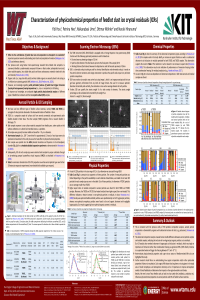
Abstract: This study presents how feedlot dust size and composition contribute to atmospheric ice nucleation and formation of local cloud and precipitation in the Texas Panhandle. Our previous work using Raman micro-spectroscopy revealed that ambient dust sampled at a commercial feedlot is predominantly composed of brown or black carbon, hydrophobic humic acid, water soluble organics, less soluble fatty acids and those carbonaceous materials mixed with salts and minerals (Hiranuma et al., 2011). Organic acids (i.e., long-chain fatty acids) and heat stable organics are recently found to be acting as an efficient ice-nucleating particle (INP; DeMott et al., 2018; Perkins et al., 2020). However, our knowledge regarding what particulate features of feedlot dust trigger immersion freezing in heterogeneous freezing temperatures (i.e., size vs. composition) is still lacking. To improve our knowledge, we conducted single particle physicochemical analyses of different types of feedlot dust simulants and their ice crystal residual (ICR) samples. Our preliminary results show that aerosol particle composition is dominated by organics with substantial inclusion of salts (e.g., potassium). This is consistent with the previous study of TXD particles composition analyses (Hiranuma et al., 2011). The elemental composition analysis revealed some notable difference between aerosol particle samples and residual samples, indicating the inclusion of non-hygroscopic organic particles as ice residuals. Our ICR analysis also revealed a decrease in hygroscopic salt inclusion in residuals, which may imply an importance of immersion rather than condensation freezing as agricultural INPs. Dry heat-resistant physicochemical properties and predominantly supermicron nature of feedlot-emitted INPs also highlight this study. Further research should focus on understanding how organic composition and/or other particulate properties influence ice nucleation. Such organic INP dataset has long been a missing piece in the study area of cloud microphysics and atmospheric chemistry and is of importance to improve atmospheric models of cloud feedbacks and determine their impact on the regional weather and climate.
References:
DeMott P. J. et al.: Environ. Sci.: Processes Impacts, 20, 1559–1569, 2018.
Hiranuma, N., et al.: Atmos. Chem. Phys., 11, 8809–8823, 2011.
Perkins, R. J. et al.: ACS Earth Space Chem., 4, 133–141, 2020.
Keywords
Ice
freezing
cloud
feedlot
residual
Manuscript
Hou_et_al_ECAS_Abst_20200630.pdf
Poster
Hou_et_al_ECAS_Poster_YH.pdf
Application of a machine learning methodology for data implementation
Estimation of Urban Biospheric and Anthropogenic CO2 Atmospheric Signals Using CO Tracer Technique