Event submissions
Published

This submission belongs to the session I. Poster of the event The 2nd International Online Conference on Nanomaterials
Published date
16 Nov, 2020
Citation
Zhong Lijing, Roman A. A. Zakoldaev, Waveguides in nanoporous glass for optofluidic purposes, in Proceedings of The 2nd International Online Conference on Nanomaterials, 15 November–30 November 2020, MDPI: Basel, Switzerland, doi: 10.3390/IOCN2020-08441
Share
Email
Facebook
Twitter
LinkedIn
Waveguides in nanoporous glass for optofluidic purposes

Zhong Lijing 1,2
'%3e%3cpath%20d='M12.6647%2010.9104C12.4176%2010.325%2012.0589%209.7933%2011.6088%209.34485C11.16%208.89511%2010.6283%208.53653%2010.0432%208.28891C10.038%208.28629%2010.0327%208.28498%2010.0275%208.28236C10.8437%207.69282%2011.3743%206.73252%2011.3743%205.64907C11.3743%203.85423%209.92005%202.40002%208.12522%202.40002C6.33038%202.40002%204.87618%203.85423%204.87618%205.64907C4.87618%206.73252%205.40677%207.69282%206.22296%208.28367C6.21772%208.28629%206.21248%208.2876%206.20724%208.29022C5.62031%208.53783%205.09365%208.89287%204.64167%209.34616C4.19192%209.79496%203.83334%2010.3266%203.58573%2010.9117C3.34247%2011.4846%203.21128%2012.0987%203.19925%2012.721C3.1989%2012.735%203.20135%2012.7489%203.20646%2012.7619C3.21157%2012.7749%203.21924%2012.7868%203.22901%2012.7968C3.23877%2012.8068%203.25045%2012.8148%203.26334%2012.8202C3.27623%2012.8256%203.29007%2012.8284%203.30406%2012.8284H4.09012C4.14776%2012.8284%204.19362%2012.7825%204.19493%2012.7262C4.22113%2011.7148%204.62726%2010.7676%205.34519%2010.0497C6.08802%209.30686%207.07452%208.89811%208.12522%208.89811C9.17592%208.89811%2010.1624%209.30686%2010.9052%2010.0497C11.6232%2010.7676%2012.0293%2011.7148%2012.0555%2012.7262C12.0568%2012.7839%2012.1027%2012.8284%2012.1603%2012.8284H12.9464C12.9604%2012.8284%2012.9742%2012.8256%2012.9871%2012.8202C13%2012.8148%2013.0117%2012.8068%2013.0214%2012.7968C13.0312%2012.7868%2013.0389%2012.7749%2013.044%2012.7619C13.0491%2012.7489%2013.0515%2012.735%2013.0512%2012.721C13.0381%2012.0947%2012.9084%2011.4856%2012.6647%2010.9104ZM8.12522%207.90243C7.52388%207.90243%206.95792%207.66793%206.53214%207.24215C6.10636%206.81636%205.87185%206.2504%205.87185%205.64907C5.87185%205.04773%206.10636%204.48177%206.53214%204.05599C6.95792%203.63021%207.52388%203.3957%208.12522%203.3957C8.72655%203.3957%209.29252%203.63021%209.7183%204.05599C10.1441%204.48177%2010.3786%205.04773%2010.3786%205.64907C10.3786%206.2504%2010.1441%206.81636%209.7183%207.24215C9.29252%207.66793%208.72655%207.90243%208.12522%207.90243Z'%20fill='%235D1EE1'/%3e%3c/g%3e%3c/svg%3e)
Roman A. A. Zakoldaev 1
1. ITMO University, Faculty of Laser Photonics and Optoelectronics, Saint Petersburg 197101 Russia
2. Huazhong University of Science & Technology, Luoyu Road 1037, Wuhan, China
Abstract
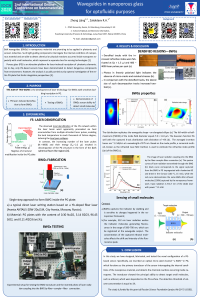
Bulk waveguides (BWGs) in nanoporous materials are promising to be applied in photonics and sensors industries. Such light guiding components interrogate the internal conditions of nanoporous material and are able to detect chemical or physical reactions occurred inside nanopores especially with small molecules, which represent a separate class for sensing technologies.
Recent years have demonstrated remarkable progress in the design and fabrication of optical porous glass (PG) sensors applied for monitoring and controlling different media and object parameters. Basically, such sensors consist of three main parts: a light source, receiver, and primary transducer. The primary transducer is a PG plate, which stores indicator; it is ready to absorb the target molecules. When the PG sensor is placed in an environment with target molecules, the primary transducer converts the chemical reaction occurring in nanopores into a measurable optical signal, for example, the absorption of radiation from the light source at a certain spectral range.
In this work, we suggest a novel concept of the primary transducer. It is the BWG inside a PG plate fabricated by the laser direct writing technique using a femtosecond laser (220 fs, 1035 nm, 1 MHz). After the writing step, PG plates are impregnated with the indicator - rhodamine 6G, which penetrates through the nanoporous framework of glass to the BWG cladding. The radiation transmitted through BWG interacts with the indicator generating a fluorescence signal at the output. The fluorescence spectrum is sensitive to chemical reactions occurred in the nanoporous framework in the cladding. The sensitivity of the peak shift in the fluorescence spectrum to the refractive index of the solution is quantified as 6250 ± 150 nm/RIU.
The results obtained open an opportunity to build a novel sensing photonics platform for detecting small doses of nanoscale objects captured by porous glass.
Keywords
porous glass
sensor
waveguide
laser direct writing
rhodamine 6G
cladding
small molecules
ethanol
Poster
sciforum-039935pdf.pdf
Physical investigation of spin-coated MoS2 films
Systematic Literature Reviews as a tool to develop Adverse Outcome Pathway landscapes in Nanotoxicology: case study of ingested Titanium dioxide nanomaterials