Event submissions
Published

This submission belongs to the session 4. Molecular and Cellular Neuroscience of the event 1st International Electronic Conference on Brain Sciences
Published date
16 Nov, 2020
Citation
Megan Cahill Baird, Karim Bey, Ricardo J Pineda, Maura K Schwartz, Shibi B Likhite, Ronald M Lindsay, Peter S DiStefano, Jia Xie, Marie-Anne Colle, Eric Bielefeld, Lynne Bianchi, Kathrin Meyer, AAV Gene Therapy for noise induced hearing loss using cerebrospinal fluid as route of delivery, in Proceedings of 1st International Electronic Conference on Brain Sciences, 10 November–25 November 2020, MDPI: Basel, Switzerland, doi: 10.3390/IECBS-08442
Share
Email
Facebook
Twitter
LinkedIn
AAV Gene Therapy for noise induced hearing loss using cerebrospinal fluid as route of delivery
'%3e%3cpath%20d='M12.6647%2010.9104C12.4176%2010.325%2012.0589%209.7933%2011.6088%209.34485C11.16%208.89511%2010.6283%208.53653%2010.0432%208.28891C10.038%208.28629%2010.0327%208.28498%2010.0275%208.28236C10.8437%207.69282%2011.3743%206.73252%2011.3743%205.64907C11.3743%203.85423%209.92005%202.40002%208.12522%202.40002C6.33038%202.40002%204.87618%203.85423%204.87618%205.64907C4.87618%206.73252%205.40677%207.69282%206.22296%208.28367C6.21772%208.28629%206.21248%208.2876%206.20724%208.29022C5.62031%208.53783%205.09365%208.89287%204.64167%209.34616C4.19192%209.79496%203.83334%2010.3266%203.58573%2010.9117C3.34247%2011.4846%203.21128%2012.0987%203.19925%2012.721C3.1989%2012.735%203.20135%2012.7489%203.20646%2012.7619C3.21157%2012.7749%203.21924%2012.7868%203.22901%2012.7968C3.23877%2012.8068%203.25045%2012.8148%203.26334%2012.8202C3.27623%2012.8256%203.29007%2012.8284%203.30406%2012.8284H4.09012C4.14776%2012.8284%204.19362%2012.7825%204.19493%2012.7262C4.22113%2011.7148%204.62726%2010.7676%205.34519%2010.0497C6.08802%209.30686%207.07452%208.89811%208.12522%208.89811C9.17592%208.89811%2010.1624%209.30686%2010.9052%2010.0497C11.6232%2010.7676%2012.0293%2011.7148%2012.0555%2012.7262C12.0568%2012.7839%2012.1027%2012.8284%2012.1603%2012.8284H12.9464C12.9604%2012.8284%2012.9742%2012.8256%2012.9871%2012.8202C13%2012.8148%2013.0117%2012.8068%2013.0214%2012.7968C13.0312%2012.7868%2013.0389%2012.7749%2013.044%2012.7619C13.0491%2012.7489%2013.0515%2012.735%2013.0512%2012.721C13.0381%2012.0947%2012.9084%2011.4856%2012.6647%2010.9104ZM8.12522%207.90243C7.52388%207.90243%206.95792%207.66793%206.53214%207.24215C6.10636%206.81636%205.87185%206.2504%205.87185%205.64907C5.87185%205.04773%206.10636%204.48177%206.53214%204.05599C6.95792%203.63021%207.52388%203.3957%208.12522%203.3957C8.72655%203.3957%209.29252%203.63021%209.7183%204.05599C10.1441%204.48177%2010.3786%205.04773%2010.3786%205.64907C10.3786%206.2504%2010.1441%206.81636%209.7183%207.24215C9.29252%207.66793%208.72655%207.90243%208.12522%207.90243Z'%20fill='%235D1EE1'/%3e%3c/g%3e%3c/svg%3e)
Megan Cahill Baird 1,2
Karim Bey 3
Ricardo J Pineda 2
Maura K Schwartz 1,2
Shibi B Likhite 2
Ronald M Lindsay 4
Peter S DiStefano 4
Jia Xie 5
Marie-Anne Colle 3
Eric Bielefeld 1
Lynne Bianchi 6
Kathrin Meyer 1,2
1. The Ohio State University
2. Abigail Wexner Research Institute at Nationwide Children's Hospital
3. ONIRIS/INRA
4. Zebra Biologics
5. The Scripps Research Institute
6. UPMC/Gannon University
Abstract
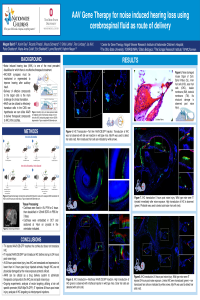
Noise-induced hearing loss (NIHL) is one of the most prevalent disabilities for which effective therapeutic treatment is currently lacking. Auditory injury caused by excessive or constant noise exposure damages the sensory elements of the ear, leading to metabolic or mechanical damage to hair cells and subsequent degeneration of spiral ganglion neurons (SGNs). To improve hearing in the NIHL patient population, maintenance and regeneration of inner hair cell-SGN synapses is critical. Although effective compounds for the treatment of NIHL have been suggested, challenges in delivery of the compounds to the inner hair cells (IHCs) hinder translation of these therapies to a clinical setting. Current routes of administration are ineffective in reaching IHCs or are invasive and may damage the cochlea. In this study, we examined less invasive delivery routes, via intrathecal (cerebrospinal fluid delivery) or intravenous injection, to administer adeno-associated virus serotype 9 (AAV9) expressing green fluorescent protein (GFP) to target IHCs and SGNs. To induce auditory injury, mice were exposed to 100 dB sound pressure level (SPL) octave band noise for 2 hours. Mice were then injected at various time points post noise injury to determine if noise exposure influenced targeting efficiency. Three weeks post injection, cochleae were processed and analyzed for GFP expression using immunofluorescence. Our results demonstrate that intravenous delivery was not successful in targeting of IHCs or SGNs at any time point measured. However, intrathecally injected AAV9 was highly effective in targeting cells in both healthy and noise-damaged cochleae at multiple time points post-noise exposure. We conclude that gene therapy techniques can be utilized to efficiently deliver therapeutic transgenes to the cochlea using cerebrospinal fluid as a delivery route. These findings determine a novel route of delivery and open a new avenue of therapeutic treatment for auditory injury and cochlear disorders.
Keywords
AAV
Gene Theray
Cochlea
NIHL
Manuscript
Brain Sciences 2020 Poster - NIHL.pdf
Poster
Brain Sciences 2020 Poster - NIHL.pdf
A Novel Retinal Gene Therapy Strategy for Batten Disease and Beyond
Rapid reprogramming of ALS patient fibroblasts differentiates CuATSM responders from nonresponders.