Event submissions
Published

This submission belongs to the session S3. Air Quality and Human Health of the event The 3rd International Electronic Conference on Atmospheric Sciences
Published date
17 Nov, 2020
Citation
Richard Viskup, Yana Vereshchaga, Anna Theresia Stadler, Theresa Roland, Christoph Wolf, Agnes Weth, Werner Baumgartner, Spectrochemical analytical characterisation of Particulate Matter emissions generated from in-use Diesel engine vehicles, in Proceedings of The 3rd International Electronic Conference on Atmospheric Sciences, 16 November–30 November 2020, MDPI: Basel, Switzerland, doi: 10.3390/ecas2020-08468
Share
Email
Facebook
Twitter
LinkedIn
Spectrochemical analytical characterisation of Particulate Matter emissions generated from in-use Diesel engine vehicles
'%3e%3cpath%20d='M12.6647%2010.9104C12.4176%2010.325%2012.0589%209.7933%2011.6088%209.34485C11.16%208.89511%2010.6283%208.53653%2010.0432%208.28891C10.038%208.28629%2010.0327%208.28498%2010.0275%208.28236C10.8437%207.69282%2011.3743%206.73252%2011.3743%205.64907C11.3743%203.85423%209.92005%202.40002%208.12522%202.40002C6.33038%202.40002%204.87618%203.85423%204.87618%205.64907C4.87618%206.73252%205.40677%207.69282%206.22296%208.28367C6.21772%208.28629%206.21248%208.2876%206.20724%208.29022C5.62031%208.53783%205.09365%208.89287%204.64167%209.34616C4.19192%209.79496%203.83334%2010.3266%203.58573%2010.9117C3.34247%2011.4846%203.21128%2012.0987%203.19925%2012.721C3.1989%2012.735%203.20135%2012.7489%203.20646%2012.7619C3.21157%2012.7749%203.21924%2012.7868%203.22901%2012.7968C3.23877%2012.8068%203.25045%2012.8148%203.26334%2012.8202C3.27623%2012.8256%203.29007%2012.8284%203.30406%2012.8284H4.09012C4.14776%2012.8284%204.19362%2012.7825%204.19493%2012.7262C4.22113%2011.7148%204.62726%2010.7676%205.34519%2010.0497C6.08802%209.30686%207.07452%208.89811%208.12522%208.89811C9.17592%208.89811%2010.1624%209.30686%2010.9052%2010.0497C11.6232%2010.7676%2012.0293%2011.7148%2012.0555%2012.7262C12.0568%2012.7839%2012.1027%2012.8284%2012.1603%2012.8284H12.9464C12.9604%2012.8284%2012.9742%2012.8256%2012.9871%2012.8202C13%2012.8148%2013.0117%2012.8068%2013.0214%2012.7968C13.0312%2012.7868%2013.0389%2012.7749%2013.044%2012.7619C13.0491%2012.7489%2013.0515%2012.735%2013.0512%2012.721C13.0381%2012.0947%2012.9084%2011.4856%2012.6647%2010.9104ZM8.12522%207.90243C7.52388%207.90243%206.95792%207.66793%206.53214%207.24215C6.10636%206.81636%205.87185%206.2504%205.87185%205.64907C5.87185%205.04773%206.10636%204.48177%206.53214%204.05599C6.95792%203.63021%207.52388%203.3957%208.12522%203.3957C8.72655%203.3957%209.29252%203.63021%209.7183%204.05599C10.1441%204.48177%2010.3786%205.04773%2010.3786%205.64907C10.3786%206.2504%2010.1441%206.81636%209.7183%207.24215C9.29252%207.66793%208.72655%207.90243%208.12522%207.90243Z'%20fill='%235D1EE1'/%3e%3c/g%3e%3c/svg%3e)
Richard Viskup 1
Yana Vereshchaga 1
Anna Theresia Stadler 1
Theresa Roland 1
Christoph Wolf 1
Agnes Weth 1
Werner Baumgartner 1
1. Institute of Biomedical Mechatronics, Johannes Kepler University Linz, Austria
Abstract
The pollutant emissions from vehicles are forming major sources of metallic nanoparticles into the environment and surrounding atmosphere. In this research we spectrochemicaly analyse chemical composition of Particle Matter emissions from in-use Diesel engine passenger vehicles. We have extracted Diesel Particulate Matter from the end part of the tail pipe, from more than seventy different vehicles. And in laboratory we have used the high resolution laser induced plasma spectroscopy (LIBS) spectrochemical analytical technique to sensitively analyse chemical elements in different DPM. We have found that PM is composed of major, minor and trace chemical elements. The major compound of PM is not strictly Carbon element but rather other adsorbed metallic nanoparticles such as Iron, Chromium, Magnesium, Zinc, Calcium. Beside the major elements of DPM there are also minor elements: Silicon, Nickel, Titan, Potassium, Strontium, Molybdenium and others. Additionally in DPM are adsorbed atomic trace elements like Barium, Boron, Cobalt, Copper, Phosphorus, Manganese and Platinum. All these chemical elements are forming significant atomic composition of real PM from in-use Diesel engine vehicles.
Keywords
air quality
air pollution
fine aerosol particles
ultrafine particles
black carbon
Particulate Matter
Diesel Particulate Matter
particulates
soot
carbon emissions
pollutant emissions
vehicle emissions
exhaust emissions
metallic nanoparticles
Manuscript
ecas2020-Spectrochemical analytical characterisation 17-11-2020.pdf
Poster
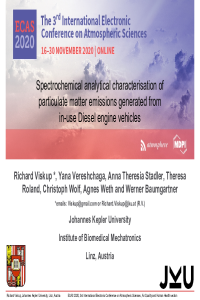
Microsoft PowerPoint - ecas 2020 - Spectrochemical analytical characterisation of particulate matter emissions.pdf
Evaluation of agricultural-related extreme events in hindcast COSMO-CLM simulations over Central Europe
Online ice-nucleating particle measurements in the Southern Great Plains (SGP) using the Portable Ice Nucleation Experiment (PINE) chamber