Event submissions
Published

This submission belongs to the session S1. Aerosols of the event The 3rd International Electronic Conference on Atmospheric Sciences
Published date
17 Nov, 2020
Citation
Hemanth S. K. Vepuri, Larissa Lacher, Jens Nadolny, Ottmar Möhler, Naruki Hiranuma, Online ice-nucleating particle measurements in the Southern Great Plains (SGP) using the Portable Ice Nucleation Experiment (PINE) chamber, in Proceedings of The 3rd International Electronic Conference on Atmospheric Sciences, 16 November–30 November 2020, MDPI: Basel, Switzerland, doi: 10.3390/ecas2020-08469
Share
Email
Facebook
Twitter
LinkedIn
Online ice-nucleating particle measurements in the Southern Great Plains (SGP) using the Portable Ice Nucleation Experiment (PINE) chamber
'%3e%3cpath%20d='M12.6647%2010.9104C12.4176%2010.325%2012.0589%209.7933%2011.6088%209.34485C11.16%208.89511%2010.6283%208.53653%2010.0432%208.28891C10.038%208.28629%2010.0327%208.28498%2010.0275%208.28236C10.8437%207.69282%2011.3743%206.73252%2011.3743%205.64907C11.3743%203.85423%209.92005%202.40002%208.12522%202.40002C6.33038%202.40002%204.87618%203.85423%204.87618%205.64907C4.87618%206.73252%205.40677%207.69282%206.22296%208.28367C6.21772%208.28629%206.21248%208.2876%206.20724%208.29022C5.62031%208.53783%205.09365%208.89287%204.64167%209.34616C4.19192%209.79496%203.83334%2010.3266%203.58573%2010.9117C3.34247%2011.4846%203.21128%2012.0987%203.19925%2012.721C3.1989%2012.735%203.20135%2012.7489%203.20646%2012.7619C3.21157%2012.7749%203.21924%2012.7868%203.22901%2012.7968C3.23877%2012.8068%203.25045%2012.8148%203.26334%2012.8202C3.27623%2012.8256%203.29007%2012.8284%203.30406%2012.8284H4.09012C4.14776%2012.8284%204.19362%2012.7825%204.19493%2012.7262C4.22113%2011.7148%204.62726%2010.7676%205.34519%2010.0497C6.08802%209.30686%207.07452%208.89811%208.12522%208.89811C9.17592%208.89811%2010.1624%209.30686%2010.9052%2010.0497C11.6232%2010.7676%2012.0293%2011.7148%2012.0555%2012.7262C12.0568%2012.7839%2012.1027%2012.8284%2012.1603%2012.8284H12.9464C12.9604%2012.8284%2012.9742%2012.8256%2012.9871%2012.8202C13%2012.8148%2013.0117%2012.8068%2013.0214%2012.7968C13.0312%2012.7868%2013.0389%2012.7749%2013.044%2012.7619C13.0491%2012.7489%2013.0515%2012.735%2013.0512%2012.721C13.0381%2012.0947%2012.9084%2011.4856%2012.6647%2010.9104ZM8.12522%207.90243C7.52388%207.90243%206.95792%207.66793%206.53214%207.24215C6.10636%206.81636%205.87185%206.2504%205.87185%205.64907C5.87185%205.04773%206.10636%204.48177%206.53214%204.05599C6.95792%203.63021%207.52388%203.3957%208.12522%203.3957C8.72655%203.3957%209.29252%203.63021%209.7183%204.05599C10.1441%204.48177%2010.3786%205.04773%2010.3786%205.64907C10.3786%206.2504%2010.1441%206.81636%209.7183%207.24215C9.29252%207.66793%208.72655%207.90243%208.12522%207.90243Z'%20fill='%235D1EE1'/%3e%3c/g%3e%3c/svg%3e)
Hemanth S. K. Vepuri 1
Larissa Lacher 2
Jens Nadolny 2
Ottmar Möhler 2

Naruki Hiranuma 1
1. Dept. of Life, Earth and Environmental Sciences, West Texas A&M University, Canyon, TX 79016, USA
2. Institute of Meteorology and Climate Research, Karlsruhe Institute of Technology, Karlsruhe, 76021, Germany
Abstract
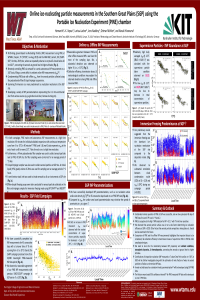
We present our field results of ice-nucleating particle (INP) measurements by the commercialized version of Portable Ice Nucleation Experiment chamber (PINE) from two different campaigns. Our first field campaign ‘TxTEST’ was conducted at West Texas A&M University (July – August, 2019), and the other ‘ExINP-SGP’ campaign was held at the Atmospheric Radiation Measurement (ARM) Southern Great Plains (SGP) site (Oct – Nov, 2019). In both campaigns, PINE made semi-autonomous INP measurements at a high time resolution of 8 minutes for individual expansions with continuous temperature scans from -5 to -35°C in 90 minutes. The PINE instrument was set to have a minimum detection capability of ~0.3 INPs per liter of air. To complement our online PINE measurements, polycarbonate filter impactor and liquid impinger samples were also collected next to PINE. Offline-droplet freezing assays were later conducted from the filter and impinger samples for immersion freezing mode. Our preliminary results suggested that the immersion freezing was the dominant ice-nucleation mechanism at the SGP site compared to the deposition mode. We did not find any statistical correlationships between cloud condensation nuclei (CCN) and INP concentration during our ExINP-SGP period, suggesting that CCN activation is not a significant prerequisite for ice nucleation at the SGP site. In addition, we analyzed the relationship between various aerosol particle size ranges and INP abundance. At SGP, we found an increase in INPs with the super-micron particles, especially for diameters > 2 μm across the entire heterogeneous freezing temperature range examined by PINE. Lastly, we provide a variety of INP parameterizations, such as ice nucleation active surface site density, water activity based freezing, and cumulative INP per liter of air, representing the ambient INPs in SGP. Our field campaign results demonstrated the PINE’s ability of making remote INP measurements, promising the future long-term operations including at isolated locations.
Keywords
Ice-nucleating particles
Online cloud chamber
Immersion freezing
Manuscript
ecas2020-template-new.pdf
Poster
Vepuri_et_al_ECAS_2020_Poster_v3_HV.pdf
Spectrochemical analytical characterisation of Particulate Matter emissions generated from in-use Diesel engine vehicles
First Conclusions from the WMO/GAW Coordinated Study on Impacts of COVID-19 Lockdown Measures on Air Quality: An Observational and Modelling Analysis