Event submissions
Published

This submission belongs to the session 4. Molecular and Cellular Neuroscience of the event 1st International Electronic Conference on Brain Sciences
Published date
18 Nov, 2020
Citation
Shrestha Sinha Ray, Shibi Likhite, Cassandra Dennys-River, Florence Roussel, Xiaojin Jean Zhang, Kathrin Meyer, Identification of a novel disease mechanism and development of therapeutics for the recently identified neurodevelopmental disease “NEDAMSS”, in Proceedings of 1st International Electronic Conference on Brain Sciences, 10 November–25 November 2020, MDPI: Basel, Switzerland, doi: 10.3390/IECBS-08470
Share
Email
Facebook
Twitter
LinkedIn
Identification of a novel disease mechanism and development of therapeutics for the recently identified neurodevelopmental disease “NEDAMSS”
'%3e%3cpath%20d='M12.6647%2010.9104C12.4176%2010.325%2012.0589%209.7933%2011.6088%209.34485C11.16%208.89511%2010.6283%208.53653%2010.0432%208.28891C10.038%208.28629%2010.0327%208.28498%2010.0275%208.28236C10.8437%207.69282%2011.3743%206.73252%2011.3743%205.64907C11.3743%203.85423%209.92005%202.40002%208.12522%202.40002C6.33038%202.40002%204.87618%203.85423%204.87618%205.64907C4.87618%206.73252%205.40677%207.69282%206.22296%208.28367C6.21772%208.28629%206.21248%208.2876%206.20724%208.29022C5.62031%208.53783%205.09365%208.89287%204.64167%209.34616C4.19192%209.79496%203.83334%2010.3266%203.58573%2010.9117C3.34247%2011.4846%203.21128%2012.0987%203.19925%2012.721C3.1989%2012.735%203.20135%2012.7489%203.20646%2012.7619C3.21157%2012.7749%203.21924%2012.7868%203.22901%2012.7968C3.23877%2012.8068%203.25045%2012.8148%203.26334%2012.8202C3.27623%2012.8256%203.29007%2012.8284%203.30406%2012.8284H4.09012C4.14776%2012.8284%204.19362%2012.7825%204.19493%2012.7262C4.22113%2011.7148%204.62726%2010.7676%205.34519%2010.0497C6.08802%209.30686%207.07452%208.89811%208.12522%208.89811C9.17592%208.89811%2010.1624%209.30686%2010.9052%2010.0497C11.6232%2010.7676%2012.0293%2011.7148%2012.0555%2012.7262C12.0568%2012.7839%2012.1027%2012.8284%2012.1603%2012.8284H12.9464C12.9604%2012.8284%2012.9742%2012.8256%2012.9871%2012.8202C13%2012.8148%2013.0117%2012.8068%2013.0214%2012.7968C13.0312%2012.7868%2013.0389%2012.7749%2013.044%2012.7619C13.0491%2012.7489%2013.0515%2012.735%2013.0512%2012.721C13.0381%2012.0947%2012.9084%2011.4856%2012.6647%2010.9104ZM8.12522%207.90243C7.52388%207.90243%206.95792%207.66793%206.53214%207.24215C6.10636%206.81636%205.87185%206.2504%205.87185%205.64907C5.87185%205.04773%206.10636%204.48177%206.53214%204.05599C6.95792%203.63021%207.52388%203.3957%208.12522%203.3957C8.72655%203.3957%209.29252%203.63021%209.7183%204.05599C10.1441%204.48177%2010.3786%205.04773%2010.3786%205.64907C10.3786%206.2504%2010.1441%206.81636%209.7183%207.24215C9.29252%207.66793%208.72655%207.90243%208.12522%207.90243Z'%20fill='%235D1EE1'/%3e%3c/g%3e%3c/svg%3e)
Shrestha Sinha Ray 1
Shibi Likhite 1
Cassandra Dennys-River 1
Florence Roussel 1
Xiaojin Jean Zhang 1
Kathrin Meyer 1
1. Research Institute at Nationwide Children's Hospital
Abstract
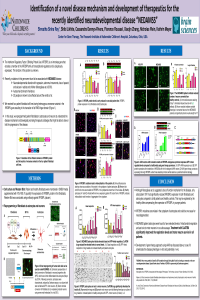
NEDAMSS is a newly discovered neurodevelopmental disorder with regression, abnormal movements, loss of speech and seizures. The disease is caused by heterozygous mutations in the Interferon Regulatory Factor 2 Binding Protein-Like (IRF2BPL) gene. IRF2BPL is a ubiquitously expressed intron-less transcriptional regulator. The function of the protein is currently unknown, but the observed disease phenotype indicates a role in development and maintenance of the nervous system. To study this disease, we used patient skin-derived fibroblasts and reprogrammed them into induced neuronal progenitor cells (iNPCs). The iNPCs were then differentiated into astrocytes. Moreover, we also used a direct conversion method to generate neurons directly from the skin fibroblasts. Using these methods and performing molecular and functional analyses of the different cell types, we identified a novel disease mechanism not previously described. While IRF2BPL is localized in the nucleus in healthy individuals, we found that several patient cell lines displayed mis-localization in the form of aggregates in the cytoplasm. Moreover, the patient astrocytes also showed abnormal mitochondrial ATP-linked respiration levels and caused neuronal death in co-culture assays. Based on these observations, we tested treatment with CuATSM, a small molecule drug currently in clinical trials for ALS. We found that CuATSM successfully rescued neuronal survival and reduced ATP-linked respiration to normal levels in NEDAMSS astrocytes. We also established multiple AAV based gene therapy tools to modulate the expression of the protein and restore its normal function in vitro and potentially in vivo. In summary, we identified a novel disease mechanism involved in NEDAMSS disease and found promising therapeutic strategies that might be able to slow or halt the progression of the disease.
Keywords
neurodevelopmental
IRF2BPL
mislocalization
cuATSM
AAV gene therapy
Manuscript
Brain Science 2020 Shrestha.pdf
Poster
Brain Science 2020 Shrestha.pdf
Neural states in tourism travel videos
Terpenic compounds in Chilean species of the genus Blechnum (Pteridophyta: Blechnaceae) with neuroprotective potential